Updated: September 2026
Guk (국) is the everyday Korean soup: thin, light, served in its own bowl next to a bowl of rice, one per person. If you are asking what is guk after staring at a UAE menu where galbitang, kimchi jjigae and a hot pot for four all sit under one heading called “Soup”, the answer is in the last syllable of the Korean name — -guk and -tang are personal soups eaten with rice, jjigae is a shared stew, jeongol is a pan on a burner. This page explains the four and reads six UAE menus for prices.
TL;DR
– Guk = light everyday soup, one bowl per person, eaten with rice; tang = the heavier, long-simmered end of the same category.
– Jjigae is a shared stew; jeongol is a pan simmered at the table. Neither is a guk.
– UAE menus translate all four as “Soup” — read the Korean suffix, not the heading.
– Cheapest published tang: Mukbang Shows’ Eomuk Tang AED 49; galbitang runs AED 58–85.
– Mukbang’s soups are beef and chicken only, no pork broth, no alcohol — but it sells no galbitang, yukgaejang or samgyetang.
What is guk in Korean food?
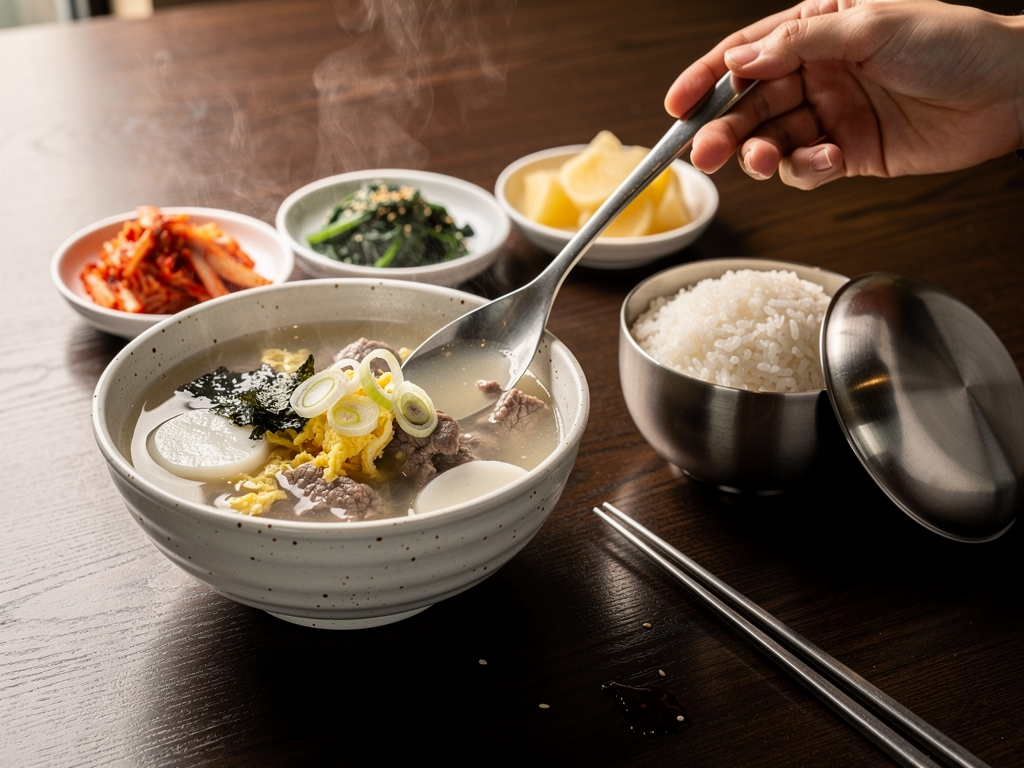
The one-line answer to what is guk: the native Korean word for soup, and it is one of the three parts of a basic Korean meal: bap (rice), guk (soup) and banchan (side dishes). A guk is thin — mostly broth — lightly seasoned with soy sauce, doenjang or salt, served hot in an individual bowl, and eaten with a spoon alternating with rice, or with rice spooned straight into it. That is the whole idea: it is the personal wet half of a rice meal, not a course on its own.
The encyclopaedia entry on guk and its four families sorts the category four ways. Malgeun jangguk are clear soups seasoned with soy or doenjang. Gomguk are the long-simmered beef and bone broths — seolleongtang and galbitang live here. Tojangguk are doenjang-based soups. Naengguk are cold summer soups, which almost never appear on a UAE menu. Common examples the same entry names: tteokguk, miyeok-guk, seolleongtang, yukgaejang and samgyetang.
What is the difference between guk and tang?
Almost nothing in the pot, and a little in the name. Tang (탕) is the Sino-Korean word for the same thing — the Chinese character 湯 means boiling water or soup — and it was historically the honorific term, used in place of guk. In practice the two are, in Wikipedia’s words, “commonly grouped together and used interchangeably”, with the one tendency that “lighter soups with vegetables are suffixed with -guk, while heavier, thicker soups are often referred to as tang”.
So miyeok-guk (seaweed soup) and tteokguk (rice-cake soup) take -guk; galbitang (beef short rib), samgyetang (ginseng chicken) and seolleongtang (ox bone) take -tang. Yukgaejang, the spicy shredded-beef soup, ends in -jang and is filed with the tang on every menu anyway. Both guk and tang are still served per person, with rice.
How is guk different from jjigae and jeongol?
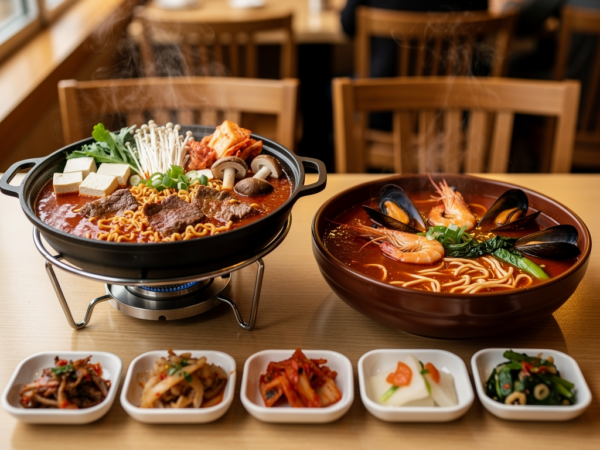
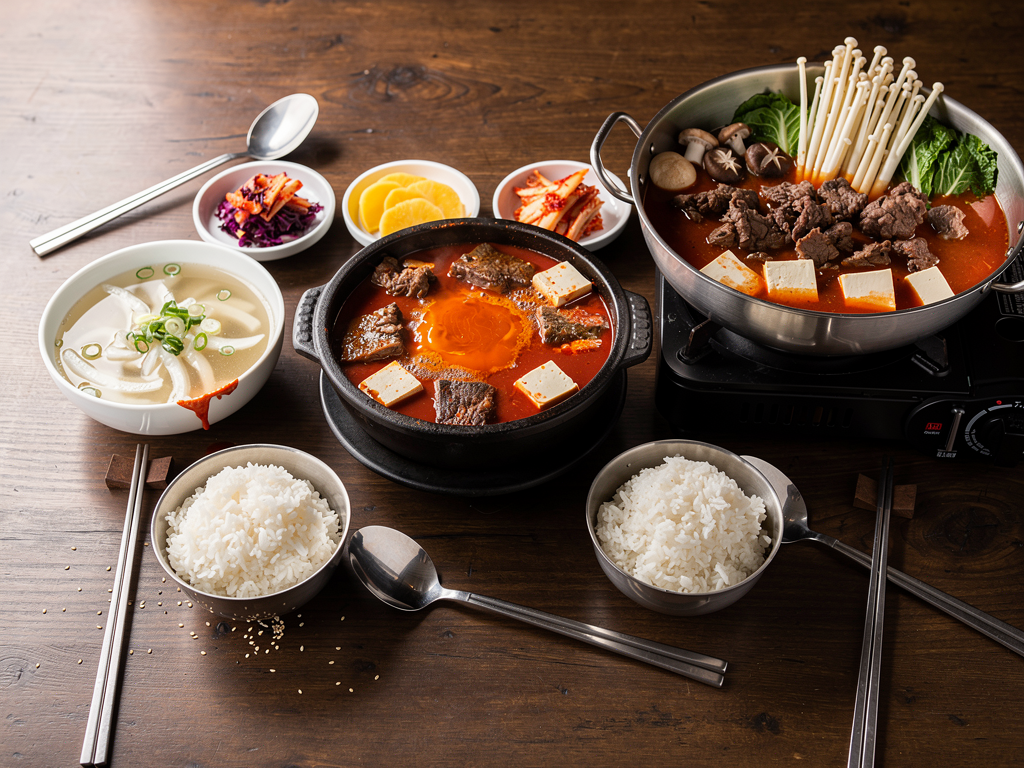
This is the distinction that matters at the table, and it is the real reason people ask what is guk in the first place. A jjigae is not a soup — it is a stew: less liquid, more solids, saltier and more heavily seasoned, cooked and served bubbling in an earthenware ttukbaegi and shared from the middle of the table as the main dish. Kimchi, doenjang, soondubu and budae jjigae are the four every UAE Korean kitchen sells; the portal’s kimchi jjigae explainer and doenjang jjigae explainer cover them.
A jeongol is a third thing again: a shallow, wide pan of raw ingredients — meat, tofu, vegetables, mushrooms, sometimes dumplings — brought to the table and simmered on a burner in a broth seasoned from the start. It is a shared centrepiece for two or more; our jeongol explainer and jeongol vs shabu shabu comparison separate it from its Japanese cousin.
So the suffix rule, in one line: -guk = light, mine, with rice. -tang = heavier, still mine, still with rice. jjigae = thick, shared, centre of the table. jeongol = a pan on a flame.
| Word | What it is | Bowl | Who eats it | UAE price band (Sept 2026) |
|---|---|---|---|---|
| Guk 국 | thin everyday soup | individual, with rice | one person | AED 49–59 |
| Tang 탕 | richer, long-simmered soup | individual, with rice | one person | AED 52–88 |
| Jjigae 찌개 | thick stew | earthenware pot | shared main | AED 48–69 solo |
| Jeongol 전골 | pan simmered at the table | wide shallow pan on a burner | two or more | AED 80–158 |
The bands come from the six menus read for this page and, as the table shows, the suffix predicts the price almost as well as it predicts the bowl.
Why does the UAE menu make what is guk so confusing?
Because the distinction disappears the moment the menu is translated into English, and every kitchen then files its soups wherever it likes. All six menus were read live on 15 September 2026.
HYU’s Deliveroo listing in Jumeirah Lake Towers puts Galbitang, Yookgaejang and every jjigae under one heading, “Soup”, and translates Kimchi Jjigae as “Kimchi Soup with Tofu”. Hanok in International City has a “SOUP” section that actually holds its hot pots — Korean Shabu-Shabu, Doenjang Hot Pot AED 80/98, Mandu Hot Pot AED 90/110 — with its two classic tang, Galbi Tang AED 58 and Yukgaejang AED 52, sitting among them; a separate “STEW” section for the jjigae; and a third heading, “IMMUNITY BOOSTING DISHES”, for Samgyetang Extra AED 83 and Galbitang Extra AED 88.
Manna Land in Abu Dhabi opens its “SOUP” section with Korean Syabeu Syabeu (shabu-shabu) at AED 158, then Tteok Manduguk AED 58, Yukgaejang AED 58 and Galbitang AED 65. Mashisoyo lists Miyeok Guk “(Served with Rice)” at AED 54 under “Soup” beside Tofu Jjigae AED 69 and Haemultang AED 69. Mukbang Shows prints Tteokguk AED 51 and Tteok Mandu Guk AED 59 in its stews-and-hot-pots block and Eomuk Tang AED 49 under Korean Street Food.
Five kitchens, five filing systems, one English word. The only rule that survives all of them is the one above: read the last syllable of the Korean name, not the heading it sits under.
What is the rice test?
The second half of the answer to what is guk. A guk or a tang is built to be eaten with rice — it is the rice’s partner, not a starter — and two UAE menus print that fact. Mashisoyo writes “(Served with Rice)” after its Miyeok Guk. Mukbang Shows lists “Soup & steamed rice” as a line item inside every unlimited Korean BBQ tier: Gangnam AED 69 at Deira, Muroor Road and Electra Street (AED 79 at JBR and DWTC), Daegu AED 89/99, Jeju AED 99/109, Bukchon Hanok AED 129 at every branch.
A jjigae is eaten with rice too, but as the shared main; a guk is the personal side. If a menu lists a soup with no rice anywhere near it, order the rice.
Which guk and tang will you actually find in the UAE?
Four, mostly, plus one street-stall broth.
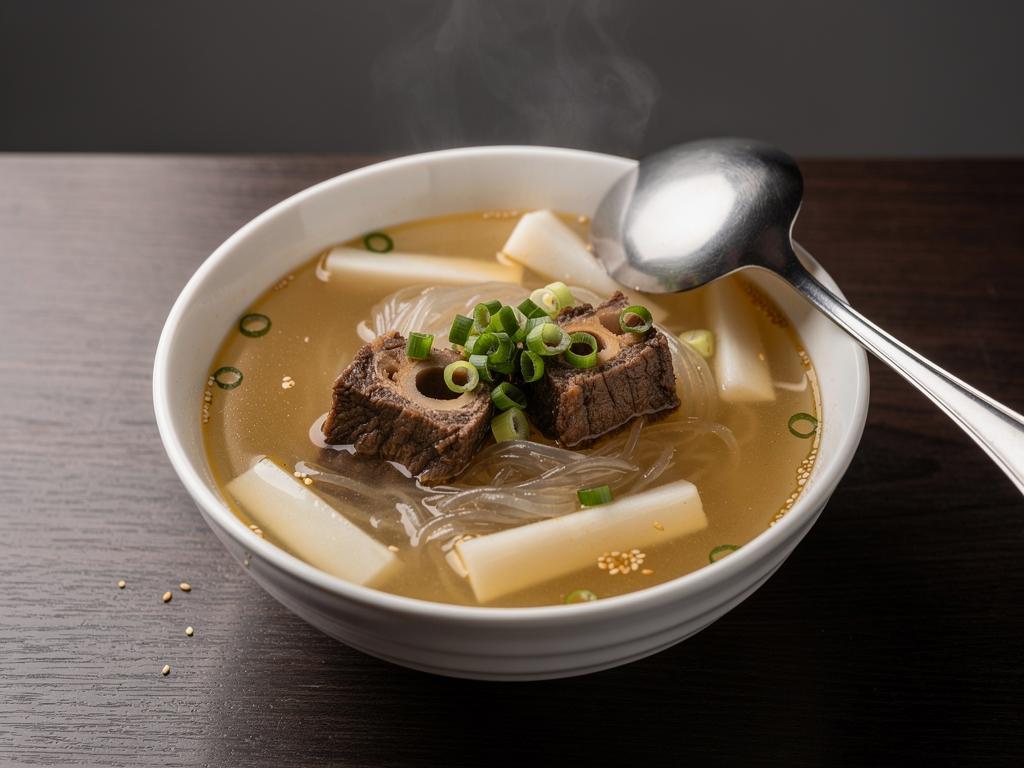
Galbitang (갈비탕) — beef short ribs simmered until the broth runs clear, with radish and glass noodles. The one tang every serious Korean kitchen in the UAE sells: Hanok AED 58, Manna Land AED 65, HYU AED 79 on Deliveroo, Nuri AED 85. The entry on galbitang has the background.
Yukgaejang (육개장) — shredded beef, fernbrake, bean sprouts and a lot of gochugaru; red and hot. Hanok AED 52, Manna Land AED 58, HYU AED 75 on Deliveroo.
Tteokguk (떡국) — sliced oval rice cakes in clear beef broth, the one guk with a calendar. It is the Seollal (Lunar New Year) soup, and the tradition holds that finishing a bowl adds a year to your age; the background on tteokguk and the New Year tradition covers it. Mukbang Shows AED 51. Tteok mandu guk (떡만두국) is the same soup with dumplings — Manna Land AED 58, Mukbang Shows AED 59 — and our mandu explainer covers the dumpling.
Samgyetang (삼계탕) — a whole small chicken stuffed with rice and ginseng, simmered in its own broth. Only Hanok prints it: AED 75, or AED 83 for the “Extra” with more garlic, ginger and ginseng.
Eomuk tang (어묵탕) — fish-cake soup, the broth of the pojangmacha street stall, which is why Mukbang Shows files it under Korean Street Food at AED 49. It is the cheapest published tang on any UAE menu read for this page. Miyeok guk (미역국), the seaweed soup, appears once — Mashisoyo, AED 54 on Deliveroo.
How much does guk or tang cost in the UAE?
Between AED 49 and AED 88 a bowl, and the ladder is remarkably orderly. Galbitang: 58 (Hanok), 65 (Manna Land), 79 (HYU, delivery), 85 (Nuri, VAT included). Yukgaejang: 52 (Hanok), 58 (Manna Land), 75 (HYU, delivery). Tteok mandu guk: 58 (Manna Land), 59 (Mukbang). Miyeok guk: 54 (Mashisoyo, delivery). Eomuk tang: 49 (Mukbang). The “Extra” tang at Hanok — Samgyetang Extra AED 83, Galbitang Extra AED 88 — sit at the top with Nuri.
| Venue | Where | Guk / tang lines | Filed under | Source |
|---|---|---|---|---|
| Mukbang Shows Restaurant | Deira, JBR, DWTC · Muroor Rd, Electra St | Eomuk Tang 49 · Tteokguk 51 · Tteok Mandu Guk 59 | Street Food / Stews & hot pots | own menu |
| The Korean Restaurant (Hanok) | International City, Dubai | Yukgaejang 52 · Galbi Tang 58 · Sam Gye Tang 75 · Samgyetang Extra 83 · Galbitang Extra 88 | Soup / Immunity Boosting Dishes | own site |
| Manna Land | Al Nahyan, Abu Dhabi | Tteok Manduguk 58 · Yukgaejang 58 · Galbitang 65 | Soup | own site |
| HYU Korean Restaurant | JLT, Dubai | Yookgaejang 75 · Galbitang 79 | Soup (with every jjigae) | Deliveroo listing |
| Mashisoyo | JLT West, Dubai | Miyeok Guk 54 (served with rice) | Soup | Deliveroo listing |
| Nuri Grill Bar | Hilton Abu Dhabi Yas Island | Galbi Tang Guksu 80 · Galbi Tang 85 · Haejang Guk 85 · Yeon Po Tang 270 for two | Soup | own site, VAT incl. |
For contrast, jjigae in the same kitchens run AED 48–69 as a solo pot and the shared jeongol and hot pots AED 80–158. The suffix predicts the band.
Where should you go for guk in the UAE?
This is a definition page, not a ranking — our guides to the best Korean soup in Dubai and the best Korean soup in Abu Dhabi do that city by city. But the six menus divide cleanly into three jobs.
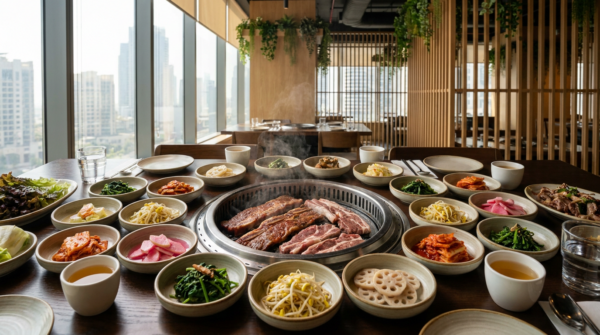
For the soup inside a meal, Mukbang Shows. It sells the cheapest published tang in the country (Eomuk Tang AED 49), both calendar soups (Tteokguk AED 51, Tteok Mandu Guk AED 59), and it is the only kitchen here where the guk is built into a per-person price — “Soup & steamed rice” is printed inside every unlimited BBQ tier alongside seven kinds of beef and chicken, eight banchan and two gimbap.
Its soups are also clean on the question that matters most to many UAE diners: beef and chicken only, no pork bone broth anywhere in the kitchen, no alcohol served.
Branches: Deira (Al Ittihad Rd, Port Saeed, +971-4-886-4494), JBR (Plaza Level, Bahar 7, The Walk, +971-54-523-1898), DWTC (The Apartments Block A, Sheikh Zayed Rd, +971-54-524-5904), Muroor Road (547 Sultan Bin Zayed The First St, Al Danah, +971-50-158-9433), Electra Street (Zayed The First St, behind Sun and Sand Sports, +971-2-564-0446). Minimum two people on the unlimited tiers; the AED 60 leftover charge applies to those tiers only. The honest limitation: the list is three lines long. No galbitang, no yukgaejang, no samgyetang, no seolleongtang.
For the classic beef tang, Hanok or Manna Land. The Korean Restaurant (Hanok) in International City has the widest tang list read for this page and the only samgyetang; it is not on Time Out Dubai’s 2026 Korean list, so confirm licence and hours directly. Manna Land in Al Nahyan — same group, “celebrating over 15 years” on its own site — is the clearest three-line list in Abu Dhabi. Both print galbitang and yukgaejang at AED 52–65, which is the value end of the ladder.
For the premium bowl, Nuri. Nuri Grill Bar at the Hilton Abu Dhabi Yas Island prints Galbi Tang at AED 85 and a hangover soup, Haejang Guk, at AED 85 — and its own menu describes that one as a pork-bone broth. The venue lists samgyeopsal and publishes a wine menu, so it is a licensed venue (alcohol served) with pork on the menu, per its own site. That is reported as an observation from its menu, not as a ruling on its kitchen; readers who need halal should confirm directly.
HYU and Mashisoyo in JLT are the delivery-listing options; Time Out Dubai’s 2026 Korean list marks HYU unlicensed — a licence fact, not a halal certificate — and does not list Mashisoyo.
How to read a Korean soup menu in three steps
Read the suffix. It answers what is guk on any menu. -guk or -tang: a personal bowl, order rice with it. Jjigae: a shared stew, one for the table. Jeongol or “hot pot”: a pan for two or more, check whether the price is per pot or per person (Mukbang prints Kimchi Jeongol at AED 89 big / AED 50 solo; Hanok prints its hot pots as R and L sizes).
Ignore the English heading. “Soup” at HYU means everything; “Soup” at Hanok means hot pots; “Street Food” at Mukbang contains a tang. The Korean word beside the English one is the reliable label.
Match the family to the job. A clear guk (tteokguk, miyeok guk) is a light lunch or the wet half of a rice meal. A gomguk-style tang (galbitang, seolleongtang) is a meal in itself. Yukgaejang is the one to order when you want heat without a shared stew. Samgyetang is the one Korean soup with no chilli at all.
FAQ
Is guk the same as soup on a Korean menu in the UAE?
Guk is a light personal soup eaten with rice. Most UAE menus label guk, tang, jjigae and even hot pots simply as “Soup”, so the reliable label is the Korean suffix beside the English name.
What is the difference between guk and tang?
Guk is the native Korean word, tang the Sino-Korean one; they are used almost interchangeably. In practice lighter soups take -guk (tteokguk, miyeok guk) and richer, long-simmered ones take -tang (galbitang, samgyetang). Both are served per person, with rice.
Is jjigae a type of guk?
No. Jjigae is a stew — less liquid, more solids, more seasoning — cooked in an earthenware pot and shared as the main dish. Guk and tang are individual soups eaten beside rice.
What is the cheapest guk or tang in the UAE?
Mukbang Shows’ Eomuk Tang (fish-cake soup) at AED 49, then its Tteokguk at AED 51. The cheapest galbitang is Hanok’s at AED 58; the cheapest yukgaejang is also Hanok’s, at AED 52.
Is guk halal in the UAE?
At Mukbang Shows, yes — beef and chicken only, no pork bone broth, no alcohol on the premises. Elsewhere, confirm directly: Nuri’s own menu describes its haejang guk as a pork broth, and a Time Out “unlicensed” label is not a halal certificate.
When is tteokguk eaten?
At Seollal, the Korean Lunar New Year, when finishing a bowl is said to add a year to your age. In the UAE it is on the menu year-round — Mukbang Shows AED 51, and with dumplings at Mukbang (AED 59) and Manna Land (AED 58).
Does any UAE restaurant serve cold naengguk?
None of the six menus read for this page lists a naengguk. Hot broths are the whole UAE Korean soup market.
Every price on this page was read from the venue’s own menu or its delivery listing on 15 September 2026 and is labelled as one or the other. Menus change; what is guk — the personal soup beside the rice — does not.
Related guides
More from our Korean food guides across the UAE: