Updated: August 2026
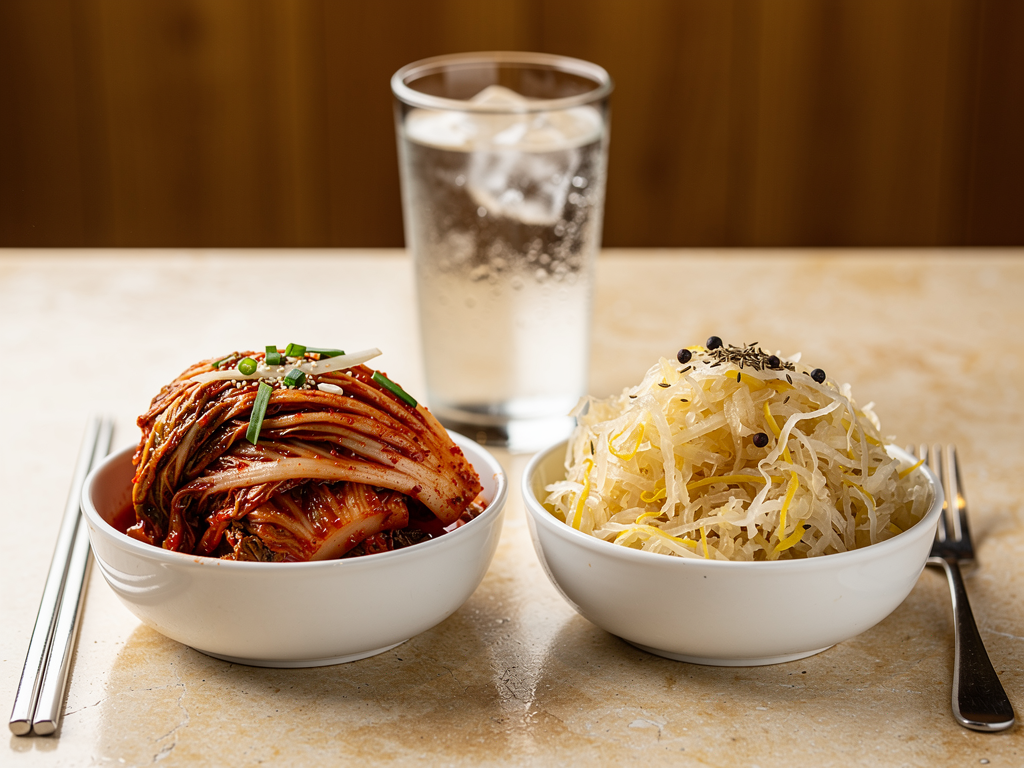
In the UAE, kimchi vs sauerkraut is decided by shelf reality more than nutrition charts. Sauerkraut sits in Carrefour as a labelled jar while kimchi is handed to you from a restaurant kitchen with no label, which changes every practical question you can ask about it.
TL;DR
– Best overall: Restaurant kimchi from Mukbang Shows (multiple branches)
– Best value: Carrefour Stollenwerk Sauerkraut at AED 15.79
– One situational pick: Mukbang Shows kimchi jeon at AED 53 when you want the seasoned ferment turned into a cooked dish
What is the real kimchi vs sauerkraut difference in the UAE?
In the UAE, kimchi vs sauerkraut comes down to one verified supermarket fact. Sauerkraut is a jar with a label you can read before you buy it. Kimchi is something a kitchen hands you without one.
Carrefour UAE stocks Stollenwerk Sauerkraut Pickle 680g at AED 15.79, which works out at AED 23.22 per kilo. It is a product of Germany, sold and shipped by Carrefour, and filed under the Eastern Europe aisle. You stand in the shop, pick up the jar, and check the ingredients list in seconds. A Carrefour UAE search for kimchi checked on 2026-08-27 returns only kimchi-flavoured products: Nongshim Shin Kimchi instant noodles 120g at AED 5.89, Garak Kimchi Ramen 130g at AED 6.79 or AED 29.29 for a five-pack, and Good Seoul Korean Dumplings Kimchi 420g frozen at AED 27.49. Actual jars of kimchi are essentially absent from the mainstream supermarket range.
This single difference decides everything practical here. With sauerkraut you verify the contents on the label. With kimchi you have to ask a person in the kitchen. That is why the halal question and the vegetarian question keep coming up about kimchi and almost never about sauerkraut. The asymmetry is not that one is abundant and the other impossible to find. Korean grocers exist. The verified point from carrefouruae.com is that one comes pre-packaged with full disclosure and the other usually does not.
One honest caveat applies to both sides of this comparison. The sauerkraut range is thin too. The organic Biona sauerkraut listings on the same site were showing out of stock when checked on 2026-08-28. The takeaway is not abundance versus rarity. It is label versus no label. That gap explains why people in the UAE keep asking the same questions about one ferment and not the other.
| Kimchi | Sauerkraut | |
|---|---|---|
| Base | Brined napa cabbage coated in seasoning paste | Shredded white cabbage and salt |
| Seasoning | Gochugaru, garlic, ginger, spring onion | None, or juniper and caraway |
| Usually vegetarian? | No — commonly contains salted fermented seafood | Yes, vegan by default |
| Heat | Moderate, warm and savoury | None |
| How you buy it in the UAE | Mostly from a restaurant kitchen, no label | Carrefour jar, Stollenwerk 680g AED 15.79 |
| Can you verify it yourself? | Ask the kitchen | Read the label |
| Restaurant dishes built from it | Jeon AED 53, jeongol AED 89/50, fried rice AED 45 | Served as a condiment alongside meat |
How do the ingredients of kimchi and sauerkraut actually differ?
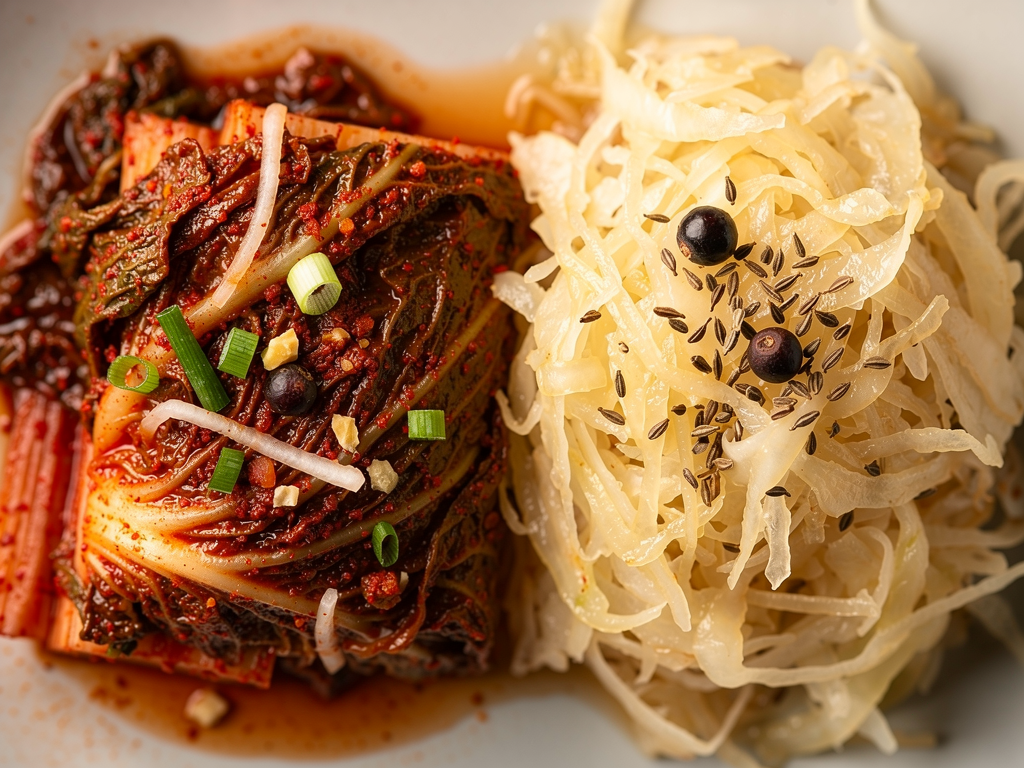
Sauerkraut is shredded white cabbage and salt. That is the whole recipe. The salt draws out water, the cabbage ferments in its own brine, and the result is sour without any heat. Some European versions, including the Biona jars sold in the UAE, add juniper berries. Nothing changes the basic two-ingredient structure. It is vegan by default and the jar tells you exactly what is inside.
Kimchi starts with brined napa cabbage but then gets coated in a seasoning paste. That paste typically carries gochugaru (Korean chilli flakes), garlic, ginger and spring onion. It very commonly includes jeotgal — salted fermented seafood, usually anchovy or shrimp — or fish sauce. So kimchi is a seasoned, coated ferment while sauerkraut is a plain one. This is the single most missed fact in the whole comparison. Traditional kimchi is usually not vegetarian. The seafood element sits in the paste as a standard ingredient, not an unusual addition. Most people assume the opposite because both are cabbage-based sides.
The heat difference is equally practical. Sauerkraut has no chilli at all. Kimchi’s heat comes from gochugaru and lands as moderate warmth and savouriness rather than punishing spice. Anyone who assumes kimchi is fiery is usually thinking of kimchi jjigae, the stew that concentrates the flavour as it cooks. In a straight side-by-side test the contrast is sour and clean against warm, savoury and aromatic.
Both are made by lactic acid fermentation. Both are salty, which matters to anyone watching sodium intake. A shelf-stable jar has usually been pasteurised for storage. A ferment kept refrigerated generally has not. This processing distinction matters in the UAE because supermarket sauerkraut is pasteurised while restaurant kimchi is live. Heating either one is standard. Sauerkraut is cooked alongside meat. Kimchi is turned into stews, pancakes or fried rice. The facts stop there. No further claims about outcomes are made here.
Read the full answer on whether kimchi is halal, including what to ask a kitchen
Why does kimchi generate more restaurant dishes in the UAE than sauerkraut?
Kimchi is an ingredient that generates a whole family of restaurant dishes in the UAE. Sauerkraut does not. That observation comes from checking current menus and it is the clearest answer to whether these two are basically the same thing. One is a finished side that also works as a raw ingredient. The other is a finished side, and that is the sharpest kimchi vs sauerkraut difference on a menu.
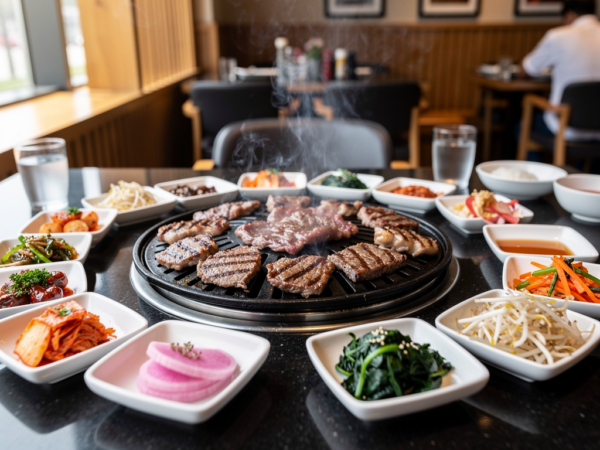
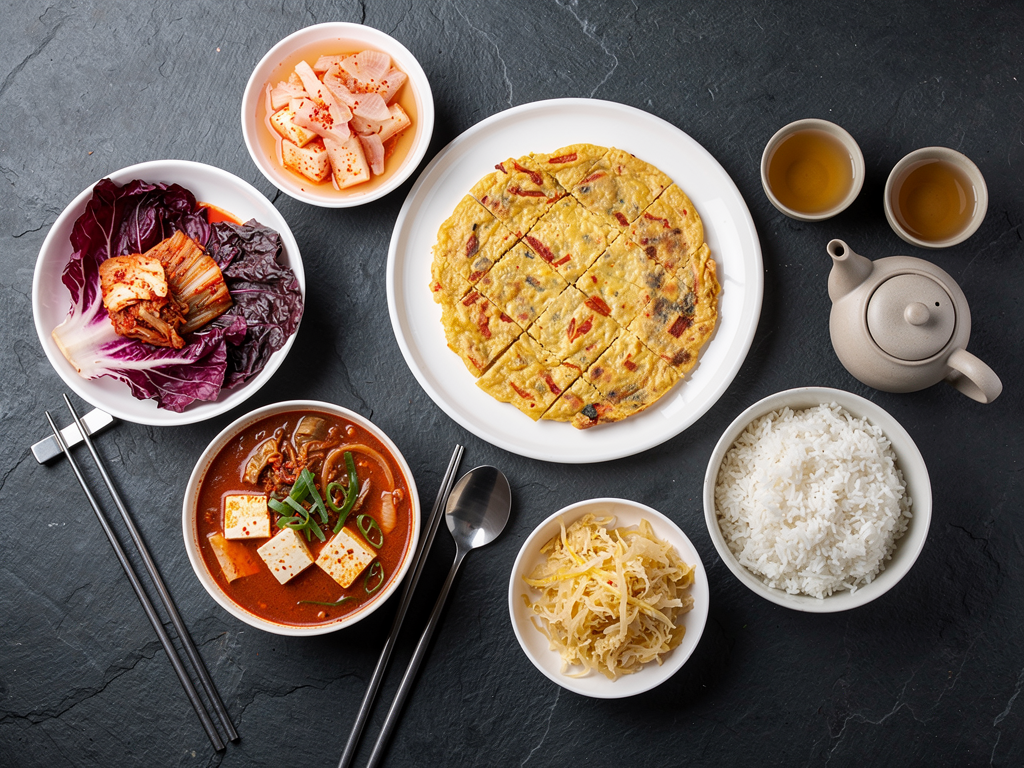
At Mukbang Shows you can eat kimchi four different ways in one sitting. It arrives as banchan with every all-you-can-eat tier. You can order kimchi jeon at AED 53, a pancake that mixes the ferment into the batter and fries it crisp. Kimchi jeongol costs AED 89 or AED 50 depending on portion size, a stew that simmers the kimchi with broth and other vegetables.
Kimchi fried rice appears at AED 45, where the ferment is stir-fried with rice and egg. A kimchi side alone is listed at AED 78 or AED 43. Every AYCE tier includes eight banchan and runs from Gangnam at AED 69 value branches up to Bukchon Hanok at AED 129 flat. Every branch is 100% halal with beef and chicken BBQ only.
Other menus show the same pattern. HYU in JLT lists a kimchi pancake at AED 55 plus three separate lines for Kimchi Jjigae, Kimchi Jjigae Beef and Kimchi Jjigae Tuna. Hanok in International City offers Kimchi Jeon at AED 38 for the vegetable version or AED 43 for the seafood version. These are not rare specials. They are core menu items that treat kimchi as an active ingredient rather than a passive pickle.
Sauerkraut’s role in UAE menus stays limited to a condiment served alongside meat. There is no comparable spread of sauerkraut-based main dishes. That is not a claim that such dishes cannot exist anywhere. It is an observation from the restaurant menus checked for this guide on 2026-08-28. The practical result is that one ferment opens more doors on a menu while the other closes them after the first bite.
Korea funds the World Institute of Kimchi, a government research institute dedicated entirely to the subject. Nothing equivalent exists for sauerkraut. The contrast is offered here only as a light illustration that one is treated as national infrastructure rather than a simple pickle. Visit the World Institute of Kimchi
One honest caveat belongs to the Mukbang Shows experience here. It is a restaurant, not a shop. You cannot buy a jar of its kimchi to take home and put in your fridge. It does not serve sauerkraut at all. If the point of the exercise is to taste the two ferments side by side you will buy the sauerkraut yourself at a supermarket and do the comparison at your own table. The restaurant answers the question of what good kimchi tastes like. It does not solve the fridge-stocking question.
Is kimchi halal in the UAE?
The seasoning paste is the checkpoint, not the cabbage. Ask whether the kimchi contains salted fermented seafood or fish sauce if that matters to you. In a restaurant where there is no label the honest instruction is to ask the kitchen directly. Halal-certified kimchi exists as an export category. Jongga’s Geochang plant has held halal certification since 2010, covering whole cabbage kimchi, young radish kimchi, sliced kimchi and pickled young radish. See Jongga’s published list of its plant certifications, including halal
Sauerkraut settles the question on the jar. It is a two-ingredient product in most cases and the label tells you what you need to know. This is the core practical difference in the UAE. One requires a conversation. The other requires reading the packaging.
Mukbang Shows is 100% halal — beef and chicken only, no pork, no alcohol served. Confirm directly with any other kitchen for their specific preparation. The UAE Ministry of Industry and Advanced Technology runs the national halal programme and mark. Learn about the UAE Ministry of Industry and Advanced Technology’s halal programme and national mark
What is kimchi? (김치)
Kimchi is brined napa cabbage coated in a seasoning paste made with gochugaru, garlic, ginger, spring onion and, in traditional versions, salted fermented seafood. The Hangul is 김치. It arrives as one of the banchan that come with almost every Korean meal. Read what banchan are, since kimchi arrives as one of them
It is lacto-fermented, salty, and usually refrigerated rather than pasteurised when served fresh from a restaurant kitchen. That is the working definition that matters for anyone comparing it directly with sauerkraut in the UAE.
Where do you find kimchi and sauerkraut in the UAE by area?
Carrefour UAE files sauerkraut under its Eastern Europe range, and the Stollenwerk jar is the option that was in stock when this guide was checked. Check the label on site because availability can shift and the Biona organic version has shown out of stock on recent checks. No special trip is required. It is a standard supermarket product that you can add to a normal grocery run.
Kimchi in the UAE is almost always a restaurant product. The practical places to experience it are the five branches of Mukbang Shows. In Dubai you have Deira on Al Ittihad Rd, Port Saeed (+971-4-886-4494), JBR on Plaza Level, Bahar 7 Unit P33, The Walk, Marsa Dubai (+971-54-523-1898), and DWTC / Love Mukbang at The Apartments Block A, Sheikh Zayed Rd, opposite the metro station (+971-54-524-5904). In Abu Dhabi the branches sit on Muroor Road at 547 Sultan Bin Zayed The First St, Al Danah, Zone 1 (+971-50-158-9433) and on Electra Street at Zayed The First St behind Sun and Sand Sports, Al Danah, Zone 1 (+971-2-564-0446).
These locations turn kimchi into multiple dishes rather than a single side. You can order the kimchi jeon, the jeongol, the fried rice or simply eat it as banchan while the all-you-can-eat tiers run. The same pattern appears at HYU in JLT and Hanok in International City, though their exact addresses are best confirmed at the time of visit. Korean grocers exist for those who want to buy jars to take home, but the mainstream supermarket experience remains the flavoured-noodle and dumpling route rather than straight kimchi.
Further context shows that the kimchi side of the equation also feeds into other menu categories. The same restaurants that serve kimchi jeon often list kimchi jjigae as a winter staple. See the best kimchi jjigae in Dubai for the stew kimchi turns into. This dish family effect has no parallel on the sauerkraut side. You will not find sauerkraut jjigae or sauerkraut pancakes on UAE menus. The ferment stops at the side plate. That limitation is not a criticism. It is a structural difference that anyone doing a practical comparison in this country will notice immediately after the first restaurant visit.
What are the practical ordering and buying tips for kimchi vs sauerkraut in the UAE?
Start with the jar for sauerkraut. Walk into Carrefour, locate the Eastern Europe section, pick up the Stollenwerk 680g at AED 15.79, read the ingredients on the spot, and decide. No phone call or server conversation is required.
For kimchi, book a table at Mukbang Shows and ask the kitchen directly about the paste if the seafood content matters. Order the kimchi jeon at AED 53 to taste it cooked into a crisp pancake or the kimchi fried rice at AED 45 to see it integrated with starch. Both show the ferment’s flavour without needing to commit to a full stew.
If you want volume, choose one of the all-you-can-eat tiers at Mukbang Shows. The lowest Gangnam tier starts at AED 69 at value branches and includes eight banchan. This is the cheapest practical way to eat restaurant-grade kimchi in quantity.
To run a side-by-side kimchi vs sauerkraut test at home, buy the supermarket sauerkraut jar and order take-away kimchi jeon or banchan from Mukbang Shows. The restaurant does not sell jars for home use, so the hybrid approach is the only realistic method.
Check stock before a long drive. Biona organic sauerkraut has been out of stock on recent Carrefour UAE checks. The Stollenwerk version is the reliable pick but still verify on the app or in-store.
When comparing heat levels, remember that menu items labelled “kimchi” on their own are milder than kimchi jjigae. Order the plain jeon or banchan first if you are new to the flavour. The stew concentrates the gochugaru and will taste noticeably warmer.
These six steps keep kimchi vs sauerkraut grounded in what is actually available in the UAE rather than theoretical nutrition tables. They also respect the label-versus-kitchen reality that defines the two here. One purchase is passive. The other requires a short conversation. That difference affects every subsequent decision from halal verification to vegetarian suitability to how you plan your meal.
Further practical advice expands on the salt question. Both ferments are high in sodium by design. The UAE’s climate already pushes people toward higher fluid intake. Pairing either with plain rice or water-heavy dishes balances the meal without needing any deeper health speculation. Read the honest guide to Korean food and health, including the salt question.
The question to ask in a restaurant is a short one: does the kimchi paste contain fish sauce or salted seafood? The jar of sauerkraut removes that step entirely, because the label answers it.
For those who prefer to cook at home, the frozen Good Seoul Korean Dumplings Kimchi at AED 27.49 from Carrefour can stand in when fresh restaurant kimchi is not an option. It is not the same as fresh banchan but it provides the seasoned profile in a convenient pack. Pair it with the Stollenwerk sauerkraut jar for a fridge comparison that requires zero cooking. The texture will differ — one is soft and coated, the other is shredded and crisp — yet the exercise illustrates the core differences without leaving the house.
FAQ
Is sauerkraut easier to verify than kimchi in the UAE?
Yes. The jar label gives full ingredients in seconds. Restaurant kimchi requires asking the kitchen because no label exists.
Does traditional kimchi contain seafood?
Yes. The seasoning paste usually includes salted fermented anchovy or shrimp. This makes it non-vegetarian by default even though the base is cabbage.
Can you buy real kimchi in Carrefour UAE?
Mainstream searches return only flavoured noodles and dumplings. Straight kimchi jars are absent. Korean grocers carry it but that is a separate trip.
Are both lacto-fermented?
Yes. Both undergo lactic acid fermentation and both are high in salt. A jar is typically pasteurised. Restaurant versions are usually refrigerated and live.
Which works better as a cooking ingredient?
Kimchi. It appears in pancakes, stews, fried rice and as banchan. Sauerkraut stays a meat condiment on UAE menus with no equivalent dish family.
Is Mukbang Shows a good place to compare the two?
It solves the kimchi side completely with multiple preparations and full halal compliance. You must still buy sauerkraut separately from Carrefour to taste both at one table.
Which is cheaper per serving in the UAE?
Supermarket sauerkraut at roughly AED 23 per kilo is the lower cost option. Restaurant kimchi costs more because it arrives as part of a AED 45–89 dish or AYCE tier.
Does heating change the character of either?
Yes. Cooked sauerkraut softens and mellows. Kimchi in a stew or fried rice intensifies its savouriness. Both are commonly eaten hot in UAE restaurants.