Updated: September 2026
Korean hot pot vs Chinese hot pot comes down to one thing you can read on the bill: Chinese hot pot sells you an empty pot — broth, then every plate, then the sauce — and Korean hot pot sells you a full one. Haidilao prints “Beef Tallow Spicy Broth AED 44”, thirty-odd plates and every sauce item at AED 5. Mukbang Shows prints “Kimchi Jeongol AED 89” and nothing else to add.
TL;DR
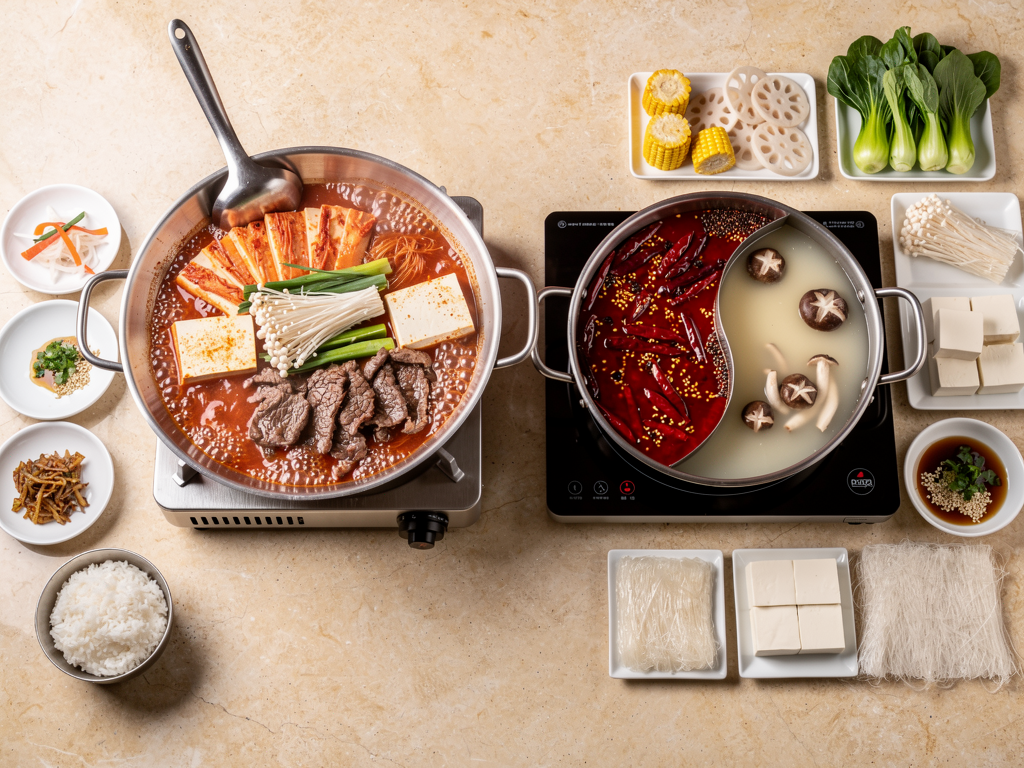
– Chinese: broth only in the pot; you cook each raw plate and mix a dipping sauce. Priced line by line (Haidilao: broth 31–49, plates 10–64, sauces 5 each) or as sets (99 for one, 436 for two, 548 for four).
– Korean: the kitchen fills a shallow jeongol pan and the table keeps it boiling. One price per pot (Mukbang: AED 50–99; Manna Land: 78–95 regular, 147–185 large).
– No dipping sauce on the Korean side; no single broth on the Chinese side.
– Korean wins for two to three on one bill line and on halal certainty; Chinese wins for a split spicy-and-mild table.
What is the difference between Korean hot pot and Chinese hot pot?
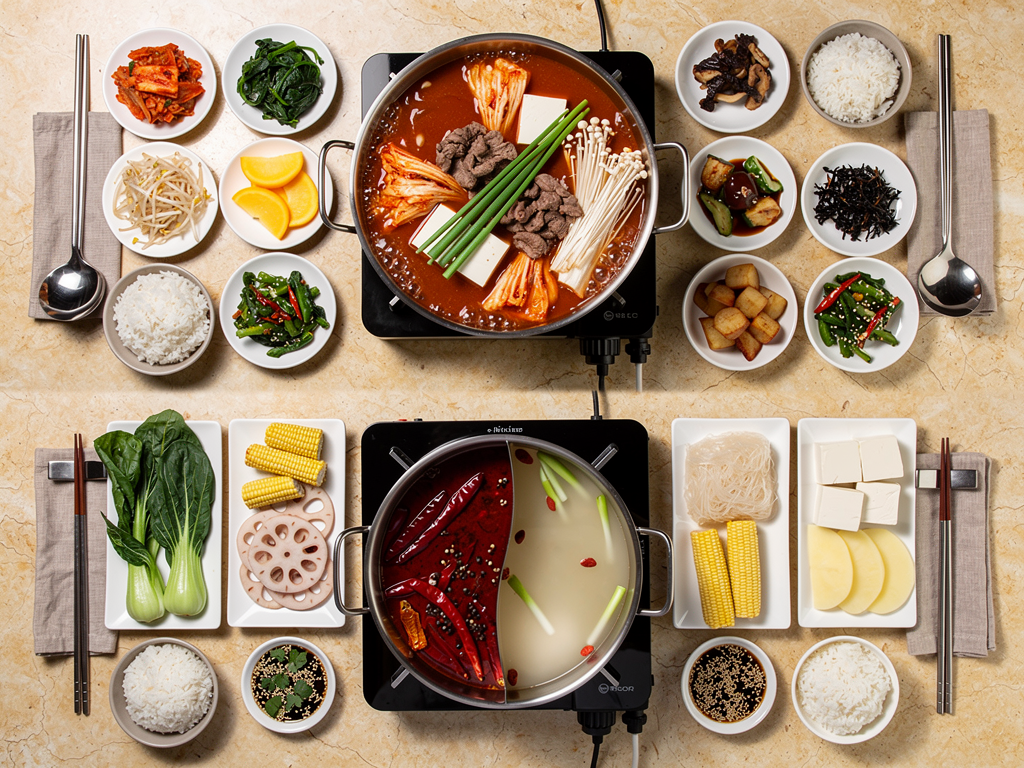
Who assembles the pot. The encyclopaedia entry on hot pot defines the Chinese format as “a dish of soup or stock kept simmering in a pot by a heat source on the table, accompanied by an array of raw meats, vegetables and soy-based foods which diners quickly cook by dipping in the broth”, after which the cooked pieces are “dipped into dipping sauces for additional flavor”. The diner is the cook.
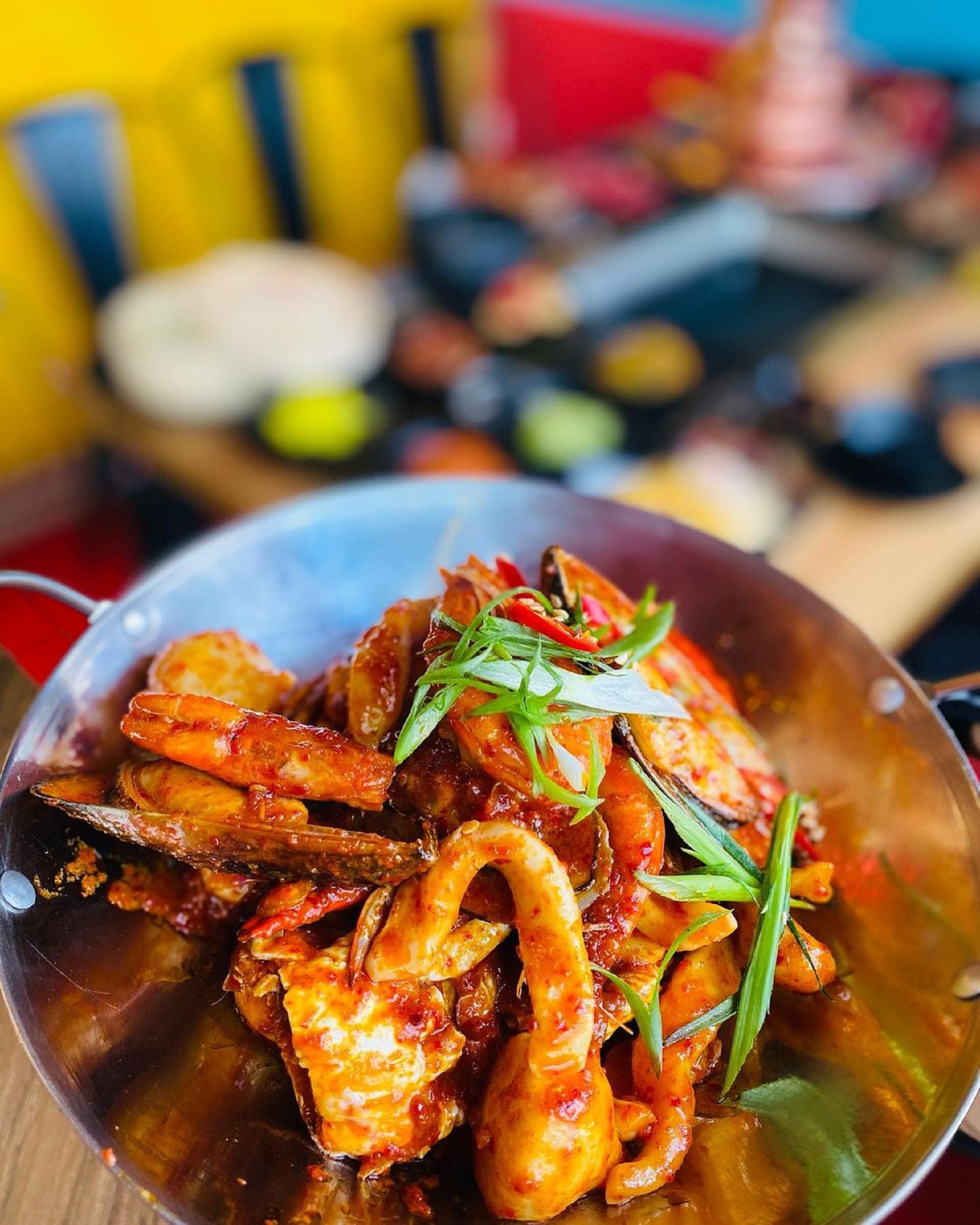
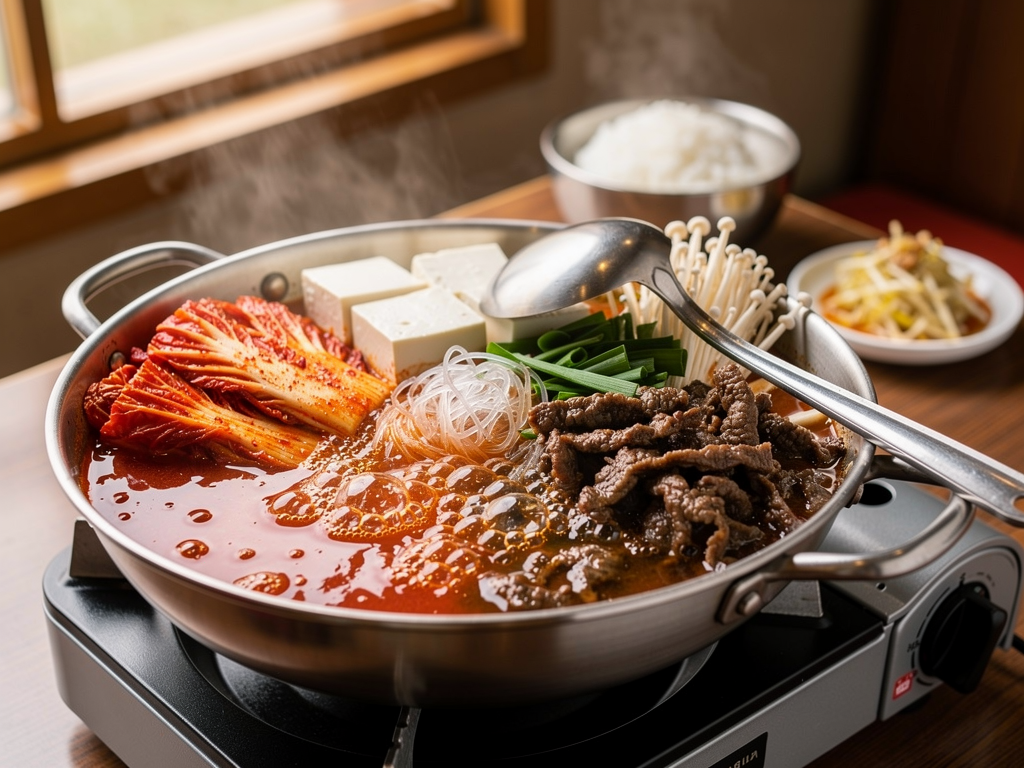
The encyclopaedia entry on jeongol defines the Korean pot as “a Korean-style hot pot made by putting meat, mushroom, seafood, seasoning, etc., in a stew pot, adding broth, and boiling it”. The kitchen arranges the pan, the broth goes in, and the boiling happens at the table. The diner ladles. The same encyclopaedia notes that Korean “jeongol and jjigae can be compared to hot pot” — they are the same idea with the work moved from the table back into the kitchen.
So the honest one-line answer to korean hot pot vs chinese hot pot is: a Chinese pot arrives empty and you build the meal; a Korean pot arrives full and you eat it. Everything else on this page — the sauce, the divider, the shape of the bill — follows from that.
Why does Chinese hot pot price the empty pot and Korean hot pot price the full one?
Because the Chinese format sells ingredients and the Korean format sells a dish.
Haidilao’s Dubai Mall listing (read live on Talabat, September 2026, delivery-app prices) prints the broth as its own line: Signature Three-Delicacy AED 31, Mushroom 34, Mala Milk 35, Ox Tail 39, Tomato Soup 39, Beef Tallow Spicy 44, Black Pepper Chicken 49. Then every ingredient is a plate: Australian Beef Slices 53, Sweet Marinated Tender Beef 49, Premium Beef Oyster Blade 55, Australian Lamb Rolls 61, Lamb Rib Rolls 64, White Shrimp 55, Enoki 16, Fresh Tofu 10, Rice Cake 21, Udon 16, Instant Noodles 20, Baby Cabbage 19, White Rice Bowl 9. Then the sauce: Minced Garlic, Sesame Oil, Peanut Sesame Sauce, Oyster Sauce, Coriander, Chopped Green Onion, Chili Powder — AED 5 each.
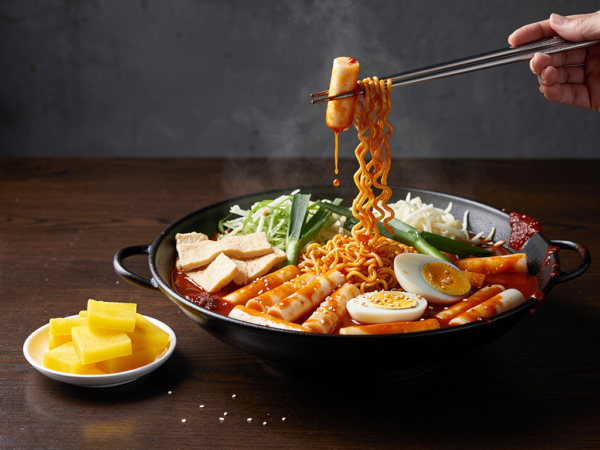
Mukbang Shows prints Kimchi Jeongol AED 89 (large) or 50, Haemul Jeongol 99, Budae Jjigae 99, Jjampong 99 or 60, Soondubu Jjigae 59, Doenjang Jjigae 59. One line per pot; the pot arrives assembled and simmering with banchan and rice around it. Manna Land’s own menu does the same in two sizes: Haemul Jeongol 84 regular / 157 large, Mandu Jeongol 78 / 147, Nakji Jeongol 78 / 147, and a “Korean Syabeu Syabeu” in beef (89 / 168), chicken (80 / 150) or seafood (95 / 185).
That is the whole structural difference in one line each: a Chinese hot pot bill is built plate by plate; a Korean hot pot bill is one number. Our guide to jeongol covers what goes into that number.
The sauce is the second split
Chinese hot pot is finished in the bowl. The broth cooks the food; the dipping sauce flavours it, and the diner mixes that sauce. Wikipedia gives the Chongqing standard — “sesame oil … mixed with crushed fresh garlic and chopped spring onions” — and Haidilao’s listing sells exactly those components at AED 5 a line, plus a “Minced Beef” item it labels “Perfect with tomato soup”. Two diners taking four items each have added AED 40 before a plate has gone in.
A jeongol has no dipping bowl. The seasoning is in the broth from the start — kimchi and gochugaru in a kimchi jeongol, doenjang in a doenjang pot, the chilli base in a jjampong — so what comes out of the pan is already the finished flavour, and the only thing added at the table is a spoon of rice. That is why the Korean menu can print one price: there is no second transaction after the pot lands.
It also changes what “spicy” means. In a Chinese pot the heat lives in the broth you chose — Wikipedia’s Chongqing style “uses mala seasoning flavored with chili and Sichuan pepper for a spicy and numbing flavor” — and a milder eater can pick the tomato or mushroom half. In a Korean pot the heat is a property of the dish, and the table shares it.
The divided pot: what Chinese hot pot can do that a jeongol cannot
One broth for the whole table is the honest limitation of the Korean format, and the Chinese format was built to avoid it. Nine Squares in Dubai is named for the fix: Time Out Dubai’s review of Nine Squares explains that “the nine squares in the name refer to the dividers offered for the hot pot, allowing you to cook different things in neatly divided sections”, with “a choice of broths, with the option of going half and half”.
Time Out’s advice is to skip the spiciest option — “the herb or oxtail versions are more palatable” — and it warns that “ingredients veer from premium USA ribeye beef to the more budget luncheon meat”.
Haidilao sells the idea for the home: an “Electric 2 Side Pot — 2 separate part in 1 pot and will taste 2 flavor in 1 meal” at AED 249 on its delivery listing. A jeongolteul, the shallow Korean pan, has no divider. If half the table wants chilli and half does not, the Chinese pot solves it and the Korean pot does not — order two.
Korean hot pot vs Chinese hot pot: what it costs in the UAE
Every figure below was read live in September 2026. Delivery-app prices are marked; Nine Squares, Shoo Loong Kan and Little Lamb print no readable hot pot prices and are listed without them.
| Venue | Format | How the pot is priced | Sauce | Divided pot |
|---|---|---|---|---|
| Mukbang Shows, Dubai + Abu Dhabi (5 branches) | Korean jeongol | Kimchi Jeongol 89 / 50 · Haemul Jeongol 99 · Budae Jjigae 99 · Jjampong 99 / 60 — one line, assembled | None — seasoning in the broth | No |
| Manna Land, Satwa + Abu Dhabi | Korean jeongol | Haemul 84 / 157 · Mandu 78 / 147 · Nakji 78 / 147 · Syabeu Syabeu beef 89 / 168 — one line, two sizes | None | No |
| Haidilao Hotpot, Dubai Mall + Festival City | Chinese hot pot | Broth 31–49 + plates 10–64 + sauces 5 each; sets 99 (1) / 436 (2) / 548 (4) (delivery-app) | AED 5 per item | Yes (2-side pot 249 to buy) |
| Nine Squares, Jumeirah 3 + International City + Dubai Mall | Chinese hot pot | Not printed on a readable page | Condiment table (Time Out) | Yes — nine dividers |
| Shoo Loong Kan, Dubai Mall Chinatown + International City | Sichuan hot pot | Image menus only; not printed | — | — |
| Little Lamb Mongolian HotPot & BBQ, Deira + Marina + Dragon Mart | Mongolian-Chinese hot pot | Hot pot not on the delivery listing (skewers 6.50–10, dishes 40–57) | — | — |
Two things stand out. First, the Korean column has a price in every cell and the Chinese column mostly does not — because a Chinese hot pot has no single price until the table has finished ordering. Second, the one Chinese venue that prints everything, Haidilao, prints roughly fifty lines to describe one dinner.
Which is cheaper for two, for four, and for one?
For two, Korean. A Mukbang Kimchi Jeongol large at AED 89 or a Haemul Jeongol at AED 99 is a centrepiece for two to three, with eight banchan and rice around it, on one bill line. Two people building a Haidilao pot à la carte — one Beef Tallow Spicy Broth (44), Australian Beef Slices (53), Sweet Marinated Tender Beef (49), Australian Lamb Rolls (61), tofu (10), enoki (16), rice cake (21), two rice (18) and four sauce items (20) — have spent AED 292 before drinks. Haidilao’s own Combo Meal for Two is printed at AED 436, with a discounted AED 261.60 showing at the time of reading.
For four, closer than you would think. Haidilao’s Combo Meal for Four is AED 548, or AED 137 a head. Two large Manna Land pots are AED 294–370; two Mukbang Haemul Jeongol are AED 198 — but a jeongol table usually adds a BBQ or a second dish, and our guide to Korean group tables in Dubai shows how that ladder runs.
For one, Chinese. Haidilao prints a 9 Sections Combo Meal for 1 Person at AED 99 and a build-your-own malatang bowl from AED 28. A jeongol is a shared pan by design; the Korean solo answer is a jjigae — Mukbang’s Soondubu or Doenjang Jjigae at AED 59 — which is the single-ingredient cousin, not the hot pot itself.
Is Korean hot pot vs Chinese hot pot halal in the UAE?
Mukbang Shows is 100% halal: beef and chicken only, no pork, no alcohol served, across all five branches — and its Budae Jjigae, the one Korean pot that elsewhere carries spam and sausage, is built without either. That is the plain answer for the Korean side.
On the Chinese side, Haidilao’s Dubai Mall listing prints beef, lamb, mutton, chicken, shrimp and fish, and its two processed lines are labelled “Signature Beef Spam” and “Beef Cocktail Sausage”. That is a fact about one printed listing, not a certification — confirm directly. Nine Squares, Shoo Loong Kan and Little Lamb print no readable hot pot menu at all, so there is nothing to report beyond their names and addresses; ask before you book. No Time Out licence label was found for any hot pot venue on this page, so the licensing question is also one to confirm directly.
Our Korean food vs Chinese food guide covers the wider halal picture across both cuisines.
Where Mukbang Shows fits, and where it doesn’t
Mukbang Shows sells the Korean pot in its native form: Kimchi Jeongol (AED 89 / 50), Haemul Jeongol (AED 99), a halal Budae Jjigae (AED 99) and Jjampong (AED 99 / 60), each one arriving assembled and simmering with eight banchan and rice around it — one line on the bill, no broth charge, no plate charge, no sauce charge — at five branches: Deira, JBR and DWTC in Dubai; Muroor Road and Electra Street in Abu Dhabi.
Our guide to Korean hot pot in Dubai and our guide to Korean hot pot in Abu Dhabi place it against the other Korean kitchens.
Where it doesn’t fit: Mukbang serves no Chinese hot pot. There is no broth menu, no raw-plate ladder, no sauce bar, no divided pot and no numbing mala tallow broth. A table that wants to build its own pot piece by piece, or split one pot between a spicy and a mild half, should book Haidilao or Nine Squares and budget AED 99 a head for the set or more à la carte. A jeongol is one undivided broth chosen for the whole table, and that is a real constraint for a mixed group.
The one-paragraph answer
A Chinese hot pot is a kit: broth, plates and sauce sold separately, cooked by you, finished in your own dipping bowl, and divisible so one table can run two broths — Haidilao prints every part of that kit, from a AED 31 broth to a AED 5 spoon of garlic. A Korean hot pot is a dish: arranged in the kitchen, seasoned in the broth, boiled at the table and priced as one line — Mukbang’s Kimchi Jeongol at AED 89 is the whole order. Pick the kit for a big mixed table that wants to build and split; pick the dish for two or three who want one number, halal certainty and a pot that arrives ready.
FAQ
What is the main difference between Korean hot pot and Chinese hot pot?
Who assembles it. In Chinese hot pot the pot arrives with broth only and the diner cooks each raw plate and mixes a dipping sauce. In Korean hot pot (jeongol) the kitchen arranges the ingredients in a shallow pan, adds the broth and the table keeps it boiling and ladles — no dipping sauce, because the seasoning is in the broth.
Which is cheaper in Dubai, Korean hot pot or Chinese hot pot?
For two or three, Korean: Mukbang’s Kimchi Jeongol is AED 89 for a centrepiece pot on one bill line, against roughly AED 292 for two building a Haidilao pot à la carte. For one, Chinese: Haidilao’s set for one is AED 99 and a jeongol is a shared pan by design.
Does Korean hot pot come with a dipping sauce?
No. A jeongol is seasoned in the broth — kimchi, gochugaru, doenjang — so the food comes out finished. Chinese hot pot relies on the dipping bowl, which is why Haidilao sells the sauce components at AED 5 each.
Can you split a Korean hot pot between spicy and mild?
Not in one pan. A jeongol is one undivided broth for the table. Chinese hot pot solves this with divided pots — Nine Squares has nine sections and Haidilao sells a two-side pot — so a mixed table should order two Korean pots or choose the Chinese format.
Is Chinese hot pot in Dubai halal?
Haidilao’s Dubai Mall listing prints beef, lamb, chicken and seafood, with its spam and sausage lines labelled beef — but that is what the listing prints, not a certification, so confirm directly. Mukbang Shows is 100% halal: beef and chicken only, no alcohol, and its Budae Jjigae is made without spam or pork.
What is a jeongol?
The Korean hot pot: meat, seafood, mushrooms and vegetables arranged in a shallow pan called a jeongolteul, broth added, boiled at the table and shared. It began as a dish for the royal court; the single-ingredient version is a jjigae.
How is Korean hot pot different from shabu shabu?
Shabu shabu is the Japanese cousin of the Chinese format — thin slices swished by the diner in a plain broth and dipped after. Jeongol is assembled and seasoned before it reaches the table. Our jeongol vs shabu shabu comparison covers that pair.
Related guides
- Our Korean food vs Chinese food guide — the hub this comparison belongs to.
- Our mandu vs dim sum comparison — the piece versus the pot.
- Our Korean fried rice vs Chinese fried rice comparison — the wok versus the stone bowl.
- Our Korean BBQ vs hot pot guide — when the choice is the grill or the pot.