Updated: September 2026
Banchan vs mezze is not the same idea wearing two hats, and the difference is who pays. Mezze is an ordered, priced course — every hummus, moutabal and fattoush has its own line and its own number. Banchan is a bundled service — it arrives unasked, it is inside the price of what you already ordered, and in Korean practice it is refilled free.
TL;DR
– Better value: banchan — eight dishes inside an AED 69 sitting at Mukbang Shows, versus roughly AED 170 for six mezze plates at Zaroob
– Better control: mezze — you choose every plate; a banchan set is fixed and cannot be swapped
– The one printed proof: The Korean Restaurant in International City sells dak galbi at AED 100 and the dak galbi set at AED 125 — an AED 25 gap that is the closest thing to a published banchan price in the country
What Is the Real Difference Between Banchan vs Mezze?
One is a service, the other is a course. That is the whole thing, and every other difference follows from it.
Banchan (반찬) is the collective Korean word for the small side dishes that come with rice. They are not appetisers: they arrive with the meal, stay on the table until the end, and are eaten with the main rather than before it. Because they are part of the meal rather than an order, Korean menus almost never carry a banchan price.
Mezze — from the Persian maza, a taste or relish — is the Levantine, Turkish, Greek and Emirati tradition of deliberately ordering many small plates, usually before or instead of a main. Every plate is chosen, and every plate is charged.
If you eat in the UAE you meet both formats constantly, which is why the two get filed under the same mental heading. They should not be. There are six real differences worth knowing: who pays, how many dishes arrive, whether refills are free, what the dishes are for at the table, fermentation versus freshness, and what happens when you take either home.
Everything below was read from each venue’s own published menu or live delivery listing on 6 September 2026. Background on both traditions: the full banchan tradition, the history of meze across the region, and the Korea Tourism Organization’s guide to Korean food.
Who Actually Pays for the Small Dishes — Banchan vs Mezze?
You do, in both cases. The difference is whether you can see it on the bill.
Mezze you can see. At Zaroob in DIFC, a six-plate cold spread of hummus AED 26, moutabbal AED 27, muhammara AED 28, vine leaves AED 31, fattoush AED 29 and tabbouleh AED 29 comes to AED 170 before a single main course arrives. Its hot mezze runs meat sambousek AED 21, cheese rolls AED 26, meat kibbeh AED 28, grilled halloumi AED 29 and sujouk AED 36.
Operation Falafel is the cheapest single-plate route: moutabal AED 21, hummus AED 27, tabbouleh AED 28, fattoush AED 29, and vine leaves AED 18 for four pieces. It also publishes sharing sizes stated on the menu as good for four people — hummus AED 45, tabbouleh AED 51, fattoush AED 56, vine leaves AED 55, moutabal AED 59 — which makes the per-head arithmetic unusually clean.
Arabian Tea House sits in the middle and mixes two traditions on one appetiser page: hummus AED 33, mutabal AED 33, labneh AED 30, falafel AED 33, cheese sambosa AED 35 and mixed sambosa plate AED 39, alongside Emirati small plates including harees AED 37, hamssat dango AED 32, emirati vegetable sambosa AED 34, balaleet AED 30, dango AED 26 and bajella AED 25.
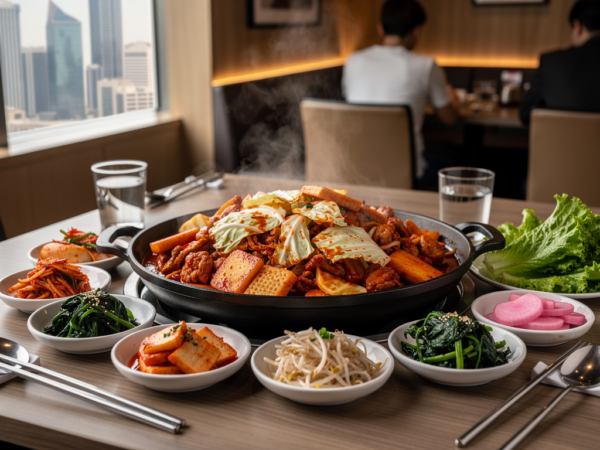
Banchan you almost never see, with one exception. The Korean Restaurant (Hanok) in International City publishes dak galbi at AED 100 and the dak galbi set at AED 125, and its own menu describes the set as the same stir-fried chicken served with side dishes of kimchi, seaweed, green onions, egg and rice. That AED 25 gap is effectively the printed price of a banchan set, and it is the only place in the UAE you can read one off a menu.
The same menu makes the point a second way. Hanok sells fried chicken as boxes that state “With 1 Set Of Banchan” — 12 pieces AED 72, 20 pieces AED 98, 28 pieces AED 138 — and prices its japchae and kimbap lunch boxes at AED 38 each “with Korean Side Dishes”. Banchan is sold as a set, never as a line item.
How Many Small Dishes Do You Get?
Eight at Mukbang Shows, seven at Madang, four plus rice in Hanok’s set — and however many you feel like paying for on the mezze side.
Mukbang Shows includes eight banchan in every all-you-can-eat tier, alongside seven BBQ kinds, two gimbap, soup and rice. Madang Korean Restaurant in Abu Dhabi bundles seven banchan into a published AED 65 weekday business lunch. Hanok’s dak galbi set names four sides plus rice.
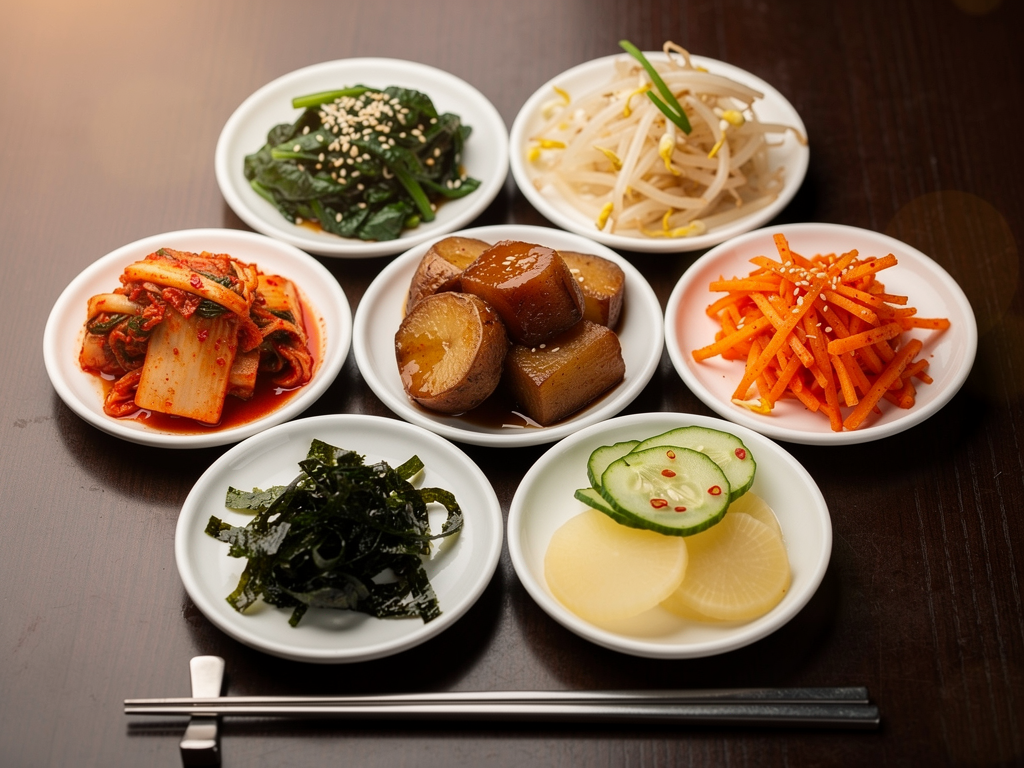
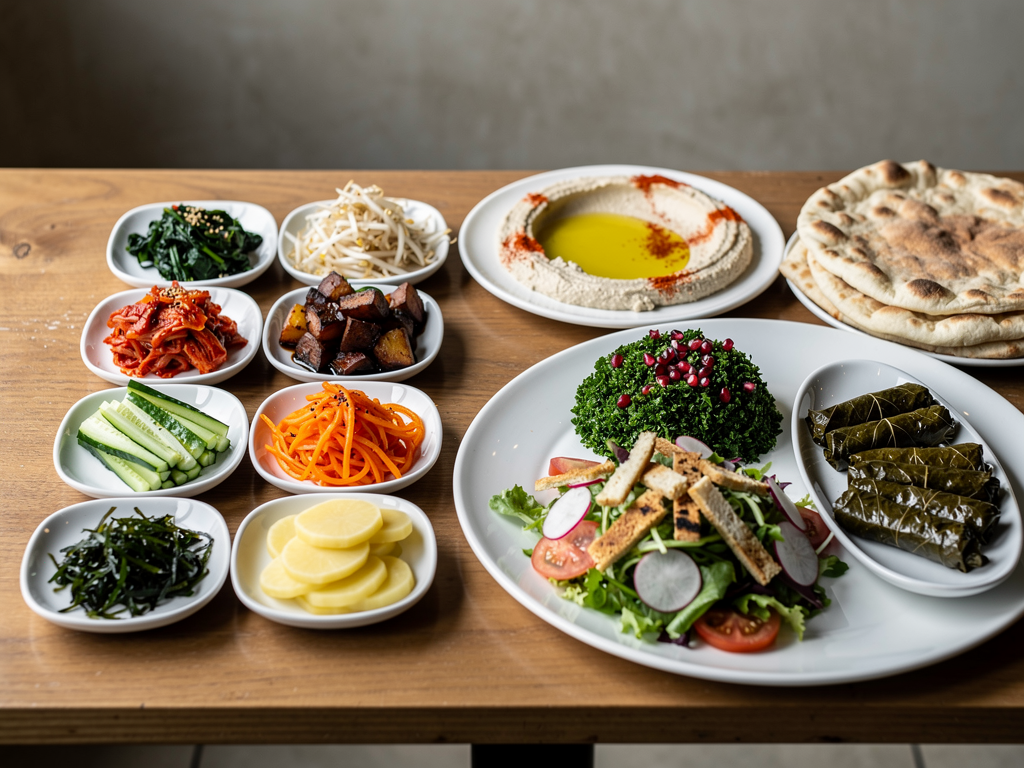
A typical UAE banchan set rotates through kimchi, seasoned spinach, bean sprouts, soy-braised potato, seasoned radish, marinated cucumber, seasoned seaweed and pickled daikon. The portions are tasting-sized — a small saucer each — which is why eight of them do not read as eight courses.
Mezze plates are physically much larger, and the count is yours to set. Four cold plates and two hot ones is a normal table order, and at Zaroob prices that is roughly AED 190 to AED 200. The difference in size matters as much as the difference in price: one Operation Falafel sharing plate of hummus feeds four people, which no single banchan dish will do.
Are Banchan Refilled Free, and Mezze Not?
Under standard Korean practice, yes — banchan is topped up without charge, and mezze is one plate, one price, order another if you want more. That is the norm rather than a guarantee, so ask when you sit down.
No UAE Korean menu we checked publishes a written refill policy, which is worth knowing before you assume anything. What the menus do show is the structure: the sides are priced inside the set, so the kitchen has no mechanism to charge you for a second helping of kimchi.
There is one real limit at Mukbang Shows, and it belongs in this section rather than buried later. The all-you-can-eat tiers carry an AED 60 leftover charge. The banchan are free to refill but they are not free to waste, so take a second helping of the two dishes your table actually likes rather than a second helping of all eight.
Mezze has no refill concept at all, and it does not need one. Nothing arrives that you did not ask for, and nothing is topped up, which is exactly the control you are paying the extra for.
What Are They For at the Table?
Banchan is there to cut through the main. Mezze is there to be the first part of the meal.
Kimchi anchors every banchan set, and its job is acidity against fat — it exists to reset your mouth between mouthfuls of grilled beef. The rest of the set works the same way beside rice: something crunchy, something fermented, something plain. That is why the dishes stay on the table until the last grain of rice rather than being cleared when the main lands.
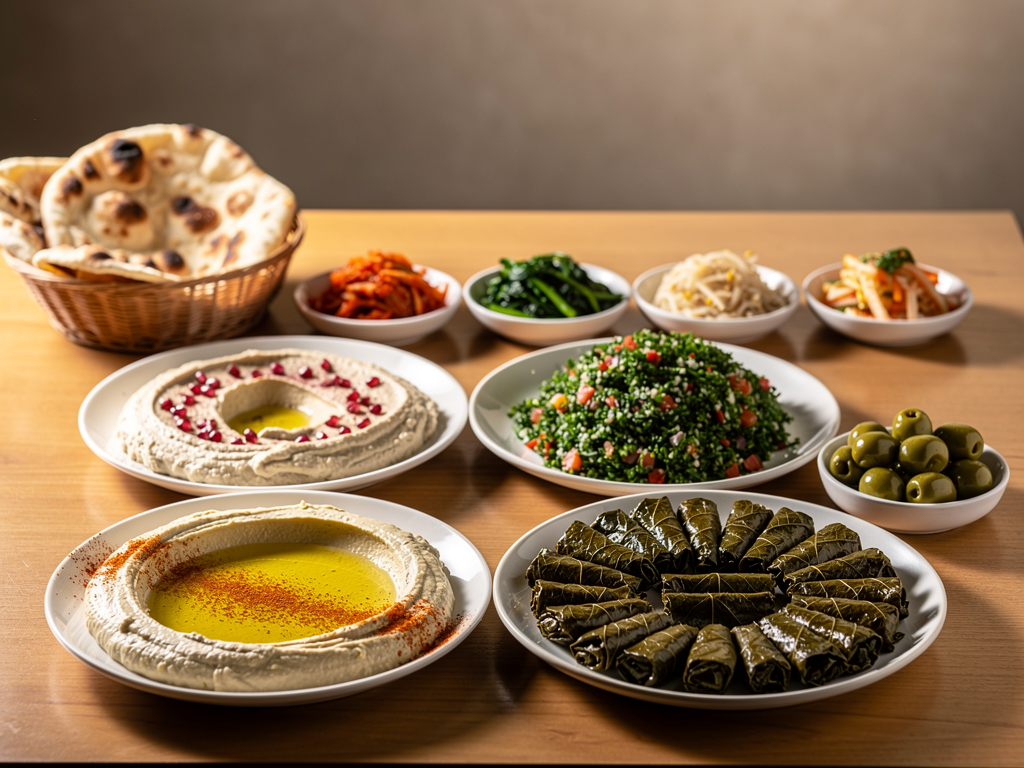
Mezze is structured as a course. Cold plates — hummus, moutabal, tabbouleh, fattoush, labneh, vine leaves — are scooped with bread at the start; hot mezze such as kibbeh, sambousek, cheese rolls and halloumi arrive as a second wave. The format is designed for grazing across an evening, and the honest downside is that a good mezze spread can fill a table before the grill even appears.
Fermentation is the cleanest separator of the two. Banchan leans on it — kimchi, pickled radish, preserved vegetables — because fermentation is how the tradition kept vegetables through a Korean winter. Mezze leans the other way, on freshness and immediate texture: chopped parsley, raw radish, warm bread, olive oil poured that minute.
What Happens When You Take Them Home?
The fermented half of a banchan set improves overnight. A dressed mezze salad does not survive the drive.
Kimchi and pickled radish keep for days and often taste sharper the next morning. Seasoned spinach and bean sprouts are best the same day. On the mezze side hummus and moutabal hold well for a day or two and vine leaves and kibbeh reheat cleanly, but fattoush and tabbouleh lose their crunch as soon as the dressing is on — which is why Operation Falafel’s for-four sharing plates are a better takeaway buy than two individual salads.
Hanok is the venue that has actually designed for this: its fried-chicken boxes ship with a banchan set attached, which is the only takeaway format in the country where the side dishes travel as standard. Ask for separate packaging in every other case.
Which Is Better Value in Dubai and Abu Dhabi?
Banchan, clearly, on arithmetic — and mezze, just as clearly, if what you want is to choose.
| Venue | Area | Price (AED) | Halal | What you get |
|---|---|---|---|---|
| Mukbang Shows (value branches) | Deira, Muroor Road, Electra Street | 69 (Gangnam tier) | 100% halal, beef and chicken only | 8 banchan bundled, plus 7 BBQ kinds, 2 gimbap, soup, rice |
| Mukbang Shows (premium branches) | JBR, DWTC | 79 (Gangnam tier) | 100% halal, beef and chicken only | Same 8 banchan; AED 60 leftover charge applies |
| Madang Korean Restaurant | Al Sa’adah, Abu Dhabi | 65 (business lunch) | Confirm directly | Main plus 7 banchan |
| The Korean Restaurant (Hanok) | International City, Dubai | 100 vs 125 | Confirm directly | Dak galbi, with and without the side-dish set — an AED 25 gap |
| Operation Falafel | Downtown Dubai and branches | 21–29 single / 45–59 for four | Confirm directly | Cheapest single mezze plates in the comparison |
| Arabian Tea House | Al Fahidi, Bur Dubai | 25–44 per plate | Its own site describes the food as middle eastern halal | Levantine and Emirati small plates on one page |
| Zaroob | DIFC, Dubai | 21–39 per plate | Confirm directly | ~AED 170 for a six-plate cold spread |
The like-for-like sum is AED 170 of ordered mezze against a banchan set folded into a AED 69 to AED 99 sitting. That is not close, and anyone claiming otherwise is not counting.
But the arithmetic is only half the comparison, and the mezze side wins the other half on two real points. The plates are several times larger. And you picked them — if three of the eight banchan on a Korean table do nothing for you, there is no mechanism to swap them, whereas a mezze order is exactly what your table asked for.
Where to Try Both in the UAE
Mukbang Shows runs five branches, all 100% halal, all including eight banchan in every tier: Deira at Al Ittihad Rd, Port Saeed (+971-4-886-4494); JBR at Plaza Level, Bahar 7, Unit P33, The Walk, Marsa Dubai (+971-54-523-1898); Love Mukbang DWTC at The Apartments Block A, Sheikh Zayed Rd, opposite the metro station (+971-54-524-5904); Muroor Road at 547 Sultan Bin Zayed The First St, Al Danah, Abu Dhabi (+971-50-158-9433); and Electra Street behind Sun and Sand Sports, Al Danah (+971-2-564-0446). Tiers run Gangnam AED 69, Daegu AED 89, Jeju AED 99 and Bukchon Hanok AED 129 at the value branches, AED 10 higher on the lower tiers at JBR and DWTC, with Bukchon Hanok flat at AED 129. Minimum two people.
The honest limitation: the banchan set at Mukbang is fixed. You get the eight dishes the kitchen sends, in the order it sends them, and you cannot trade three of them for three others the way you can build a mezze order plate by plate. If choosing every small dish on the table is the point of the meal for you, a mezze house will always beat us on that.
More on the tradition itself in our guide to what banchan actually is, and on feeding a bigger table in our guide to Korean group set menus in Dubai. Prices are on the full Mukbang Shows menu.
The Korean Restaurant (Hanok), International City, Dubai is the single most useful menu in this comparison because of the AED 25 set gap. It is a drive from central Dubai and cluster parking is tight; confirm halal status directly.
Madang Korean Restaurant, Al Sa’adah, Zone 1 (Holiday Inn), Abu Dhabi publishes the AED 65 weekday lunch with seven banchan. It does not publish individual dish prices, and the dinner spend at a hotel venue is materially higher than the lunch set; confirm halal status directly.
Zaroob – Levant Street Flavors, DIFC is rated 4.6 from more than 500 ratings on Deliveroo and publishes a full priced mezza list, which very few Levantine houses do. The DIFC site is a delivery and walk-in operation rather than a long-sitting mezze restaurant, and delivery list prices can differ from in-store; confirm halal status directly.
Operation Falafel, Downtown Dubai (Dubai Mall) plus Dubai Hills, Al Barsha 3, Silicon Oasis and Muhaisnah is rated 4.7 from more than 500 ratings and is the only venue here publishing both a single and a for-four price for the same plate. Mall branches are busy at weekends; confirm halal status directly.
Arabian Tea House, Al Fahidi (Bastakiya, Bur Dubai), plus Mercato Mall, Umm Suqeim, the Archaeological Site and Sharjah, dates itself to 1997 and describes its own food as middle eastern halal food. The Al Fahidi site is a heritage courtyard with no parking of its own, and its full menu only renders properly in a browser rather than a plain page fetch.
Is Banchan Halal in the UAE?
At Mukbang Shows, yes without qualification: the whole venue is 100% halal, beef and chicken only, no pork, no samgyeopsal, no alcohol on the menu or the drinks list.
Elsewhere there is one genuine thing to ask about, and it is not pork. Traditional kimchi seasoning often contains jeotgal — salted fermented shrimp or anchovy. That is a seafood question rather than a pork question, and it matters if you avoid shellfish, but it is the only common ingredient in a banchan set that catches people out. One question at the table settles it.
On the mezze side, Arabian Tea House describes its own food as middle eastern halal food on its own website. For every other venue in this guide — Korean or Levantine — confirm directly with the restaurant rather than assuming either way.
How to Order Well, Either Way
Order the Korean main first and let the banchan land. You cannot order banchan on its own at most venues, and you should not try — the sides are tuned to the dish they arrive with.
At Hanok, if you want the side dishes, order the set version of dak galbi or a chicken box rather than the base dish. AED 25 for a full side-dish spread is the best-value small-plate order in this entire comparison.
Build a mezze spread deliberately rather than by accident: two or three cold plates and one hot plate per four people is a spread, six cold plates is a meal you will not finish before the grill arrives. Use Operation Falafel’s for-four sizes if your table is four or more; two singles cost more than one sharing plate almost every time.
Do not order both formats at one table without thinking. Hummus, moutabal and labneh are all creamy and mild; kimchi, pickled radish and seasoned cucumber are all sharp and acidic. Pick one axis and let the other be the main course.
And pace the banchan against the rice, not against the meat. The set is designed to last the whole meal — clearing it in the first ten minutes is the single most common mistake first-timers make at a Korean table.
FAQ
What is the difference between banchan vs mezze?
Banchan is a bundled service included in the price of your main and refilled free under Korean practice. Mezze is a course you order and pay for plate by plate. Everything else — portion size, refills, whether you choose the dishes — follows from that one difference.
How much does banchan cost in the UAE?
Almost never separately. The one published figure is the AED 25 gap between Hanok’s dak galbi at AED 100 and its dak galbi set at AED 125. Mukbang Shows includes eight banchan inside tiers from AED 69; Madang includes seven inside a AED 65 lunch.
Is mezze more expensive than banchan?
On direct arithmetic, yes. Six cold plates at Zaroob is roughly AED 170 before a main. But the plates are several times larger than a banchan saucer and you chose every one of them.
Can I choose which banchan I get?
Usually not. The kitchen sends a fixed set — at Mukbang Shows it is eight dishes and they cannot be swapped. Choosing every plate is precisely what mezze is for.
Do Korean restaurants in the UAE refill banchan for free?
That is the standard practice and the pricing structure assumes it, but no UAE Korean menu we checked publishes a written policy. Ask when you sit down.
Is banchan halal?
The base is vegetables. The one ingredient worth asking about is jeotgal, the salted fermented seafood used in some kimchi seasoning — a seafood issue, not a pork one. Mukbang Shows is 100% halal throughout, so the question does not arise there.
Can I order banchan without a main course?
Rarely. Most Korean venues tie the set to a main or a set meal. The à la carte Korean sides you can order alone are full plates rather than tasting dishes — at Mukbang Shows that means kimchi at AED 43 or AED 78, korean corn cheese at AED 39 and gyeran jjim at AED 39.
Banchan vs mezze comes down to what you want the small plates to do. If they are the meal, order mezze and pay for the privilege of choosing. If they are there to make a grilled main taste better and keep the bill down, banchan does that job better than any priced spread in the country.
Related guides
More from our Korean food guides across the UAE: