Updated: August 2026
Partly, and not by default. Is Korean food gluten free is a question with a genuinely encouraging half — the cuisine is built on rice, not wheat — and a harder half, because wheat hides in three places most guides never mention. No Korean restaurant in the UAE publishes an allergen panel, so nothing here is coeliac-safe without asking.
TL;DR
– Best overall: Mukbang Shows — the widest naturally wheat-free spread of any Korean menu in the country.
– Best value: HYU in JLT — the one menu that prints its noodle starch in English.
– One situational pick: HARU in Abu Dhabi, for a rice-based plate in the capital.
This is general information about ingredients, not medical or dietary advice. Anyone with coeliac disease or a diagnosed wheat allergy should speak to their doctor and confirm directly with any restaurant before ordering.
Is Korean food gluten free?
Not by default, but it starts in a better place than most cuisines. Korea’s staple grain is rice, so a large part of the menu — rice bowls, rice cakes, sweet-potato glass noodles, plain grilled meat, most stews — contains no wheat before anything is added to it. What puts the wheat back in is the seasoning layer, and that is invisible on every menu in this country.
How do I read the noodle off a UAE Korean menu?
You read it out of the dish name, because UAE Korean menus gloss their own starches in English. This is the single most useful trick on the page and you can run it yourself on any Korean menu today.
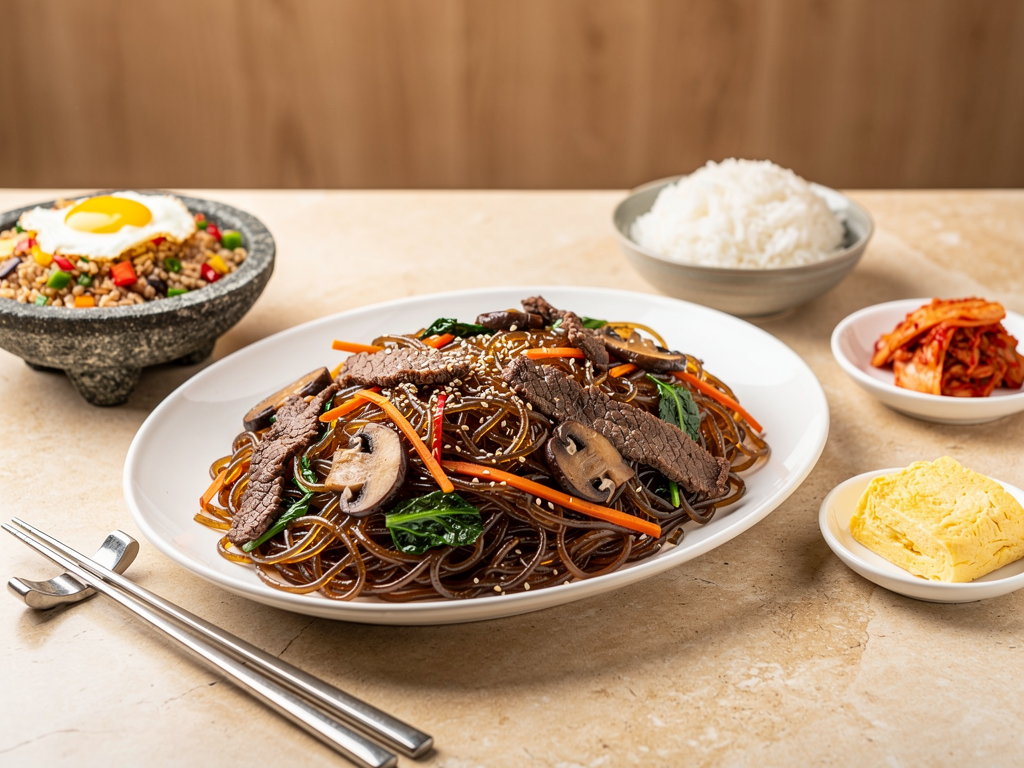
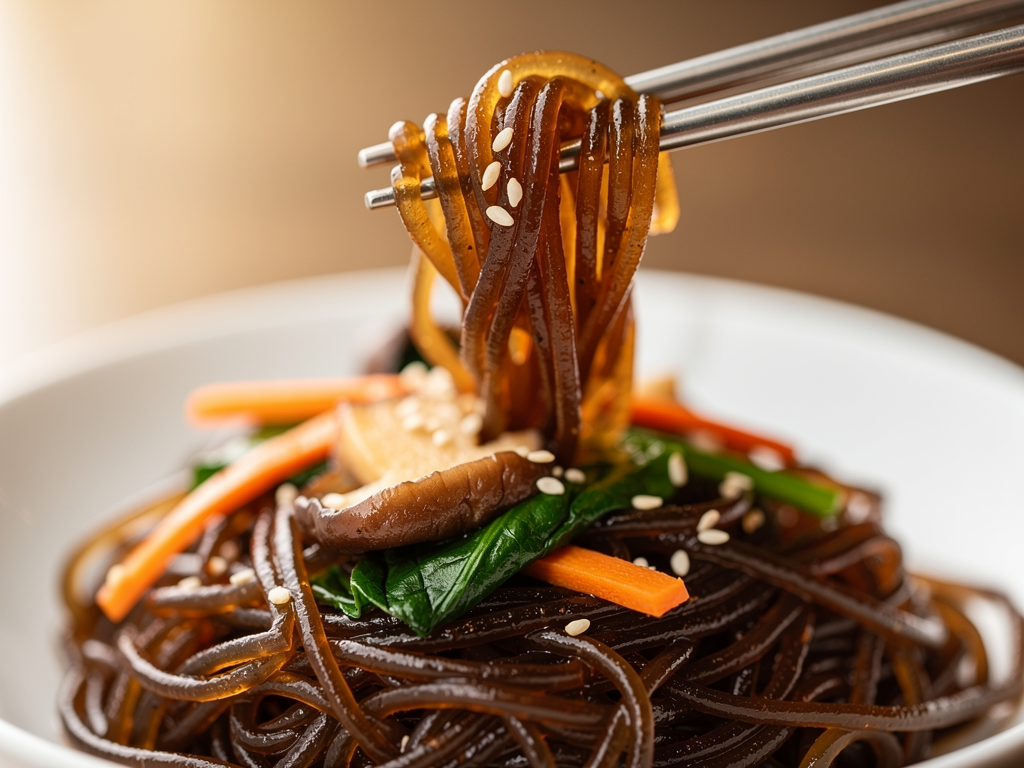
HYU Korean Restaurant in Cluster O, JLT prints it plainly. On the no-wheat side: Beef Japchae, “stir fried glass noodle with veg & bulgogi beef”, AED 70; Vegetable Japche, “stir fried glass noodle with veg”, AED 65; Galbitang, “beef short rib soup with glass noodle & radish”, AED 79; and Yookgaejang, “spicy beef soup with vegetables and glass noodles”, AED 79. Korean glass noodles — dangmyeon — are made from sweet potato starch. There is no wheat in the noodle.
On the wheat side the same menu is just as explicit: Bibimgooksoo, “spicy flour noodle with veg & spicy sauce”, AED 65, and Jjajangmyun, “stir fried flour noodle with savory sauce & veg”, AED 69. It also sells Egg Ramyun AED 60, Cheese Ramyun AED 65 and Seafood Ramyun AED 75, and offers “add noodles (ramyun)” at AED 20. Ramyun is a wheat noodle.
Then there is the one that catches people out. HYU lists Moolnaengmyun as “cold buck wheat noodle soup with veg”, AED 69. Buckwheat is not wheat despite the name — but commercial naengmyeon is very commonly blended, with buckwheat cut by potato or sweet potato starch and frequently by wheat flour as well, to get the elasticity the noodle is known for. Buckwheat on a Korean menu describes the flavour, not a wheat-free guarantee. If you take one correction away from this page, take that one.
Where does the wheat actually hide?
The noodle is the visible question and the easy one. These three are where wheat really gets into a Korean meal, and two of them are invisible on any menu.
Soy sauce. This is the big one. Most brewed soy sauce, Korean ganjang included, is made from soybeans and wheat, and it is everywhere: bulgogi and galbi marinades, japchae seasoning, braises, dipping sauces, the seasoning on stir-fried rice. It is why a glass-noodle japchae is still not a wheat-free dish. Wheat-free tamari-style soy sauce exists, but it is a specialist product and there is no reason to assume a restaurant kitchen is using it.
Gochujang. The fermented red chilli paste is built on soybean, chilli and glutinous rice — but many commercial gochujang recipes also include wheat flour or barley malt, and brands genuinely differ. So the tteokbokki sauce needs its own checkpoint even though the rice cake underneath it does not.
Fish cake and crab stick. The one nobody flags. Korean fish cake (eomuk) and imitation crab stick are processed surimi products, and wheat starch is a common binder in them. These are not obscure ingredients hiding in a back-of-house recipe — they are printed on the menu, in the middle of the most popular dishes. HYU lists “fish cake” in the filling of every kimbap it sells, from the basic Kimbap at AED 45 to Beef and Tuna Kimbab at AED 55, lists “crab bar” in several of them, and prints fish cake into both Ttukbokki AED 65 and Rabokki AED 65. Anyone scanning that menu for wheat reads straight past it.
What about pancakes, dumplings and stews?
Two more sit in plain sight on the same menu, and one of them the venue tells you itself. HYU prints “Egg is included in flour” under both its Seafood pancake AED 60 and its Kimchi pancake AED 55 — jeon is a flour batter, and the kitchen says so in writing. Its Budae-Jjigae AED 79.99 lists “ramyun” among the contents, which is a wheat noodle sitting inside a stew.
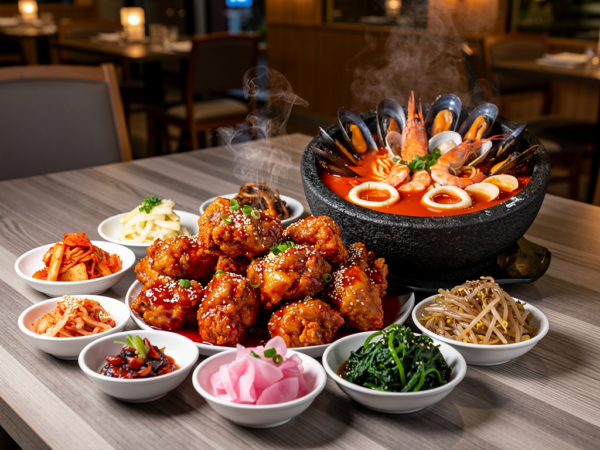
Mandu wrappers are wheat too, which is why Beef dumpling and Veg Dumpling at AED 45 are not the safe order they look like. And Korean fried chicken is battered and deep-fried, making it the least wheat-free thing on any Korean menu — worth stating plainly, because it is also one of the most ordered.
What is naturally wheat-free in Korean food?
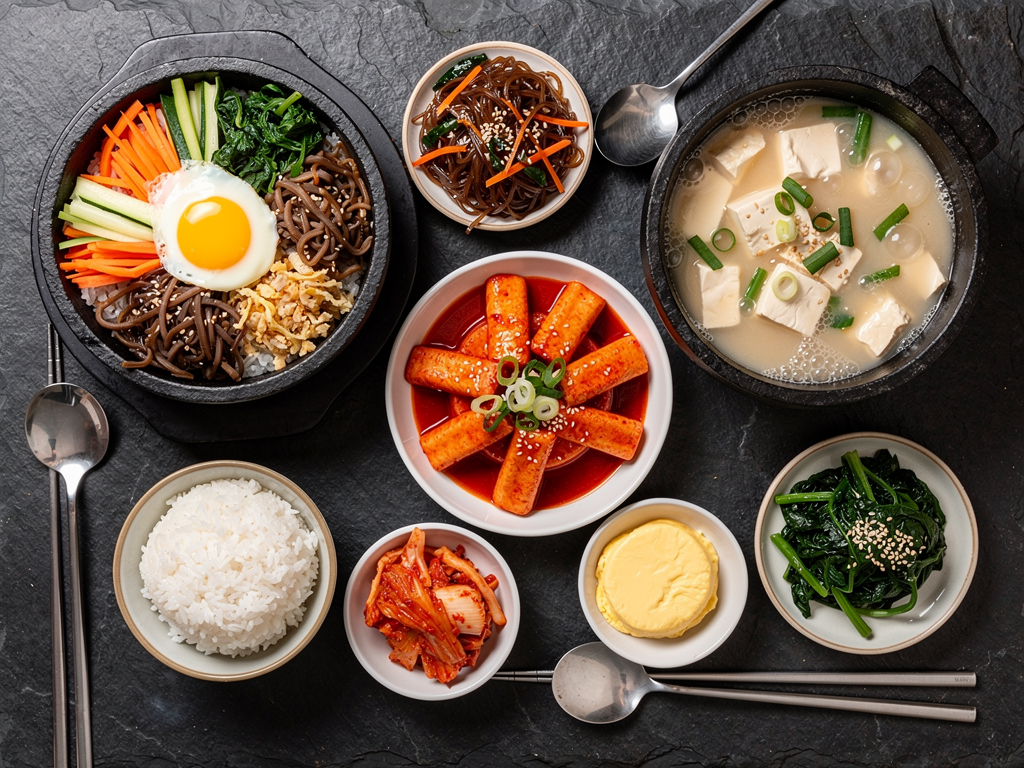
The encouraging half, and it is a long list by the standards of most cuisines. Wheat-free by construction, before seasoning: steamed rice; bibimbap and every rice bowl; bokkeumbap fried rice; tteok rice cakes, including the ones in tteokbokki; dangmyeon glass noodles; plain grilled beef and chicken; gyeran jjim steamed egg; Korean corn cheese; most stew bases including soondubu and kimchi jjigae; kimchi itself; and Korean shaved-ice desserts.
That is a wider starting point than a lot of people expect, and it is a direct consequence of rice being the staple grain. But it comes with a caveat that has to travel with it every time: seasoning is where the wheat comes back. A bowl of rice is wheat-free. A bowl of rice with a soy-based sauce stirred through it may not be.
Why is this harder in the UAE than the answer suggests?
Because there is no document to read. No Korean restaurant checked in the UAE publishes a per-dish allergen panel or a gluten-free menu. Deliveroo shows an “Allergens and more” link on HYU’s page, and it points the customer to contact the restaurant rather than publishing a breakdown. The gloss on the menu covers the noodle and nothing else.
The second reason is equipment. Korean BBQ is a shared-equipment format by design: shared grills, shared side-dish bowls, shared sauce containers, shared fryers for the fried items. Even a dish with no wheat in the recipe is prepared in a kitchen handling a great deal of it. For someone with coeliac disease that is a cross-contact problem no amount of menu-reading can solve.
So the honest bottom line is a split one. Korean food in the UAE is a strong cuisine for someone reducing wheat, and a hard one for someone who needs coeliac-grade certainty. The Celiac Disease Foundation explains what gluten actually is, and Coeliac UK covers what cross-contact means in practice — both are better guides to your own threshold than any restaurant page, this one included.
Which Korean restaurants in the UAE make this easiest?
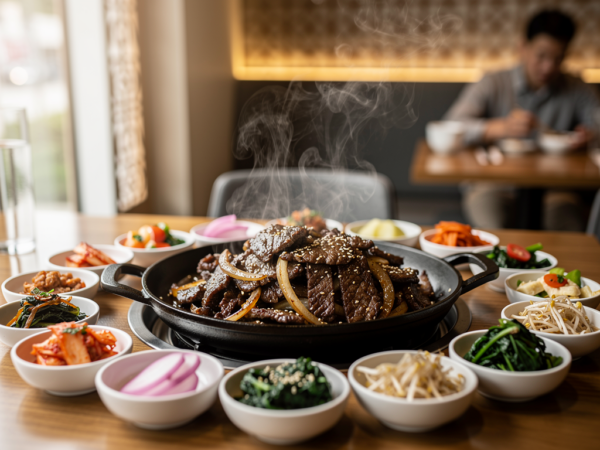
Mukbang Shows is the pick for a structural reason rather than a claim: it has the widest naturally wheat-free spread of any Korean menu in the country, so someone eating around wheat is choosing from most of the menu instead of the corners of it.
Before seasoning, that list runs Japchae AED 55 on sweet potato glass noodle, Bibimbap AED 53–62, Beef Dupbap and Bulgogi Dupbap AED 66, Fried Rice AED 45–51, Tteokbokki AED 55 and Rabokki AED 49 on rice cakes, Soondubu Jjigae AED 59, Doenjang Jjigae AED 59, Gyeran Jjim AED 39, Korean Corn Cheese AED 39, Kimchi AED 43–78 and Bingsu AED 37 — plus the grill itself, which is beef and chicken and fire.
The unlimited tiers put 7 BBQ kinds, 8 banchan, 2 gimbap, soup and rice on the table: Gangnam AED 69 (AED 79 at JBR and DWTC), Daegu AED 89 (99), Jeju AED 99 (109), Bukchon Hanok AED 129 flat. Minimum 2 persons, AED 60 leftover charge. Branches are Deira on Al Ittihad Road, JBR on The Walk, DWTC on Sheikh Zayed Road, and Muroor Road and Electra Street in Abu Dhabi.
The honest limitation, and it matters more than the list above. Mukbang publishes no allergen panel and no gluten-free menu, so everything here is a reading of how the dishes are built, not a guarantee from the kitchen. The marinades on the grill meats and the sauces on the rice dishes are soy-based, which puts them squarely in the soy-sauce question.
The unlimited format is shared-grill and shared-banchan by design, and the sets include 2 gimbap, which in most recipes carry fish cake or crab stick. For a diner with coeliac disease this is not a safe venue and should not be treated as one. It is a good venue for someone cutting wheat down rather than out. The two-person minimum also rules out a solo dinner.
HYU in Cluster O, JLT is the most useful menu in the country for this question, purely because it glosses its own starches — glass noodle, flour noodle, buckwheat — and prints its flour batters. Roughly AED 45–143 a dish, in a small no-frills room that queues at peak, à la carte only. No allergen panel. It also prints a clause worth knowing: “Side dishes are only included with appetizers if over 100 AED of appetizers are ordered.” Confirm halal meat sourcing directly.
Mashisoyo in Cluster G, JLT is cheap and casual at around AED 50 a head, heavy on bibimbap and rice dishes, which is the naturally wheat-free end of the menu. Delivery-led, and no allergen information published. It publishes a halal claim on its own site.
Shogun on the 3rd floor of Al Ghurair Centre Tower 2 in Deira is halal-certified all-you-can-eat Korean BBQ, roughly AED 69 for the lunch set and around AED 120 at dinner. Grilled meat and rice is the short-ingredient-list part of any Korean meal, though a menu spanning Korean, Japanese and Thai widens rather than narrows the shared-kitchen question.
Mannaland on Al Mina Road in Al Hudaiba is a long-running home-style kitchen, roughly AED 60–120 per person, with a stew-and-grill menu built on rice rather than noodles. Plain, dated room, à la carte only, no allergen information. Confirm halal meat sourcing directly.
HARU on Al Najda Street in Abu Dhabi, with a second location in Al Zeina, is the easiest first call in the capital for a rice-based Korean plate. Cafe-restaurant format; check current menu and hours.
DAK Korean Chicken on Al Reem Island is the honest counter-example. It states its chicken is 100% halal at source, AED 41–59 a dish — and Korean fried chicken is batter and shared fryers, so it is exactly the thing to avoid on this particular question.
What does it cost to eat around the wheat?
Less, if anything. The naturally wheat-free end of a UAE Korean menu is also the cheaper end: rice dishes and bibimbap run roughly AED 45–75 across the city’s Korean restaurants, glass-noodle japchae around AED 55–70, and steamed rice as little as AED 8, while the wheat-heavy items — ramyun bowls, jjajangmyeon, fried chicken and pancakes — sit in a similar or higher band.
| Venue | Area | Price AED | Wheat-free depth | Standout order |
|---|---|---|---|---|
| Mukbang Shows | Deira, JBR, DWTC, Muroor, Electra | 37–129 | Widest — rice, glass noodle, rice cake, grill | Japchae AED 55 or Bibimbap AED 53–62 |
| HYU | Cluster O, JLT | 45–143 | Good, and the only menu that labels its starch | Glass-noodle Japchae AED 70 |
| Mashisoyo | Cluster G, JLT | ~50 | Rice-led | Bibimbap |
| Shogun | Al Rigga, Deira | 69–120 | Grill and rice | Grilled meat and rice sets |
| Mannaland | Al Hudaiba | 60–120 | Rice and stews | Home-style rice stews |
| HARU | Al Najda and Al Zeina, Abu Dhabi | Confirm directly | Rice-led | Rice-based Korean plate |
| DAK Korean Chicken | Al Reem Island, Abu Dhabi | 41–59 | Lowest — batter and shared fryers | The counter-example |
How should I actually order?
Read the noodle gloss in the dish name first. Glass noodle, flour noodle or buck wheat noodle sorts the noodle section in seconds.
Treat buckwheat as a flavour, not a guarantee. Commercial naengmyeon is usually a blend and frequently includes wheat.
Ask about the soy sauce before you ask about the noodle. It is in far more dishes than any noodle is, and it is the single highest-yield question you can put to a kitchen.
Scan the printed fillings for fish cake and crab stick. They sit inside kimbap, tteokbokki and rabokki, and they are wheat-starch carriers hiding in plain text.
Skip anything described as a pancake or jeon. It is a flour batter, and some menus print that outright.
A plain grilled-meat-and-rice order is usually the shortest ingredient list on a Korean table — but the marinade is still a soy-sauce question, so it is a starting point rather than an answer.
And if you have coeliac disease, call before you go rather than asking at the table during a busy service. Shared grills and shared fryers are the norm here, and that is a conversation worth having when someone has time to have it.
Our guide to Korean noodles in Dubai names every noodle type and what it is made of, and the best japchae in Abu Dhabi covers the glass-noodle dish this question keeps landing on.
If you are weighing up the wider picture, we have also written on whether Korean food is healthy and whether Korean food is spicy, both answered the same way — off the menu itself.
FAQ
Is Korean food gluten free by default?
No. The core of rice, glass noodles, rice cakes and plain grilled meat starts without wheat, but soy sauce, gochujang and fish cake put it back into a great many dishes. Ask rather than assume.
Does “buckwheat noodle” mean wheat-free?
No. Buckwheat is not wheat, but commercial naengmyeon is usually blended and frequently includes wheat flour for texture. The menu word describes the flavour, not the full ingredient list.
Is japchae safe if the noodle is sweet potato starch?
The noodle is wheat-free by construction. The seasoning is soy-based, and most brewed soy sauce contains wheat, so the dish as served is a question for the kitchen.
Is gochujang always made with wheat?
No — brands genuinely differ. Some commercial recipes include wheat flour or barley malt and some do not, so the tteokbokki sauce is worth asking about specifically.
Do any Korean restaurants in the UAE publish gluten-free menus?
None of the venues checked publish an allergen panel or a gluten-free menu. Direct questions to the kitchen are the only route.
Can someone with coeliac disease eat safely at a Korean BBQ here?
Treat every Korean BBQ venue as unverified. Shared grills, shared banchan bowls, shared fryers and soy-based marinades make cross-contact the norm rather than the exception, and no venue here certifies otherwise.
Which single question gives me the most information?
“Is there soy sauce in this dish?” It appears in more Korean dishes than any noodle does, and the answer tells you more than anything printed on the menu.
The short version: Korean food gives you a bigger naturally wheat-free core than most cuisines, and then quietly puts the wheat back through the sauce bottle. Read the starch gloss, ask about the soy sauce, check the printed fillings for fish cake — and treat everything here as general information rather than a safety guarantee.
Related guides
More from our Korean food guides across the UAE: