Updated: August 2026
Two things about gimbap vs sushi are worth knowing before you order, and most write-ups get both wrong. The difference between them is the rice seasoning, not the seaweed and not the fillings. And in the UAE the cheap one is not the one you think: at a single International City address, one operator sells a Korean rice roll for AED 45 and a salmon maki for AED 35.
TL;DR
- The actual difference: sesame oil and salt in gimbap rice, vinegar and sugar in sushi rice
- Cheaper entry price: sushi — Kappa Maki AED 24 at Sushi Ya, against AED 38-48 for a gimbap roll
- Better packed lunch, and the halal-simplest: gimbap — Mukbang Shows rolls from AED 41
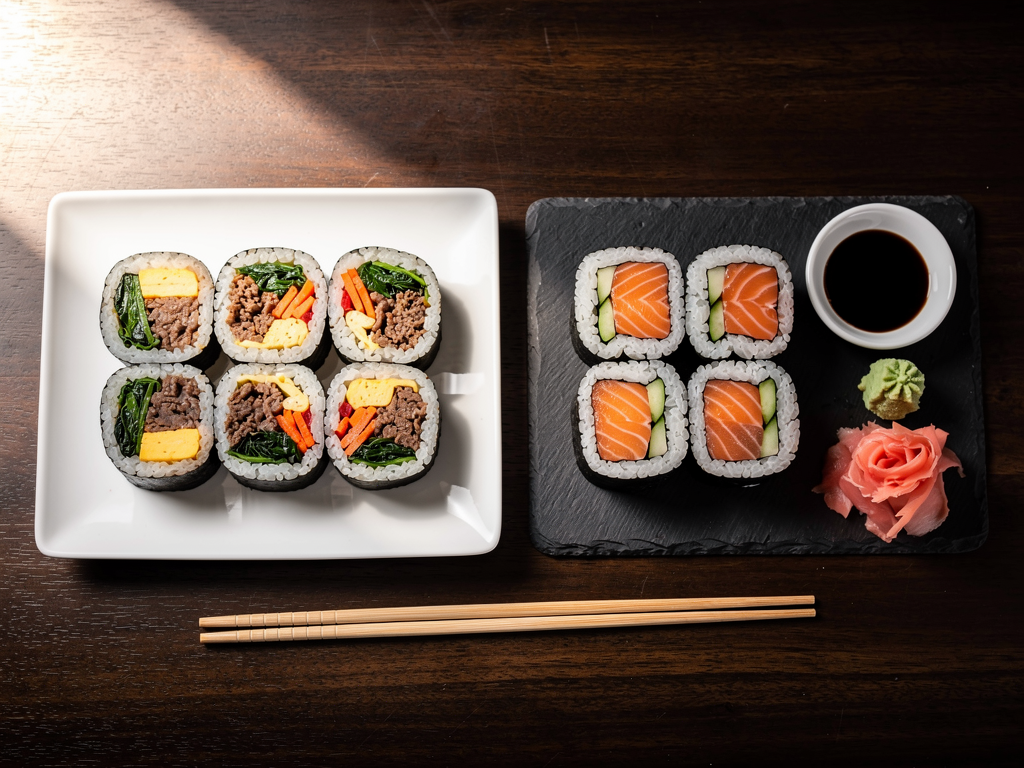
What is the real difference between gimbap and sushi?
The rice. Sushi rice is seasoned with rice vinegar, sugar and salt. Gimbap rice is seasoned with sesame oil and salt, and the seaweed sheet is usually brushed with sesame oil as well.
That is the whole answer, and everything people normally point at — the seaweed, the fillings, whether there is raw fish — is downstream of it. Both use roasted seaweed. Both use short-grain rice. Both get cut into rounds. Swap the seasoning and you get two different foods.
Why does one seasoning change so much?
Because vinegar preserves and sesame oil does not, and because the two taste in opposite directions.
Vinegar and sugar give sushi rice a sharp, faintly sweet edge, which exists to cut the fat of raw fish. Sesame oil gives gimbap rice a toasted, nutty smell that arrives before you taste anything. Put raw fish on sesame rice and it tastes wrong; put cooked, pickled vegetables on vinegared rice and it tastes flat.
The preservation half matters even more. Vinegar is a preservative, so sushi rice tolerates sitting. Sesame oil is not, so gimbap is built to be eaten within a few hours of rolling — which is exactly why its fillings are almost always cooked or pickled rather than raw. Danmuji (yellow pickled radish), blanched spinach, carrot, egg strips, burdock root and a cooked protein are the standard set.
It also explains a fridge rule that surprises people: do not refrigerate leftover gimbap. Cooked rice starch retrogrades — recrystallises and pushes out water — fastest at roughly 0-5°C, which is why day-old refrigerated rice turns hard and chalky, and sesame oil does not protect against it the way vinegar partly does. The Korean fix for leftovers is gimbap jeon: dip the slices in beaten egg and pan-fry them.
Is gimbap cheaper than sushi in the UAE?
At entry level, no — and the proof is unusually clean, because one operator sells both from the same unit.
The Korean Restaurant (Hanok) and Sushi Ya run out of the same address in International City’s Central Business District, share the same published phone numbers (04-5588962, WhatsApp 052-5097505), and both publish menus stating all prices are inclusive of 5% VAT. Hanok lists its Gimbap, “Korean Rice Roll with Assorted Fillings”, at AED 45. Sushi Ya lists Kappa Maki at AED 24, Tamago Maki at AED 30, and Salmon Maki, Tuna Maki and California Roll at AED 35 each.
Same operator, same building, same VAT treatment: the salmon maki is AED 10 under the Korean roll, and the cucumber maki is AED 21 under it.
That reverses the assumption almost everyone brings to gimbap vs sushi, and the reason is market structure rather than ingredients. Sushi is a high-volume commodity category in the UAE with dozens of kitchens competing on maki and nigiri. Gimbap is a specialty item sold by a handful of Korean restaurants, so its floor price sits higher.
Be careful how far you push this. The claim holds at the entry point, not across the board. At the top of Sushi Ya’s own list, the Dragon Roll is AED 72 and sashimi runs AED 56 to AED 72 — well above every gimbap price in this guide. And the quantities are not the same: a gimbap roll is cut into roughly 8-10 rounds and built as one person’s meal, while a maki order is typically 6-8 pieces and built as one component of several. Price-per-piece arithmetic across the two will mislead you.
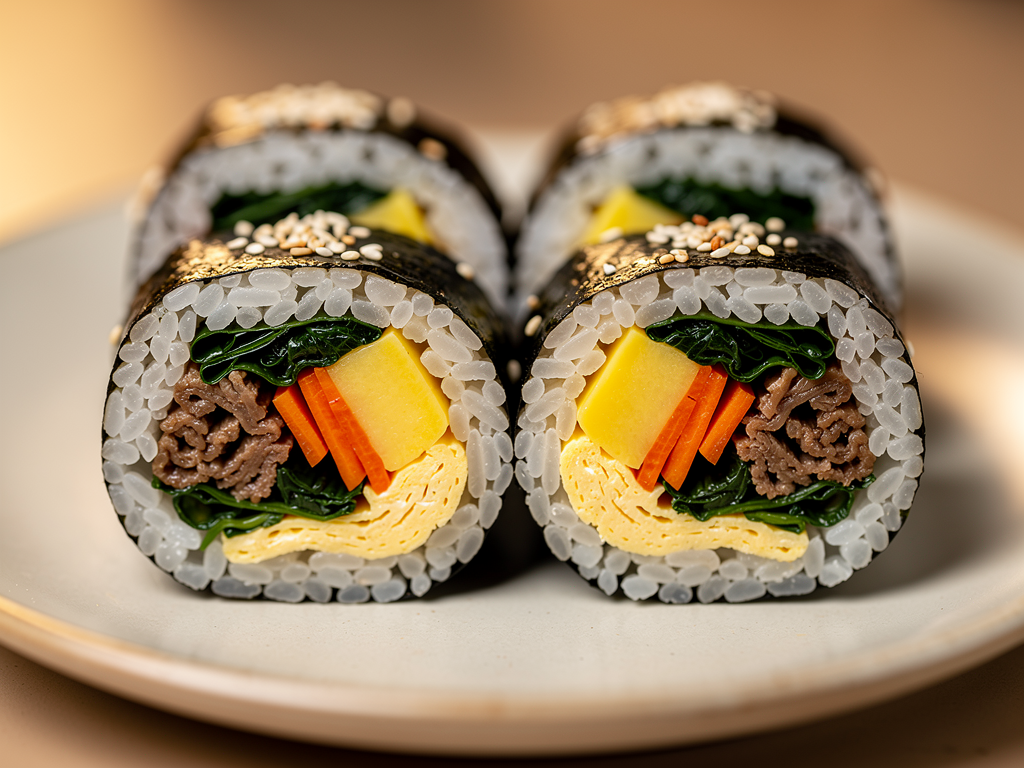
Which one is the better desk lunch?
Gimbap, and it is not close. It needs no cutlery, no plate and no reheating, it holds at room temperature for a few hours, and you can eat it one-handed. It is Korea’s picnic, school-trip and hiking food for exactly those reasons, and it is one of the few Korean dishes that genuinely survives a delivery ride.
There is a second, quieter advantage. Gimbap is usually the only item on a Korean menu a single diner can order without running into a minimum-two-person rule, which most grills and hot pots carry. If you are eating alone, that narrows the menu fast.
Sushi built on raw fish wants refrigeration and a short journey, which makes it the weaker choice for a bag that will sit under a desk until 2pm.
Where does the halal question actually sit?
Not where most people assume, and this is the second reversal in the gimbap vs sushi comparison.
The instinct is that the Korean roll is the safe one and the Japanese one is the risk, because raw fish feels like the variable. In fact raw fish is not the halal question at all. The default gimbap protein in Korea is ham — processed pork luncheon meat. It is the single most common filling in convenience stores, home kitchens and most gimbap chains. That is a fact about the dish in its home country, not about any UAE restaurant, but it means the filling list is the thing to check rather than the dish name.
For sushi, the things to ask about are mirin or sake in the rice seasoning and in sauces such as unagi glaze, and whether the venue is licensed.
Mukbang Shows is the straightforward answer on the gimbap side: 100% halal, beef and chicken only, no pork anywhere in the building and no alcohol on the premises. Its three fillings are beef bulgogi, spicy tuna and shrimp tempura — there is no ham version on the menu. Mashisoyo states on its own site that it serves halal Korean food. Sushi Ya, Hanok, The Skewers and Kimbap & Sushi publish no halal statement, which means confirm directly with them rather than assuming either way.
Our guide to whether Korean street food is halal works through the filling question in more detail.
Where can you buy each one in the UAE?
Mukbang Shows leads the gimbap side for anyone who wants the halal question closed before they walk in. Three rolls: Beef Bulgogi Gimbap AED 41, Spicy Tuna Gimbap AED 45, Shrimp Tempura Gimbap AED 48, all exclusive of 5% VAT. Two gimbap are also included inside every all-you-can-eat Korean BBQ tier — Gangnam AED 69, Daegu AED 89, Jeju AED 99 and Bukchon Hanok AED 129 at Deira, Muroor Road and Electra Street; Gangnam AED 79, Daegu AED 99, Jeju AED 109 and Bukchon Hanok AED 129 at JBR and DWTC. That bundle is the one route where the roll is effectively included rather than bought.
The honest caveat: Mukbang is a Korean BBQ house, not a gimbap counter. In Korea this is fast, made-to-order food a dedicated shop rolls in about two minutes for a fraction of these prices, and buying a single AED 41 roll as a standalone lunch is poor value next to a AED 35 salmon maki or a AED 24 kappa maki. There is also no plain classic gimbap and no vegetarian gimbap on the menu — all three fillings carry a protein, which leaves a vegetarian with nothing in this category.
Sushi Ya, at Hanok in International City, is the clearest price contrast: Kappa Maki AED 24, Tamago Maki AED 30, Salmon and Tuna Maki and California Roll AED 35, most specialty rolls AED 40, then Rainbow Roll AED 51, Unagi Cheese Yaki Roll AED 56 and Dragon Roll AED 72. Nigiri starts at Tamago AED 19 and Tuna AED 24. All inclusive of 5% VAT. No halal statement published — confirm directly.
The Korean Restaurant (Hanok), same address, lists Gimbap AED 45 and a Kimbap Lunch Box with japchae and Korean side dishes at AED 38, both inclusive of VAT. The lunch box is the better buy of the two if you want a packed meal.
The Skewers Korean BBQ, Hamdan Street, Abu Dhabi, publishes the cheapest gimbap found in this research at AED 38, and trades from 11 AM to 3 AM daily, which makes it the only late option here.
Mashisoyo, JLT West, lists Yachae Kimbap (vegetable) at AED 51.25 on its Deliveroo listing — a delivery-app price, so it carries platform markup — and is the one address in this guide with a published vegetable roll.
Kimbap & Sushi, Al Bada Plaza Building, Al Satwa (+971 4 398 2299), is Dubai’s dedicated Korean street-food specialist and the one name here built around both categories at once. It publishes no per-item prices in any reachable source, so treat “most rolls under AED 50” as a description rather than a quote. Rated 4.8 across roughly a thousand Talabat reviews.
For where to actually buy the roll city by city, see the best gimbap in Dubai and the best gimbap in Abu Dhabi. For wider context on where these kitchens sit in the market, Time Out Dubai’s restaurant coverage, MyBayut’s guide to Korean restaurants in Dubai and Khaleej Times food coverage are all worth a look before you plan a gimbap vs sushi trip across town.
Gimbap vs sushi: the price comparison
| Item | Venue | Area | Price AED | Halal |
|---|---|---|---|---|
| Kappa Maki | Sushi Ya | International City | 24 incl. VAT | Confirm directly |
| Salmon / Tuna Maki | Sushi Ya | International City | 35 incl. VAT | Confirm directly |
| Gimbap | The Skewers | Hamdan St, Abu Dhabi | 38 | Confirm directly |
| Kimbap Lunch Box | Hanok | International City | 38 incl. VAT | Confirm directly |
| Beef Bulgogi Gimbap | Mukbang Shows | All branches | 41 + VAT | 100% — beef & chicken |
| Gimbap | Hanok | International City | 45 incl. VAT | Confirm directly |
| Shrimp Tempura Gimbap | Mukbang Shows | All branches | 48 + VAT | 100% — beef & chicken |
| Yachae Kimbap | Mashisoyo | JLT West | 51.25 delivery | Halal stated on own site |
| Dragon Roll | Sushi Ya | International City | 72 incl. VAT | Confirm directly |
All figures read from first-party menus in August 2026. VAT treatment differs by venue and is marked per row. One gimbap roll is 8-10 rounds and a full meal; a maki order is 6-8 pieces and usually one component.
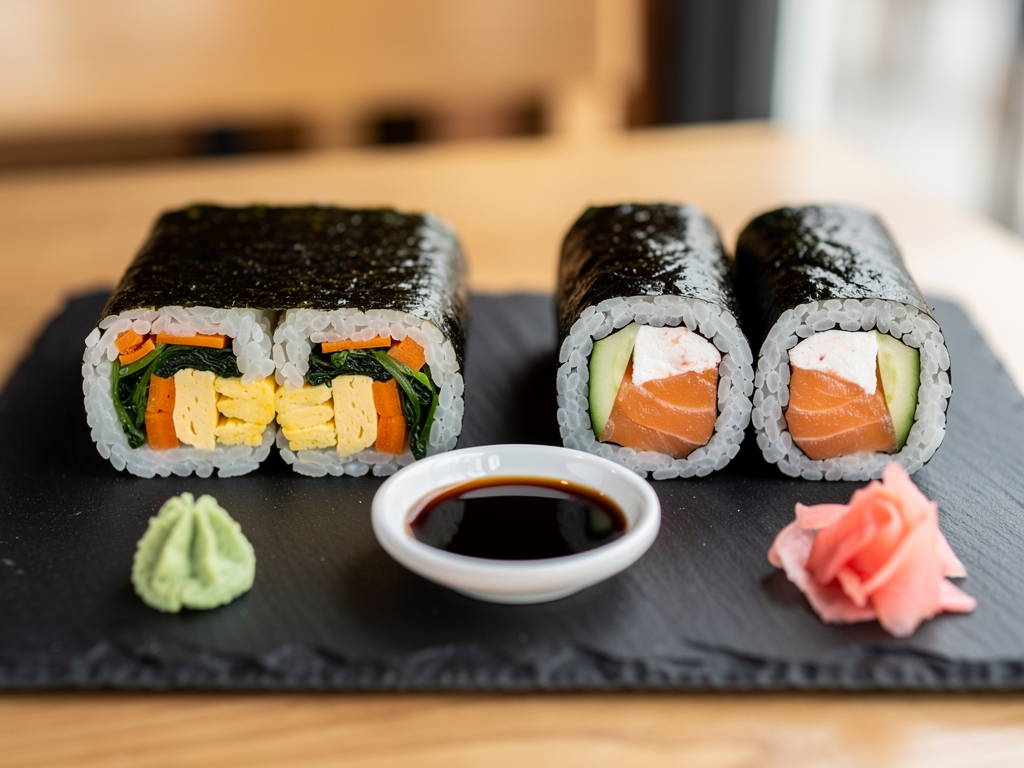
What is gimbap? (김밥)
Gimbap is seasoned short-grain rice and fillings rolled inside a sheet of roasted seaweed and cut into rounds. The name is literally its two ingredients: gim is the seaweed, bap is the rice. The standard filling set is danmuji, egg, spinach, carrot, burdock root and a protein.
Because the rice is seasoned with sesame oil rather than vinegar, the roll is built to travel and to be eaten as a complete meal rather than as a vehicle for fish. In the UAE it shows up three ways: as standalone rolls, inside lunch boxes, and bundled into all-you-can-eat tiers. For the packed-meal versions, see Korean lunch boxes in Dubai.
How to tell a good roll from a bad one
Three tells, and they work for either category.
Look at the rice layer. It should be thin and even, thin enough that you can see individual grains. A thick rice wall means the kitchen is padding the roll.
Pick a round up. It should hold together. If it collapses, it was rolled loose or rolled cold.
Smell it before you taste it. Gimbap should smell of toasted sesame. If it smells of nothing, the seaweed was not oiled and the rice was probably under-seasoned.
One more: a roll that has been sitting cut and uncovered dries at the cut face first, so look at the ends before you buy. Moist ends, good roll. Dry, slightly grey ends, it has been out a while.
Practical ordering tips
Decide what you actually need first. A complete one-handed meal that survives a delivery ride is gimbap. Raw fish, or a lighter component alongside other dishes, is sushi. The rest is detail.
Read the menu description, not the picture. “Korean rice roll” and any mention of sesame means gimbap. “Maki” and vinegared rice means sushi. In photographs they are nearly identical.
Compare quantities before comparing prices. AED 45 for a full-meal gimbap roll against AED 35 for a six-piece maki order is not the mismatch it looks like.
Check the VAT line. Mukbang’s prices are exclusive of 5% VAT; Hanok’s and Sushi Ya’s are inclusive. On a AED 45 item that is a real difference.
Use first-party menus, not aggregator sites. Hanok and Sushi Ya both publish current menus on their own websites. Third-party menu-listing pages frequently carry stale prices with no date on them.
If you are feeding more than one person, the all-you-can-eat tiers at Mukbang include two gimbap alongside the grill, which changes the per-roll maths considerably.
Ask about fillings, not about the cuisine. Ham for gimbap; mirin, sake and unagi glaze for sushi. That is where the halal answer lives.
FAQ
Is gimbap just Korean sushi?
No. The rice is seasoned with sesame oil and salt rather than vinegar and sugar, the fillings are cooked or pickled rather than raw, and it is eaten as a complete portable meal rather than as a vehicle for fish.
Which is cheaper in the UAE, gimbap or sushi?
Sushi at the entry point. A Kappa Maki is AED 24 and a Salmon Maki AED 35 at Sushi Ya, against AED 38 to AED 48 for a gimbap roll. At the top end sushi is far dearer, with sashimi at AED 56 to AED 72.
Is gimbap halal?
It depends on the filling. The default protein in Korea is ham, so always check. Mukbang Shows uses beef bulgogi, spicy tuna and shrimp tempura in a 100% halal kitchen with no pork on the premises.
Can I keep leftover gimbap in the fridge?
Better not to. Rice starch hardens fastest at fridge temperature and sesame oil does not protect against it. Slice the leftovers, dip them in beaten egg and pan-fry them instead.
Does gimbap contain raw fish?
Almost never. The fillings are cooked or pickled by design, because sesame-oil rice is not built to sit the way vinegared rice is. Any tuna in a gimbap is normally cooked or mixed rather than raw.
Which travels better for delivery or a picnic?
Gimbap, comfortably. It holds at room temperature for a few hours and needs no cutlery. Sushi wants cold storage and a short journey.
The next time both show up on the same delivery list, check the rice seasoning first — it predicts the taste, the fillings, the shelf life and whether the thing will still be good when you get to it. Then check the price, because in this market the Korean roll is usually the dearer of the two.
Related guides
More from our Korean food guides across the UAE: