Updated: August 2026
Jajangmyeon vs jjampong comes down to sauce versus soup. Jajangmyeon is a thick, sweet-savoury black bean sauce stirred into wheat noodles, with no chilli in it at all. Jjampong is a fiery red seafood noodle soup. Same restaurants, same cooks, opposite moods — and in the UAE, roughly the same five kitchens.
TL;DR
– Not spicy, travels well, cheaper: jajangmyeon
– Spicy, seafood, one big bowl to yourself: jjampong
– Both on one menu at published prices: Mukbang Shows — AED 55 and AED 60 solo / AED 99 sharing
– Cheapest published: jajangmyeon AED 38 at The Skewers, jjampong AED 53 at Manna Land
Jajangmyeon vs jjampong: what is the actual difference?
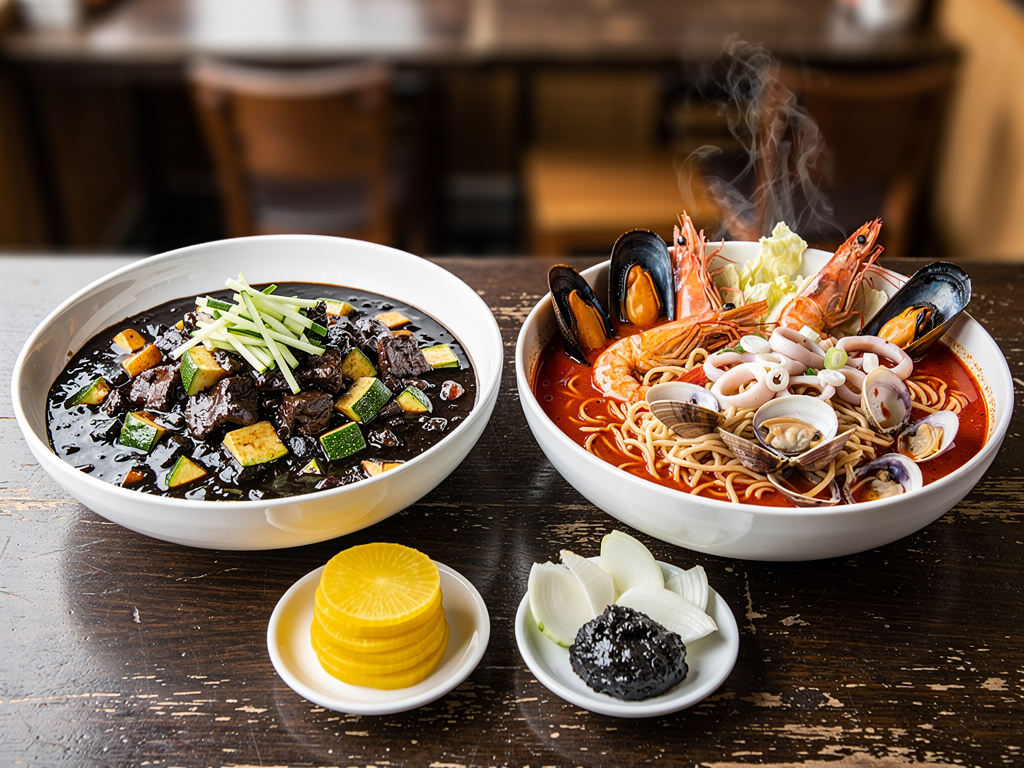
Jajangmyeon is noodles under a thick black bean sauce, stirred hard before eating, sweet-savoury and not spicy. Jjampong is noodles sitting in a red chilli-and-seafood broth, eaten with a spoon as much as chopsticks. One is a sauce dish, the other is a soup.
What they are not is rivals from different worlds. They are two halves of one cuisine, and a kitchen that has one nearly always has the other. Choosing is a mood question, not a quality question — which is exactly why Korea has argued about it for a century.
| Aspect | Jajangmyeon | Jjampong |
|---|---|---|
| Colour | Glossy black-brown | Bright red |
| Base | Chunjang black bean paste, fried in oil | Gochugaru and dried chilli bloomed in oil |
| Heat | None | Properly hot |
| Seafood | Usually none | Squid, mussels, prawns, clams |
| Format | Thick sauce stirred into noodles | One large soup bowl per person |
| Sharing | Easy — it is a sauce | Awkward — the broth cools once split |
| Delivery | Survives; sauce often packed apart | Softens; noodles keep drinking the broth |
| Who it suits | Kids, anyone chilli-averse, delivery | Heat seekers, seafood eaters, cold days |
| Typical UAE price | AED 38–60 | AED 53–78 |
What is jajangmyeon? (짜장면)
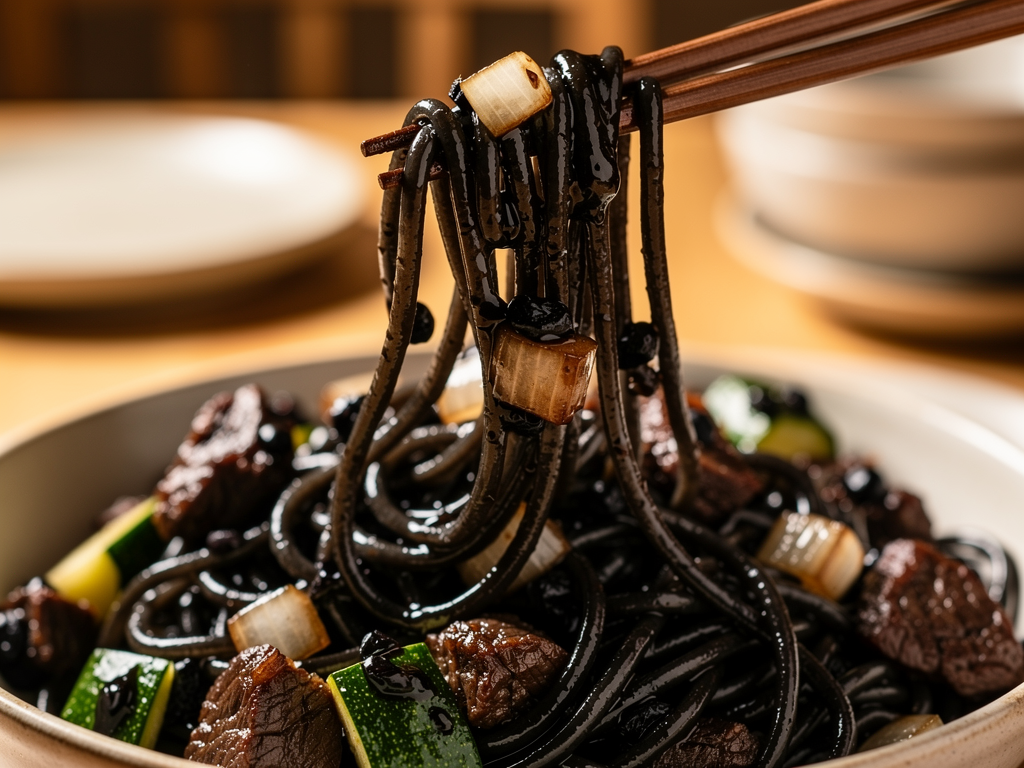
Jajangmyeon is wheat noodles under a thick, glossy dark sauce built on chunjang, a Korean black soybean paste. The chunjang gets fried in oil before anything else goes into the pan, because raw chunjang is bitter, and frying it is what turns it sweet and savoury. That one step is the whole dish.
The sauce carries diced onion, potato or courgette and a meat, thickened with a starch slurry so it coats the noodles rather than pooling under them. It arrives unmixed and you stir it hard at the table before the first bite. There is no chilli in it anywhere.
The canonical recipe uses diced pork, usually pork belly, rendered into the oil at the start so the fat carries the chunjang. In the UAE, halal kitchens make it with beef, chicken or seafood instead, and the swap works because most of the flavour is coming from the fried paste rather than the meat. If you are ordering somewhere you have not checked, asking which meat is in the sauce is the entire halal question for this dish.
What is jjampong? (짬뽕)
Jjampong is a spicy Korean-Chinese noodle soup: wheat noodles in a red broth loaded with seafood and vegetables. The red comes from gochugaru and dried chillies bloomed in hot oil at the start of the cook, and the standard seafood line-up is squid, mussels, prawns and clams.
It is built as one large bowl per person rather than a sharing dish, and it is eaten with a spoon as much as with chopsticks. Its ancestry runs through the same Incheon Chinese kitchens as jajangmyeon, and it shares a family tree with Japan’s Nagasaki champon.
The heat is worth describing properly because it is not the heat people expect. It is chilli-oil heat — sharp at the front, fading fast — rather than the deep fermented burn of a kimchi stew. That makes a bowl of jjampong easier to finish than its colour suggests.
Which one should you order?
Order jajangmyeon if anyone at the table does not do chilli, if children are eating, if you want the cheaper bowl, or if the food is going in a car. The thick sauce is the most delivery-proof Korean noodle dish there is, and it is one of the most-ordered delivery foods in Korea for exactly that reason.
Order jjampong if you want heat, if you want seafood, if it is a cold or miserable day, or if you want one big bowl that belongs entirely to you. It is also the better order when you are hungry rather than peckish — a full bowl of broth, noodles and shellfish is a heavier meal than the sauce dish.
If the table genuinely cannot decide, the Korean solution is 짬짜면 (jjamjjamyeon), a divided bowl with one on each side. It is common in Korea and effectively absent from UAE menus, so the practical local version is two people ordering one of each and swapping halfway. Order tangsuyuk to share alongside and you have the standard Korean-Chinese table.
Why does jjampong always cost more?
Because seafood costs more than onion and black bean paste, and every UAE menu that publishes both prices shows the same gap. At The Skewers in Abu Dhabi, jajangmyeon is AED 38 and jjampong is AED 70, with a lobster version at AED 78. At Mukbang Shows, jajangmyeon is AED 55 and jjampong is AED 60 solo or AED 99 in the sharing size.
The gap runs roughly AED 5 to AED 30 depending on how much shellfish goes in the bowl. It is the cleanest way to sanity-check a menu you have never seen: if a kitchen prices its jjampong at or below its jajangmyeon, the seafood load is probably light, and it is worth asking what is actually in it.
The rule that predicts where you can find either dish
Here is the thing nobody writing about Korean food in the UAE says out loud: a kitchen either carries the whole Korean-Chinese family — jajangmyeon, jjampong and tangsuyuk — or it carries none of it.
That is not a stylistic choice, it is equipment. The family needs a wok section, a stock of chunjang that gets used often enough to stay good, and a noodle station. A Korean grill house built around tabletop BBQ has none of those things, which is why you can find bibimbap in twenty places across Dubai and this pair in roughly five.
The rule also predicts the future map. Any new Korean-Chinese specialist that opens will add tangsuyuk in the same week it adds these noodles, and any grill-only venue advertising just one of the pair is worth a phone call before you drive there.
Where can you eat both in the UAE?
Mukbang Shows carries both at all five branches, with published prices: Jajangmyeon AED 55, Jjampong AED 60 solo or AED 99 sharing, and Chicken Tangsuyuk at AED 59 to complete the set. Related noodles run Japchae AED 55, Bibimguksu AED 48 and Fried Rice AED 45–51. The branches are on Al Ittihad Road in Port Saeed, Deira; The Walk at JBR; Sheikh Zayed Road at DWTC; and Sultan Bin Zayed The First Street and Zayed The First Street in Al Danah, Abu Dhabi. Call +971-4-886-4494 (Deira), +971-54-523-1898 (JBR), +971-54-524-5904 (DWTC), +971-50-158-9433 (Muroor Road) or +971-2-564-0446 (Electra Street).
The honest limitation: Mukbang is a Korean BBQ and seafood house that also runs the Korean-Chinese noodles, not a dedicated jjajang house. If you want four different black-bean variants on one menu — minced beef, seafood, vegetable — a specialist has a deeper list. What Mukbang has is both dishes at published prices in five locations across two cities, which almost nobody else here manages.
The Skewers Korean BBQ, Hamdan Street, Abu Dhabi, publishes the cheapest jajangmyeon in the country at AED 38, with jjampong at AED 70 and a lobster version at AED 78. Open to 3AM daily, which makes it the late option for either dish. It is a casual street-food room rather than a specialist kitchen, and halal status is not independently verified — confirm directly.
The Korean Restaurant (Hanok, by Manna Land), Indigo Spectrum 1, International City, Dubai, is the closest thing the emirate has to a dedicated Korean-Chinese kitchen. It carries several black-bean variants alongside jjampong and tangsuyuk — exactly the set a proper wok section produces — and it is where the local Korean community goes for these two specifically. International City is awkward without a car, the room is small and often busy, and no prices are published; listings estimate AED 150–180 for two. Ask which meat is in the sauce.
Manna Land Korean Restaurant, Al Muroor Road, Abu Dhabi, publishes Jjambong at AED 53 — the lowest listed price for the spicy bowl in the capital — as part of the only fully priced Korean menu in the city, with prices inclusive of 5% VAT. No jajangmyeon price appears on the same menu, so ask. It closes at 11PM. Confirm halal status directly.
Seoul Garden, Al Karama, Dubai, is one of the city’s older Korean kitchens, with noodle bowls and hot pots alongside tabletop grills. The room is dated and the Korean-Chinese section is narrower than a specialist’s. No prices published; confirm both the menu and halal status directly.
Hyu Korean Restaurant, JLT, Dubai, serves one of the most photographed jjampong bowls in the city, udon-style, from a small family-run room on the Marina side. Listings describe it as not serving alcohol. No published prices, and a narrower noodle range than a specialist. Confirm the current menu directly.
The Taste of Korea, Al Wahda Mall Extension and the Cristal Hotel on Electra Street, Abu Dhabi, publishes unlimited tiers at AED 39 to AED 79 rather than dish prices. Individual noodle availability is not published, so check before assuming either dish is on the tier. Confirm halal status directly.
Price comparison
| Venue | Area | Jajangmyeon (AED) | Jjampong (AED) | Notes |
|---|---|---|---|---|
| Mukbang Shows | 5 branches, Dubai + Abu Dhabi | 55 | 60 solo / 99 sharing | Both published everywhere; halal, beef and chicken only |
| The Skewers | Hamdan Street, Abu Dhabi | 38 | 70 (78 lobster) | Cheapest published jajangmyeon; open to 3AM |
| Manna Land | Al Muroor Road, Abu Dhabi | Not published | 53 | Cheapest published jjampong in the capital |
| The Korean Restaurant (Hanok) | International City, Dubai | Not published | Not published | Deepest Korean-Chinese list; ~AED 150–180 for two |
| Seoul Garden | Al Karama, Dubai | Not published | Not published | Long-standing all-rounder; ~AED 170 for two |
| Hyu | JLT, Dubai | Not published | Not published | Known for its jjampong; no published prices |
| The Taste of Korea | Al Wahda Mall + Electra St, Abu Dhabi | Not published | Not published | Unlimited tiers AED 39–79 instead |
Are jajangmyeon and jjampong halal in the UAE?
The pork question belongs to the traditional recipe, not to any restaurant in this country. Classic jajangmyeon is built on pork belly, and some jjampong broths use a pork stock — that is a fact about the dishes as they are made in Korea.
In practice, UAE kitchens serving a Muslim-majority market build both with beef, chicken or seafood. Mukbang Shows is 100% halal across all five branches, beef and chicken only, with no pork and no alcohol anywhere, so the sauce and the broth are both pork-free by policy.
Anywhere you have not checked, the two questions that settle it are: which meat is in the black bean sauce, and what is the jjampong broth made from. Ten seconds each, and they remove the only real variable. Neither question implies anything bad about a venue — it is the same thing Korean diners ask.
What to order alongside them
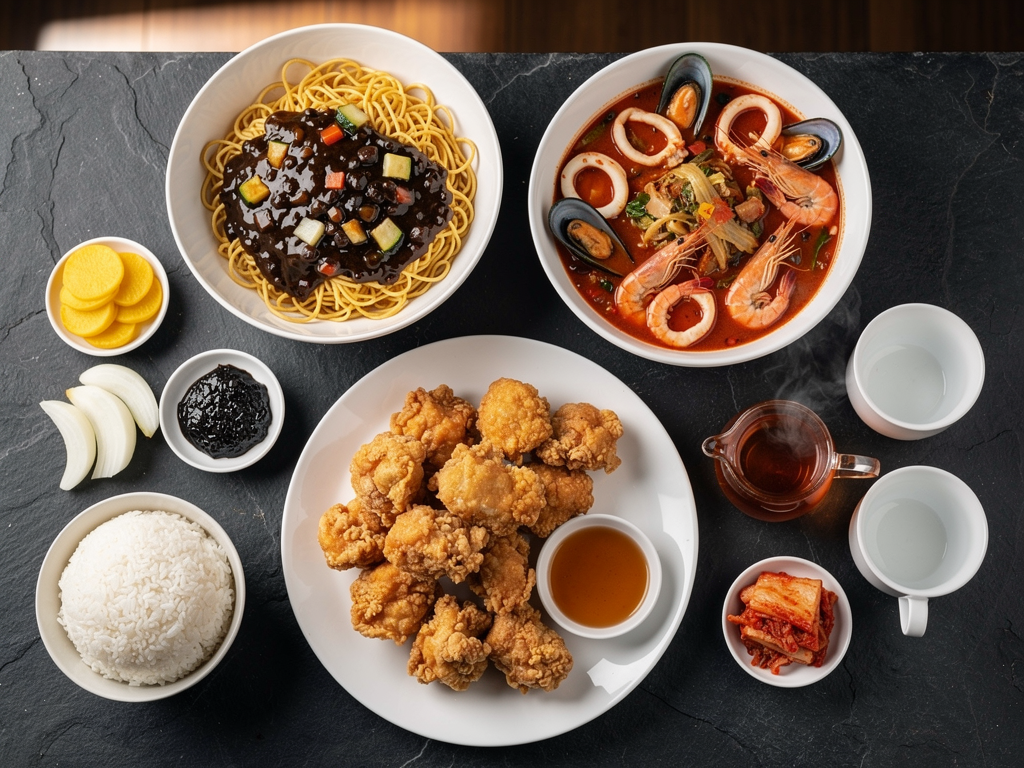
Tangsuyuk is the third member of the family and the traditional companion, especially when two people split one of each noodle. Mukbang’s version is Chicken Tangsuyuk at AED 59.
The standard sides in Korea are danmuji — yellow pickled radish — and raw onion wedges with a dish of chunjang to dip them in. Both cut the richness, and the onion in particular does more for a heavy black bean bowl than anything you could order instead.
With jjampong, the useful move is rice rather than a starter. A bowl of broth that good is worth stretching, and rice at the end is what Korean diners do with it.
Where to find jajangmyeon vs jjampong across the UAE
The map follows the equipment rule. In Dubai, the options cluster in Deira and Port Saeed, JBR, DWTC on Sheikh Zayed Road, International City, Al Karama and JLT. In Abu Dhabi, they sit along Hamdan Street, Al Muroor Road and Electra Street.
Deira is the easiest starting point for visitors, with Mukbang on Al Ittihad Road near the hotel cluster. International City has the deepest Korean-Chinese menu but needs planning, because public transport out there is limited. Abu Dhabi has no metro, tram or rail at all, so every venue in the capital is a car or a taxi.
Practical ordering tips
- Decide by chilli tolerance first. If anyone at the table avoids heat, jajangmyeon is the default and nobody has to be brave.
- For delivery, order jajangmyeon. The sauce is often packed separately and the noodles stay firm; jjampong noodles keep absorbing broth the entire journey.
- Ask which meat is in the sauce anywhere you have not checked before. It is a normal question, not an awkward one.
- Split one of each when there are two of you, and add tangsuyuk. That is the standard Korean order and it solves the argument.
- Ask for extra danmuji and raw onion. They are standard, they are cheap, and they change how a heavy bowl eats.
- Stir jajangmyeon properly — all the way to the bottom of the bowl — before the first mouthful. Under-stirred, the top is sauce and the bottom is plain noodles.
FAQ
Which is spicier, jajangmyeon or jjampong?
Jjampong, by a wide margin. Jajangmyeon has no chilli in it at all, while jjampong gets its colour and heat from gochugaru and dried chilli bloomed in oil. The heat is sharp and fades quickly.
Which is more popular in Korea?
They are argued about as a pair rather than ranked, which is why the phrase 짜장면이냐 짬뽕이냐 exists. Jajangmyeon is one of the country’s most-ordered delivery foods, largely because it survives the journey.
Can you get a half-and-half bowl in the UAE?
Jjamjjamyeon, the divided bowl, is common in Korea and effectively absent from UAE menus. Order one of each between two people and swap halfway instead.
Is jajangmyeon sweet?
Yes, noticeably. Frying the chunjang before anything else goes in the pan is what removes its bitterness and brings out the sweetness, which is what separates it from its drier Chinese ancestor.
Does jjampong always contain seafood?
The classic bowl is built on squid, mussels, prawns and clams. Some kitchens run meat or vegetable versions, so if you need one, ask rather than assume — it is not a standard listing.
Which one is better for delivery?
Jajangmyeon. The sauce is thick and frequently packed apart from the noodles. A jjampong bowl leaves the kitchen right and arrives soft, because the noodles never stop drinking the broth.
For wider context, Time Out Dubai’s roundup of Korean restaurants in the city, Time Out Abu Dhabi’s guide to Korean restaurants in the capital and MyBayut’s Abu Dhabi Korean restaurant guide all map the venues by area.
For city-level rankings we keep separate guides to the best jjampong in Dubai and jajangmyeon in Abu Dhabi, plus a full jjampong explainer and a comparison of how jjampong stacks up against budae jjigae.
Jajangmyeon vs jjampong is a mood decision dressed up as a debate: thick savoury noodles on one side, spicy seafood soup on the other, both from the same kitchen family. Learn which mood each one answers and you will never need to read a Korean-Chinese menu twice.
Related guides
More from our Korean food guides across the UAE: