Updated: July 2026
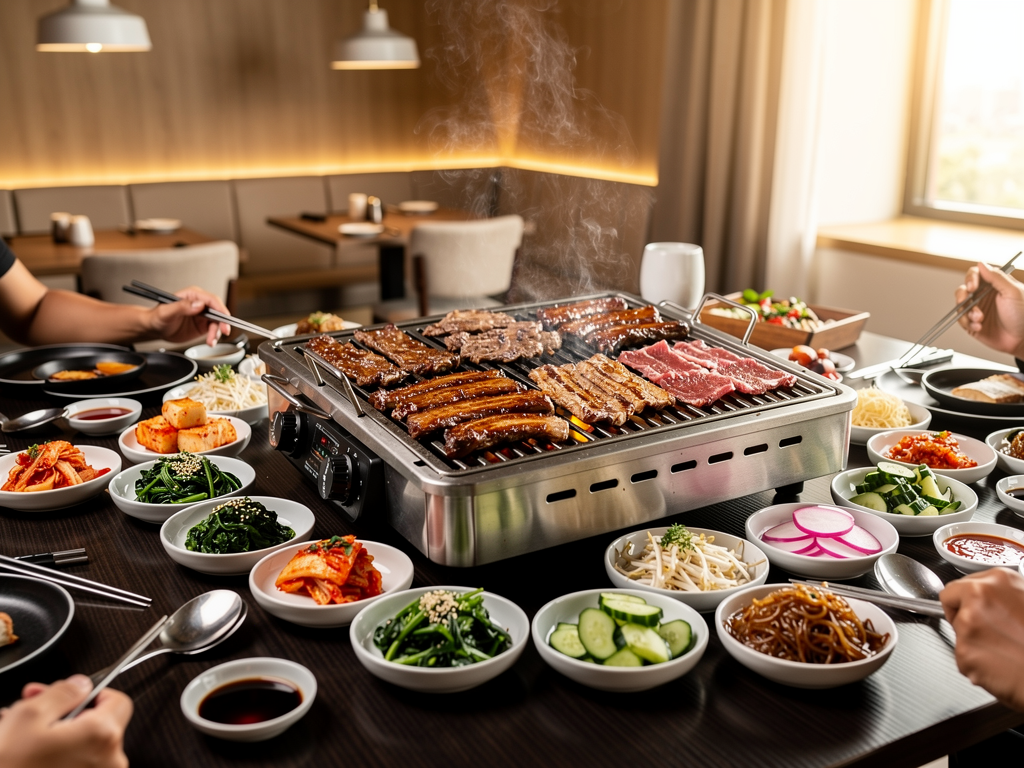
Is Korean BBQ halal? Not by default. The Korean original is built around pork, and traditional marinades often contain rice wine. It becomes halal when a restaurant grills only halal-sourced beef and chicken, keeps alcohol out of the marinade, and runs a pork-free kitchen — which is how several UAE grill rooms operate, starting at AED 69.
TL;DR – Best overall: Mukbang Shows, Deira — pork-free kitchen, AYCE from AED 69 – Best value: The Skewers, Abu Dhabi — unlimited grill advertised at AED 59 – Best quiet option: HYU, JLT — small alcohol-free room, a la carte
Is Korean BBQ halal?
Not automatically, and anyone telling you otherwise is skipping the details. Korean BBQ is halal only when three things are true at once: the beef and chicken come from a halal source, no alcohol goes into the marinade, and the kitchen does not also handle pork.
That combination is rare in Korea and common in the UAE. Dubai and Abu Dhabi now have several Korean grill rooms that carry no pork at all and serve nothing alcoholic, which turns a question that needs research in Seoul into a non-question here.
The rest of this guide covers what actually disqualifies a Korean BBQ meal, which cuts are safe, the marinade question almost nobody asks, and where to eat. For the wider cuisine — stews, noodles, banchan — see the guide to whether Korean food is halal.
Why isn’t all Korean BBQ halal?
Four things, and they are structural rather than accidental.
Pork is the default cut. In Korea, samgyeopsal (pork belly) is the single most-ordered grill item, with moksal (pork collar) and hangjeongsal (pork jowl) close behind. Beef is treated as the expensive upgrade, not the standard. A Korean BBQ menu written for Seoul will lead with pork.
Alcohol goes into the marinade. Classic galbi and bulgogi marinades are soy sauce, sugar, garlic, sesame oil and grated pear or onion — but a great many recipes and commercial marinades also include mirin or cheongju, both rice wines, for sweetness and tenderising.
The drinking culture sits at the table. Soju, makgeolli and beer are the traditional pairing with grilled meat, so a large share of Korean BBQ rooms worldwide hold alcohol licences.
Equipment is shared. In a kitchen that grills both pork and beef, the same grill plate, tongs and scissors can move between them. That matters to strict diners even when the beef itself is halal-sourced.
Remove all four and Korean BBQ is halal. That is exactly what the dedicated halal operators here have done.
Which Korean BBQ cuts are halal?
Almost all the beef and chicken ones, assuming halal sourcing. The safe roster covers bulgogi, LA galbi short ribs, chadolbaegi brisket, deungsim ribeye, ansim tenderloin, striploin, wagyu and marinated chicken.
The cut worth knowing about is woo samgyeop — beef belly, sliced the same way as pork belly and grilled the same way. It is the direct stand-in for samgyeopsal, and it is why a halal Korean BBQ table does not feel like it is missing something.
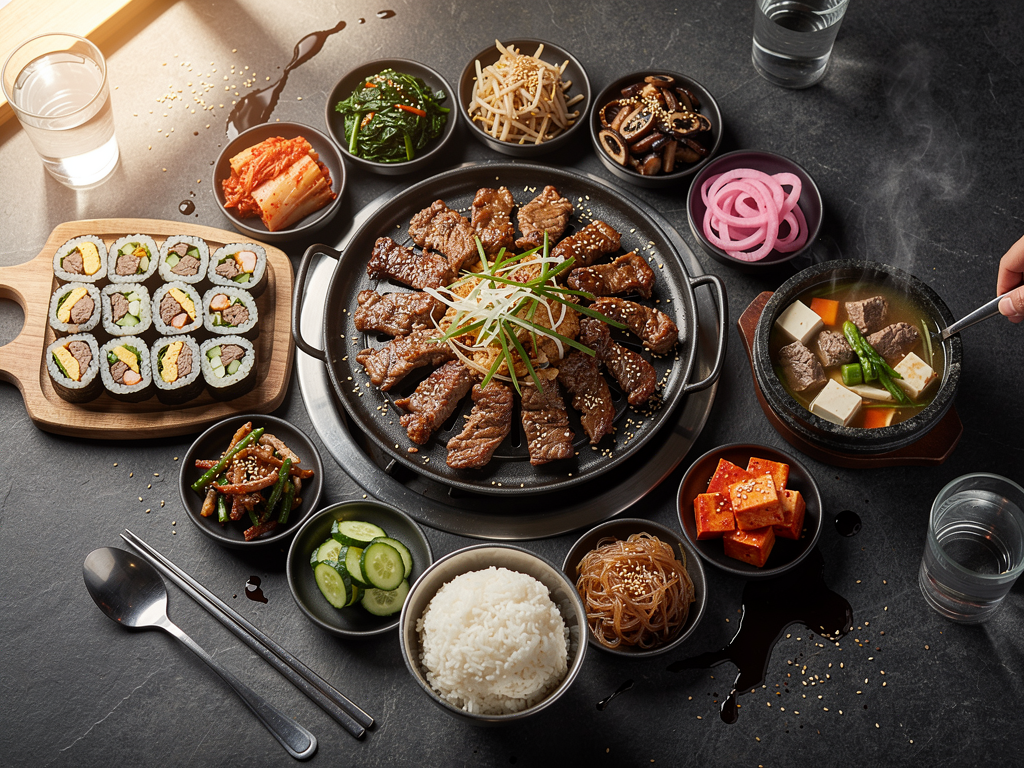
Everything around the grill is fine too. The banchan spread of kimchi, pickled radish, seasoned bean sprouts and spinach, the ssam lettuce wraps, ssamjang, the sesame-oil-and-salt dip, rice, soups and japchae all sit inside halal rules, provided the kitchen confirms no alcohol is used in any sauce. Korea.net has covered the push to make Korean food halal as the cuisine has gone global.
Which Korean BBQ items should Muslims avoid or check?
Samgyeopsal and every other pork cut, obviously — pork belly, pork collar, pork jowl, and any combo set that quietly includes them. Read the set contents, not just the set name.
Then the drinks. Soju, makgeolli and beer appear on many Korean BBQ drinks lists, and a room that serves them is not an alcohol-free room even if the meat is halal.
Then anything the kitchen cannot vouch for: a marinade or sauce with an unconfirmed recipe, and a grill that also cooks pork. Neither is exotic. Both are a thirty-second question.
Several of the UAE’s best-known Korean grill rooms sit inside licensed hotels — HANU at St Regis Gardens, Smoki Moto at the Marriott on Palm Jumeirah, Kimpo at Conrad Dubai and Hoe Lee Kow in Dubai Hills are all licensed venues per 2026 city guides, and some state their meat is halal-sourced. Those are two different claims. Halal-sourced meat in a room that serves alcohol is still a room that serves alcohol, and only you can decide whether that matters. Confirm directly rather than assuming either way.
Is the marinade at Korean BBQ halal?
This is the question most people forget, and it is the one that catches out an otherwise careful order.
A traditional galbi marinade tenderises the meat with rice wine. Mirin and cheongju both show up in standard recipes and in bottled commercial marinades, which means the sauce can disqualify a beef cut that was halal when it arrived.
Halal kitchens solve it without losing anything: grated pear, apple or pineapple juice, onion purée and a splash of vinegar do the same tenderising and give the same sweetness. The result tastes like galbi because it is galbi — just built the other way.
So ask. One sentence from the waiter settles it, and any kitchen that has genuinely committed to halal will answer immediately because they get asked constantly. The Korea Tourism Organization’s Korean food guide is a good primer on what goes into these dishes in the first place.
Can a Korean BBQ grill be halal if the restaurant also cooks pork?
Honestly: it depends, and this is where reasonable people land in different places.
Shared grill plates, tongs and scissors create a real route for cross-contamination. Some mixed kitchens manage it carefully with separate equipment and fresh plates. Others do not, and you cannot tell from the dining room which kind you are in.
A kitchen that never brings pork through the door removes the question entirely — there is nothing to cross-contaminate with. That is the model most strict diners prefer, and in the UAE it costs no more than the alternative. When the fully pork-free option is also the cheaper option, there is not much reason to accept the uncertainty.
How do you check if Korean BBQ is halal before you book?
Five checks, about a minute on the phone.
- Look for the halal certificate — displayed at the entrance or stated on the menu and website.
- Scan the menu for pork words — samgyeopsal, moksal, hangjeongsal, bossam, jokbal. Their complete absence is the strongest signal there is.
- Check whether the venue is licensed. A bar or a soju list means the room serves alcohol, which is a separate question from whether the meat is halal.
- Ask about the marinade — specifically whether mirin or rice wine is used.
- Ask whether pork is cooked in the same kitchen or on the same equipment.
On current listings, Shogun and The Taste of Korea describe themselves as halal-certified, and 2026 Dubai guides list Sobahn as fully halal. HYU runs an alcohol-free room, though sourcing is worth confirming directly. For The Skewers and Korean Bowl, confirm directly. Time Out Dubai’s Korean restaurant list is a reasonable starting point for addresses and hours.
Where can you eat halal Korean BBQ in the UAE?
Seven places where the question “is Korean BBQ halal” has a usable answer, ranked by how little you have to interrogate the waiter. Every one gets an honest downside, including the one at the top.
1. Mukbang Shows — Deira, JBR, DWTC, Muroor Road, Electra Street
Mukbang Shows tops this list for one reason: it has no pork in the building, so every check above is answered before you sit down. Beef and chicken only, no samgyeopsal, no alcohol on the menu or in the marinades, and a drinks list that runs to mocktails, bubble tea, Korean tea and fresh juices.
The all-you-can-eat runs four tiers. At the Deira and Abu Dhabi branches: Gangnam AED 69, Daegu AED 89, Jeju AED 99, Bukchon Hanok AED 129. At the premium JBR and DWTC branches: AED 79, 99, 109 and 129. Every tier includes 7 BBQ meats, 8 banchan, 2 gimbap, soup and rice, with a two-person minimum.
À la carte premium beef is priced per plate: Wagyu AED 115, Rib Eye AED 119, Tenderloin AED 119, LA Galbi AED 109, Striploin AED 99, Brisket AED 95.
The honest limitation: these are loud, high-turnover all-you-can-eat rooms built for groups. The two-person minimum applies and the AED 60 leftover charge is enforced, so it is a poor fit for a quiet solo dinner or for someone who wants two premium cuts and nothing else. For that, HYU below is the better call.
Deira: Al Ittihad Rd, Port Saeed, +971-4-886-4494. JBR: Bahar 7, The Walk, +971-54-523-1898. Love Mukbang DWTC: Sheikh Zayed Rd opposite the World Trade Centre metro station, +971-54-524-5904. Muroor Road, Abu Dhabi: +971-50-158-9433. Electra Street: +971-2-564-0446. The full Mukbang Shows menu is online.
2. Shogun — Al Ghurair Centre, Deira
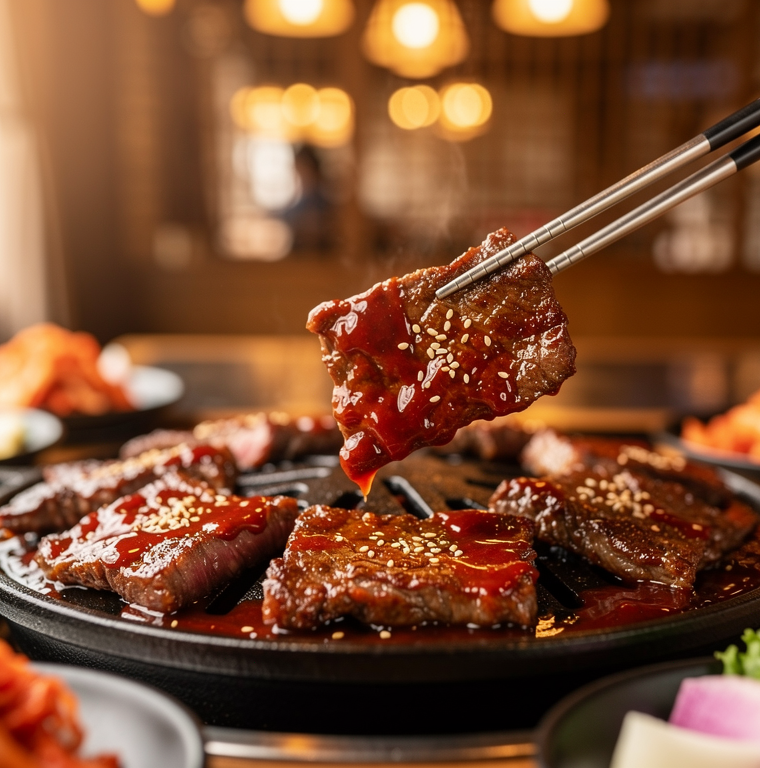
Halal-certified per current listings, with an all-you-can-eat Korean BBQ advertised from around AED 69 and running closer to AED 120 per head at dinner. The unlimited grill covers ribeye, striploin, beef bulgogi and brisket with unlimited banchan, rice and stew. Downside: the menu spans Korean, Japanese and Thai rather than committing to one, and weekends queue without a booking. Confirm the current AYCE price when you call — it moves.
3. Sobahn — Matloob Building, Sheikh Zayed Road
Listed as fully halal by 2026 Dubai guides, with built-in grills at every table and a menu that runs ribeye, wagyu and marinated beef alongside tofu stews and japchae. Expect roughly AED 150–200 per person. Downside: there is no unlimited option, so a proper grill dinner lands well above the AYCE rooms. If an alcohol-free floor is what you need, confirm the drinks policy when you book.
4. HYU — Cluster O, JLT
A small, family-run, alcohol-free room that Dubai’s Korean community has used since 2010. Yangnyeom galbi, house-fermented kimchi jjigae and dakgangjeong, roughly AED 80–200 per person à la carte. This is the calm alternative to a hall full of grills. Downside: it queues at peak, there is no unlimited grill, and halal meat sourcing is worth confirming directly on arrival.
5. The Taste of Korea (TOK Premium) — Al Wahda Mall, Abu Dhabi
Halal-certified, with tabletop BBQ plus a buffet of banchan, japchae, stews and bibimbap, and karaoke and a photo booth attached. The buffet is advertised around AED 39 and the unlimited BBQ around AED 79, but those figures differ between listings — call before you budget. Downside: it is mall dining, with the energy that implies.
6. The Skewers — Hamdan Street, Abu Dhabi
The cheapest unlimited Korean BBQ advertised in Abu Dhabi at AED 59, with unlimited wings at AED 39. A no-frills value room. Downside: the menu is short next to the bigger Korean kitchens, some dishes that appear in its marketing do not appear on the actual menu, and you should confirm halal status directly.
7. Korean Bowl — Al Danah, Abu Dhabi
A well-rated neighbourhood kitchen (4.7 on Google) on Al Widih St behind the Millennium Hotel, on 02-675-2562. Home-style stews and rice bowls rather than tabletop spectacle. Downside: this is not a Korean BBQ room, so go for the soup, not the grill — and confirm halal sourcing directly.
Halal Korean BBQ in the UAE compared
| Venue | Area | Price (AED) | Halal status | Standout order |
|---|---|---|---|---|
| Mukbang Shows | Deira, JBR, DWTC, Abu Dhabi ×2 | 69–129 AYCE | 100% halal, no pork, no alcohol | Gangnam AYCE tier at 69 |
| Shogun | Al Rigga, Deira | ~69 AYCE / ~120 dinner | Halal-certified per listings | Unlimited ribeye and brisket |
| Sobahn | Sheikh Zayed Road | 150–200 à la carte | Listed as fully halal | Wagyu on the table grill |
| HYU | Cluster O, JLT | 80–200 à la carte | Alcohol-free room; confirm sourcing | Yangnyeom galbi |
| TOK Premium | Al Wahda Mall, Abu Dhabi | ~39 buffet / ~79 BBQ | Halal-certified | Unlimited BBQ with buffet |
| The Skewers | Hamdan St, Abu Dhabi | 59 unlimited | Confirm directly | Unlimited grill at 59 |
| Korean Bowl | Al Danah, Abu Dhabi | Mid-range | Confirm directly | Home-style stews |
What does halal Korean BBQ cost in the UAE?
Less than most people expect, and less than the licensed alternatives.
All-you-can-eat is the value play: roughly AED 59–79 per person at entry tiers, rising to AED 99–129 for premium unlimited tiers with wagyu and extra cuts. À la carte grill meals land around AED 95–200 once you add two or three cuts, banchan and a stew. Licensed hotel Korean rooms start higher again, from roughly AED 150 to AED 400 and up.
The useful conclusion: here, eating halal is the cheap option, not a premium you pay for. The Korean BBQ price breakdown for Dubai goes deeper on the tier maths.
Where the halal Korean BBQ rooms cluster
In Dubai, Deira and Port Saeed are the value zone — Mukbang Shows sits on Al Ittihad Road and Shogun is a short drive away at Al Ghurair Centre on Al Rigga Road, both reachable on the Green and Red lines with a short taxi hop at the end.
Sheikh Zayed Road covers the mid-to-upper end, with Sobahn near the Financial Centre and Emirates Towers stops, and Love Mukbang directly opposite the World Trade Centre metro station. JLT is the quiet option, with HYU a short walk from the DMCC station.
Abu Dhabi has no metro, so plan around taxis and Careem. Al Wahda Mall puts TOK Premium in a climate-controlled setting on a major bus route. Hamdan Street and Al Danah hold The Skewers, Korean Bowl and both Mukbang branches within a short drive of the Corniche.
The practical upshot: most districts across both cities are within about fifteen minutes of a Korean BBQ room that has already answered the halal question. For a Dubai-wide view, see the best halal Korean food in Dubai.
Practical tips for a halal Korean BBQ night
Pick the format before the venue. All-you-can-eat suits groups and big appetites; à la carte suits two people who want three good cuts. AYCE tiers usually carry a two-person minimum, so solo diners should head to HYU or Korean Bowl instead.
Ask the marinade question early. Do it when you book, not when the meat lands. Halal kitchens answer it in one sentence.
Grill in order. Brisket and bulgogi cook fastest and are the forgiving cuts to learn on; save ribeye and wagyu for when the plate is seasoned and you have the heat right. Use the scissors on longer strips so they cook evenly instead of curling and burning.
Do not crowd the plate. Four or five pieces at a time cook properly. A full grill steams the meat and drops the temperature.
Check the leftover policy before you order the second round. Mukbang enforces an AED 60 charge and applies it, so pace the table rather than stacking plates you will not finish.
Time your arrival. Before 6:30pm or after 9:30pm cuts the wait meaningfully at the popular branches on weekends.
What is Korean BBQ? (고기구이)
Gogi-gui is the Korean term for grilling meat at the table — marinated or plain, cooked in front of you, and eaten wrapped in lettuce with rice, ssamjang and a spread of banchan. In Korea the default meat is pork. In the UAE’s halal rooms it is beef and chicken, which is why the same format lands differently here.
FAQ
Is Korean BBQ halal by default in Korea? No. Pork is the most-ordered cut, rice wine appears in many marinades, and soju is the standard pairing. Halal-adapted Korean BBQ exists in Korea but it is the exception.
Is woo samgyeop the halal version of samgyeopsal? Yes. It is beef belly, sliced and grilled the same way as pork belly. It is the standard substitute on halal Korean BBQ menus.
Does a halal certificate mean the restaurant is alcohol-free? No. Halal-certified meat and an unlicensed venue are two separate things. Check the drinks list if an alcohol-free room matters to you.
Can I eat Korean BBQ alone in the UAE? At à la carte venues like HYU or Korean Bowl, yes. All-you-can-eat rooms generally require two people minimum.
Is kimchi at a Korean BBQ halal? Classic cabbage kimchi is cabbage, chilli, garlic, ginger and salt, often with fish sauce or salted shrimp, all halal, and no alcohol. Confirm at the restaurant if you want certainty.
Are licensed hotel Korean restaurants automatically not halal? No, and it is not fair to say so. Some serve halal-sourced meat while also serving alcohol on the floor. Ask them directly and decide for yourself.
Is Korean BBQ halal in Dubai and Abu Dhabi? At the dedicated halal rooms, yes — several carry no pork and no alcohol at all. It is not automatic across every Korean restaurant, so run the five checks above.
The short version: Korean BBQ is not halal out of the box, but every obstacle — pork, marinade, alcohol, shared equipment — is one a restaurant can remove, and in the UAE several have removed all four without charging more for it. Ask the five questions once, find your room, and it stops being a question at all.
Related guides
Related guides
More from our Korean food guides across the UAE: