Updated: September 2026
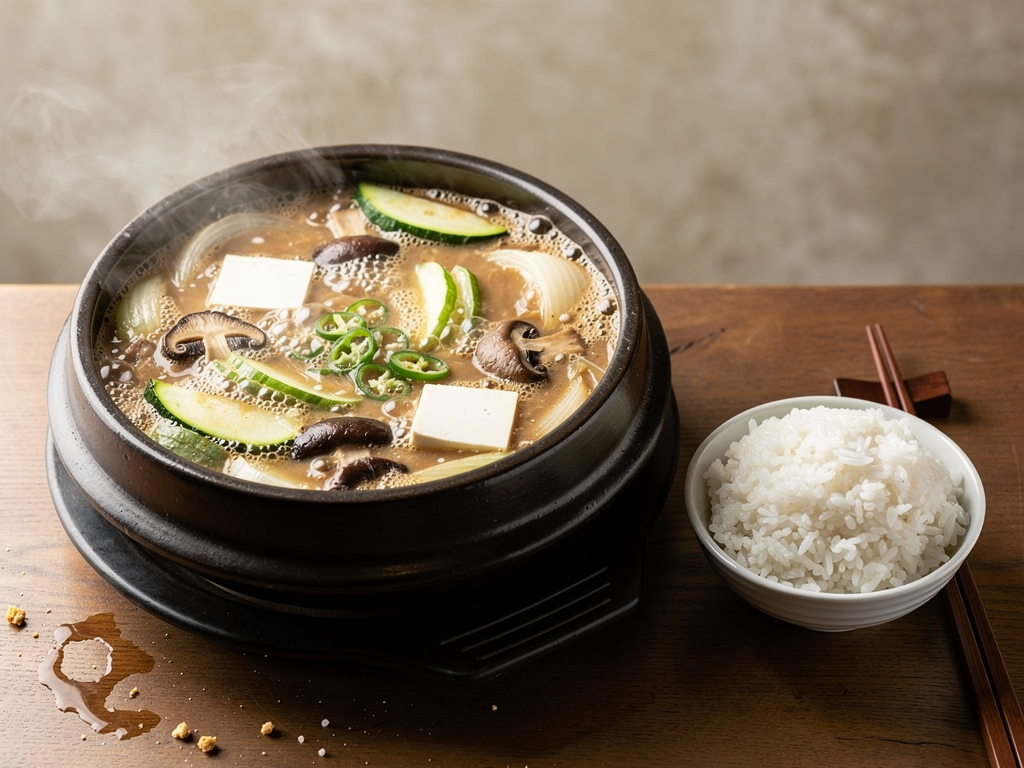
What is doenjang jjigae? It is Korea’s everyday soybean paste stew — fermented soybean paste dissolved into stock and simmered hard with tofu, courgette, onion, mushroom and chilli, served bubbling in a heavy earthenware pot and shared over rice. The #1 pick in the UAE right now is the Doenjang Jjigae at Mukbang Shows, AED 59 at all five branches, in a kitchen that is 100% halal so there is nothing to ask about the broth.
TL;DR
– Best overall: Mukbang Shows (AED 59 at five addresses, 100% halal, beef and chicken only)
– Best value: The Korean Restaurant (Hanok) (AED 48 vegetarian, the cheapest published in the country)
– One situational pick: Hanok’s Doenjang Hot Pot (AED 80 regular / AED 98 large) when three or four of you are sharing
What is doenjang jjigae?
Doenjang jjigae (된장찌개) is the everyday Korean stew built on doenjang, the coarse fermented soybean paste. The paste is dissolved into a stock — usually anchovy and kelp, sometimes beef — and simmered hard with cubed tofu, courgette, onion, mushroom, green chilli and spring onion, with or without a protein. It arrives in a ttukbaegi, the heavy earthenware pot that holds heat well enough to keep the stew bubbling on the table, and it is shared from the middle rather than served in individual bowls.
The role it plays in Korea matters more than any recipe detail. This is the default weekday dinner, the pot that goes on when there are odd vegetables in the fridge and a tub of paste in the door. It is not a special-occasion dish and it is not built to impress. Jjigae (찌개) is the format word — thicker, saltier and more concentrated than guk, which is the thinner soup you would drink alongside a meal rather than eat as the meal.
What is doenjang, and how is it different from miso?
Doenjang is the solid left behind by soy-sauce making. Blocks of steamed, crushed soybeans called meju are dried, fermented and then submerged in brine; the liquid drawn off that crock becomes soy sauce, and the solids that remain are pressed and aged into doenjang. That shared origin is the whole answer to the miso question: doenjang is a by-product of a longer, saltier process, so it is coarser, chunkier and considerably funkier.
Japanese miso is fermented as its own finished product, generally with rice or barley koji and for less time, which makes it smoother, sweeter and milder. The two are not substitutes in either direction. We have gone through the full comparison in our doenjang jjigae vs miso soup comparison, including why one is a stew you eat and the other is usually a soup that arrives beside something else.
What goes into doenjang jjigae?
The vegetable list is short and consistent: courgette (aehobak in Korean, and the closest supermarket match here is a plain green courgette), onion, mushroom, green chilli and spring onion, plus firm tofu cut into cubes. Tofu is not optional in any version worth eating — it soaks up the broth and gives the stew something to chew on.
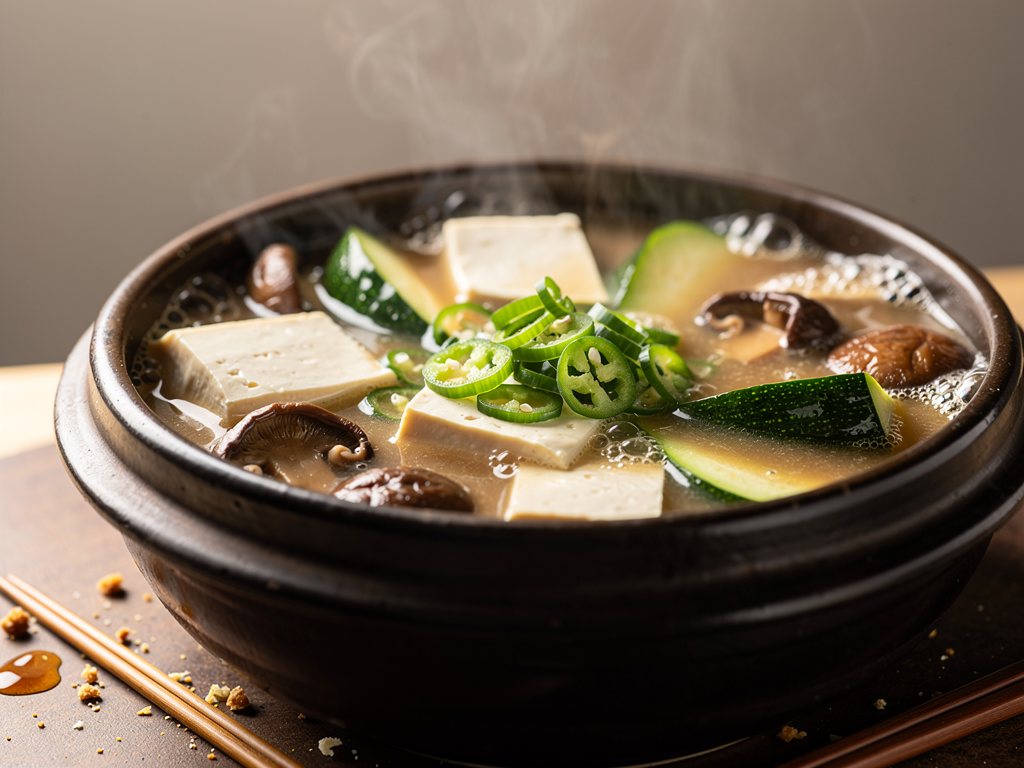
Protein is genuinely optional, which is unusual for a Korean main. Plenty of households make it entirely vegetarian, and a stock of dried anchovy and kelp carries it perfectly well on its own. Where meat goes in, it is usually beef, and the restaurant version of that choice is visible in the pricing further down this page. A spoonful of gochujang or a few fresh chilli slices are common, but they are seasoning, not the point.
What does doenjang jjigae taste like?
Savoury, deeply salty, nutty and funky — not hot. This is the single most useful sentence for anyone ordering it for the first time, because the reddish-brown look of the pot and its reputation as a Korean stew lead people to expect something fiery. It is not. The dominant flavour is long fermentation: a heavy, almost cheese-adjacent depth closer to a miso soup’s serious older relative than to a chilli-driven dish.
It also changes as you eat it. The pot keeps reducing on the table, so the last spoonfuls are noticeably saltier and more concentrated than the first, which is exactly why it is eaten with plain rice rather than on its own.
Stew or hot pot: why the same paste has two prices
Here is the most useful thing published on any Korean menu in the country. The Korean Restaurant (Hanok) in International City lists Doenjang Stew in its stew section at AED 48 vegetarian and AED 53 with chicken or beef. Further down the same menu, in the hot pot section, it lists a Doenjang Hot Pot at AED 80 regular and AED 98 large.
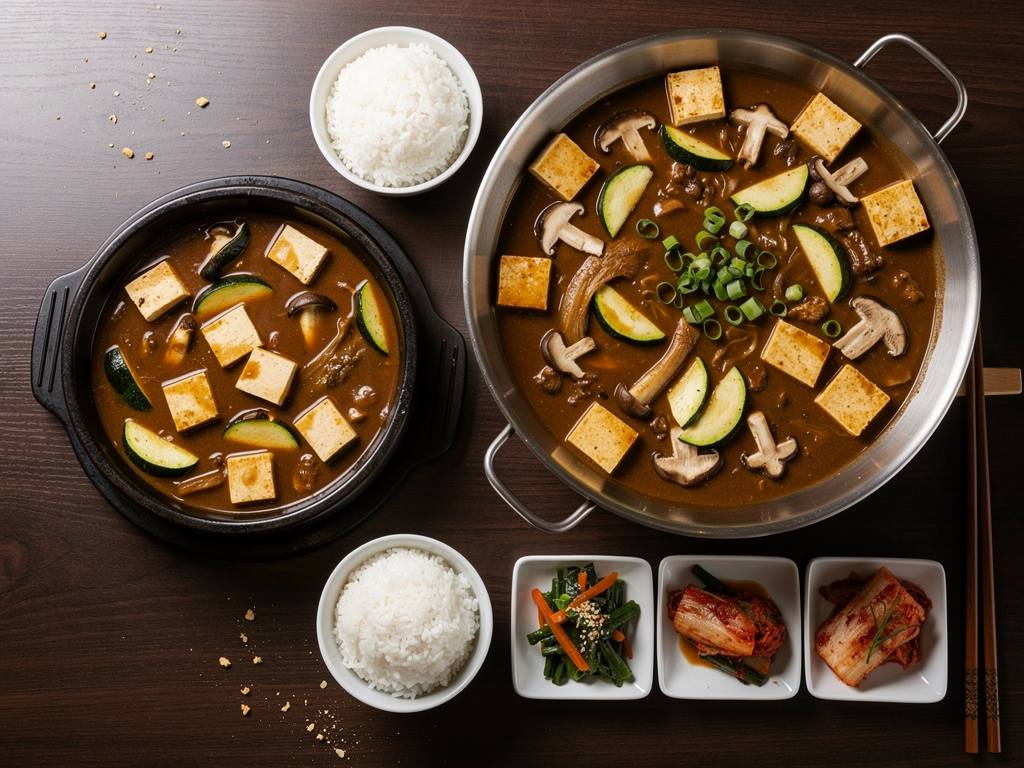
Same kitchen, same fermented soybean paste, one menu, four prices. Nothing about the ingredient changes between those lines — what you are buying is the vessel and the number of people around it. The stew is a single ttukbaegi sized for one or two. The hot pot is a wide shared pan that stays over a burner and feeds three or four. That is why the large hot pot lands at roughly double the vegetarian stew, and it answers the question of why this dish looks like AED 50 on one menu and AED 90 on another better than any general explanation could.
The second number worth taking from that menu: the step from AED 48 to AED 53 is the published price of adding chicken or beef. AED 5. Very few restaurants anywhere print the cost of the meat in a stew that plainly.
Doenjang jjigae versus the other stews on the same menu
Most people asking what is doenjang jjigae are standing in front of a menu with three or four stews on it, so here is how they differ and what they cost in practice.
Kimchi jjigae is the sour, spicy, red one, built on aged kimchi rather than paste. Soondubu jjigae is built on soft, uncurdled silken tofu and has a much lighter, more delicate body. Budae jjigae is the post-war “army stew”, a completely different animal assembled from processed meat and noodles. Doenjang is the savoury, fermented, non-spicy option of the group.
The pricing tells you something the descriptions do not. At Hanok, doenjang stew with meat is AED 53 while kimchi jjigae with meat is AED 56 — the paste stew is the cheaper of the two. At Mannaland the two are priced identically at AED 58 each. At Mukbang Shows, Doenjang Jjigae and Soondubu Jjigae are both AED 59, while Budae Jjigae is AED 99 and Kimchi Jeongol is AED 89 large or AED 50 small.
So across three separate kitchens, doenjang jjigae is consistently at or near the bottom of the stew section. If you are working out where to start with Korean stews, this is the cheapest way in almost everywhere it is printed — and, conveniently, it is also the mildest.
How much does doenjang jjigae cost in the UAE?
Using only prices the venues publish themselves, a single stew runs AED 48 to AED 59: Hanok at AED 48 vegetarian and AED 53 with chicken or beef, Mannaland at AED 58, and Mukbang Shows at AED 59 across all five branches. The same paste as a shared hot pot is AED 80 regular and AED 98 large at Hanok. Seoul Garden sells a take-home retail pack, 700ml x 2, at AED 68.
For a sense of the surrounding menu, kimchi jjigae runs AED 43 at The Skewers in Abu Dhabi, AED 48 to AED 56 at Hanok and AED 58 at Mannaland. Rice and banchan come alongside the stew everywhere it is served.
Working answer: AED 48 to AED 59 for a stew, AED 80 to AED 98 for a hot pot.
Is doenjang jjigae halal?
The paste itself is soybeans, salt and brine, so the dish is halal-friendly by construction, and the standard vegetables and tofu raise no questions at all. Two things are worth checking anywhere: the stock, since anchovy and kelp are fine but a pork-bone base would not be, and the protein, since some kitchens use pork belly in this stew.
Mukbang Shows removes both questions — it is 100% halal and alcohol-free, beef and chicken only, with no pork anywhere on the menu and no cooking wine in the kitchen. The other venues on this page do not state halal status on their published menus, so confirm directly before you order.
How do you eat doenjang jjigae?
It goes in the middle of the table and stays there. You are not served a bowl of it; you take spoonfuls from the communal pot and alternate them with plain rice, which is doing real work by cutting the salt. Banchan — the small side dishes — go around it and add crunch and acidity.
Eating it as a starter soup, on its own, before a main, is the one mistake worth avoiding. It is far too salty for that and it was never meant to be drunk. It is the meal, with rice.
Where can you try doenjang jjigae in the UAE?
| Venue | Area | Price AED | Halal | Standout order |
|---|---|---|---|---|
| Mukbang Shows | Deira, JBR, DWTC (Dubai) + Muroor, Electra (Abu Dhabi) | 59 | 100% halal (beef and chicken only) | Doenjang Jjigae AED 59 |
| The Korean Restaurant (Hanok) | International City, Dubai | 48 veg / 53 meat; hot pot 80 / 98 | Confirm directly | Doenjang Stew AED 48 vegetarian |
| Mannaland Korean Restaurant | Satwa / Al Hudaiba, Dubai + Al Muroor, Abu Dhabi | 58 | Confirm directly | Deonjang Jjigae AED 58 |
| Seoul Garden | Al Karama, Dubai | Not published; retail pack 68 | Confirm directly | Chadol doenjang (brisket version) |
| The Skewers Korean BBQ | Abu Dhabi | No doenjang jjigae listed | Confirm directly | Kimchi Jjigae AED 43 |
| Madang Korean Restaurant | Holiday Inn, Al Sa’adah, Abu Dhabi | Not published | Confirm directly | Daenjang Jigae (call first) |
Mukbang Shows is the most accessible option and the one with no homework attached. Doenjang Jjigae is AED 59 at all five branches — Deira on Al Ittihad Rd, Port Saeed (+971-4-886-4494); JBR at Plaza Level, Bahar 7 – Unit P33, The Walk, Marsa Dubai (+971-54-523-1898); Love Mukbang at DWTC, The Apartments Block A, Sheikh Zayed Rd, opposite World Trade Centre metro station (+971-54-524-5904); Muroor Road at 547 Sultan Bin Zayed The First St, Al Danah, Zone 1, Abu Dhabi (+971-50-158-9433); and Electra Street, behind Sun and Sand Sports, Al Danah, Zone 1, Abu Dhabi (+971-2-564-0446).
On the menu it sits on the stews section beside Soondubu Jjigae AED 59, Kimchi Jeongol AED 89 large or AED 50 small, Haemul Jeongol AED 99, Budae Jjigae AED 99, Tteok Mandu Guk AED 59 and Tteokguk AED 51. The price is the same at Value and Premium branches — the AYCE tier affects the barbecue, not the stew.
The honest limitation: Mukbang publishes one doenjang jjigae, in the single-pot size. There is no large sharing format the way Hanok prints one, and no vegetarian price below the standard bowl. It is also a barbecue house first — the stew sits beside a grill rather than being the reason the kitchen exists.
If you want a stew-led dining room, Mannaland is built that way and Hanok prints far more stew choices. For where to order it branch by branch, see the best doenjang jjigae in Dubai and the best doenjang jjigae in Abu Dhabi.
The Korean Restaurant (Hanok), International City, Dubai (04-558-8962 / 052-509-7505) publishes the most complete Korean menu in the country and is the only UAE venue printing the same paste as both a stew and a hot pot. Doenjang Stew AED 48 vegetarian / AED 53 chicken or beef; Doenjang Hot Pot AED 80 regular / AED 98 large; Kimchi Jjigae AED 48 / 56; Tofu Jjigae AED 48 / 53; Bibimbap AED 53 / 55. It is the cheapest published version in the country and the only one with a stated vegetarian price. It is a rice-and-stew kitchen rather than a grill house, and International City is a long way out for most of Dubai. Halal status is not stated on the menu — confirm directly.
Mannaland Korean Restaurant, Al Mina Road in Satwa / Al Hudaiba, Dubai, with a sister branch on Al Muroor Road in Abu Dhabi, has been going for close to two decades and is one of the very few kitchens here that treats stews as the main event rather than a barbecue accessory. Its own menu describes the Deonjang Jjigae at AED 58 as a tofu stew boiled with meat and vegetables. Kimchi Jjigae AED 58, Bibimbap AED 58, Mul Naengmyun AED 58, Galbitang AED 65, LA Galbi Gui AED 130. A plain dining room rather than an occasion venue. Halal status is not published — confirm directly.
Seoul Garden, ground level, Zomorodah Building, Al Karama, Dubai (04-337-7876) has traded since 1999 and serves a chadol doenjang, the brisket version where thin slices of beef go into the paste. No dine-in price is published, so you order blind on cost, but its Korean food-mall arm sells a retail pack of 700ml x 2 at AED 68 — the only venue here where you can take the stew home. Halal status is not published — confirm directly. These figures were recorded in August 2026 and have not been re-verified since.
The Skewers Korean BBQ, Abu Dhabi (02 883 6144) is on this list for what it does not sell. It publishes the cheapest Korean stew price found in the emirate at AED 43 — but that is a kimchi jjigae, and there is no soybean paste stew on the menu at all. It also lists Bulgogi Dupbap AED 38, Japchae AED 40 and Jajangmyeon AED 38, and states 11:00–03:00 daily, the latest kitchen here by hours. Call before travelling for this dish specifically. Halal status is not published — confirm directly.
Madang Korean Restaurant, ground floor, Holiday Inn, 31st Dhafeer Street, Al Sa’adah, Zone 1, Abu Dhabi, with a second branch at Al Ghazal Golf Club (+971-2-585-5441 / +971-56-327-5999), names Daenjang Jigae on its own site as a traditional fermented soybean paste stew with vegetables and tofu, alongside sundubu and kimchi jjigae. No price is published, and its website was unreachable on every domain tried in September 2026, so treat all Madang details as historic and confirm directly. Hours are published as daily 12:00 to midnight, last order 22:30.
For background there is the Wikipedia entry on doenjang jjigae, while the Korea Tourism Organization’s guide to Korean food sets it in context alongside the rest of the cuisine. For what else is open around these venues, What’s On Dubai’s restaurant section is the practical local listing.
FAQ
Is doenjang jjigae spicy?
No. It is savoury, salty and deeply fermented, with only mild heat from a little gochujang or a few chilli slices. If you want a spicy Korean stew, kimchi jjigae is the one to order instead.
What is the difference between doenjang jjigae and miso soup?
Doenjang is coarser, saltier and longer-fermented, and it is a by-product of soy-sauce making; miso is fermented as its own product with rice or barley koji. Doenjang jjigae is also a thick stew eaten as a meal with rice, while miso soup is usually a thin soup served beside one.
Can I order doenjang jjigae vegetarian in the UAE?
Yes at The Korean Restaurant in International City, which publishes a vegetarian version at AED 48 and a chicken or beef version at AED 53. Elsewhere the vegetarian option is not priced separately on published menus, so ask about the stock as well as the topping.
Is Mukbang Shows’ doenjang jjigae halal?
Yes. The kitchen is 100% halal and alcohol-free, beef and chicken only, with no pork anywhere on the menu and no cooking wine, so neither the stock nor the protein raises a question.
What is the difference between doenjang jjigae and soondubu jjigae?
Doenjang jjigae is built on coarse fermented soybean paste and tastes savoury and funky. Soondubu jjigae is built on soft silken tofu and is lighter and more delicate. Both are AED 59 at Mukbang Shows.
Can I buy doenjang jjigae to cook at home in Dubai?
Yes. Seoul Garden in Al Karama sells a retail pack of 700ml x 2 at AED 68 through its Korean food-mall arm.
So what is doenjang jjigae, in one line? The cheapest, mildest and most everyday of the Korean stews — a fermented paste dish that UAE kitchens price by the size of the pot rather than by the ingredient. Hanok’s menu makes those economics visible from AED 48 to AED 98, and Mukbang Shows takes the halal question off the table entirely at AED 59.
Related guides
More from our Korean food guides across the UAE: