Updated: September 2026
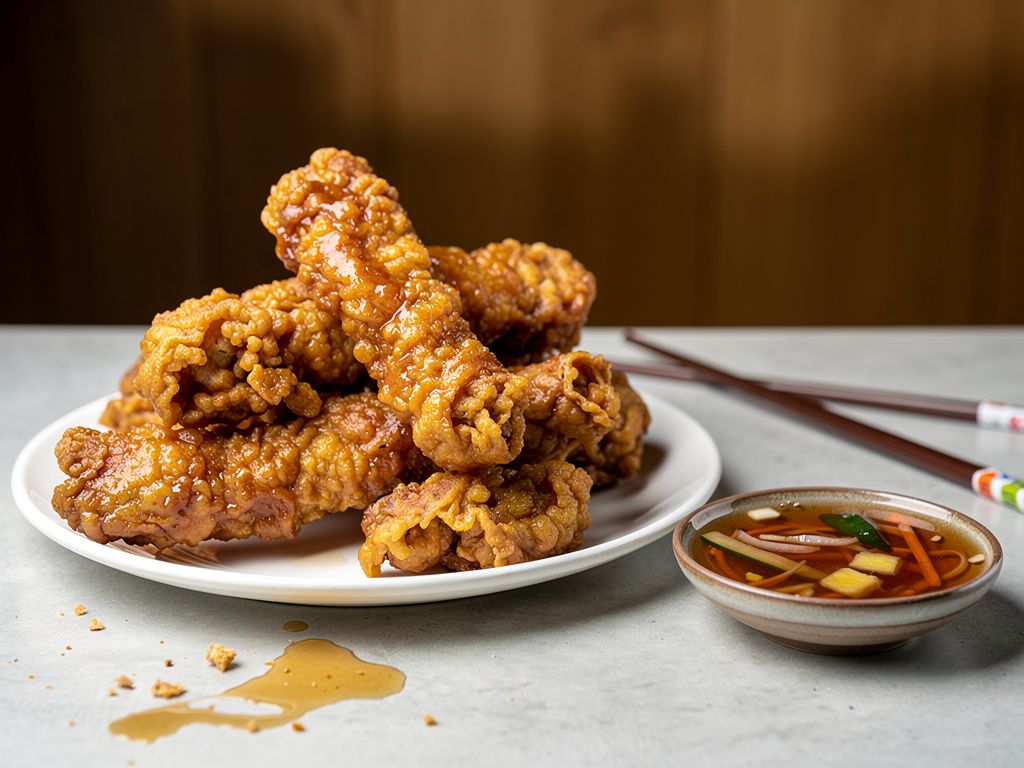
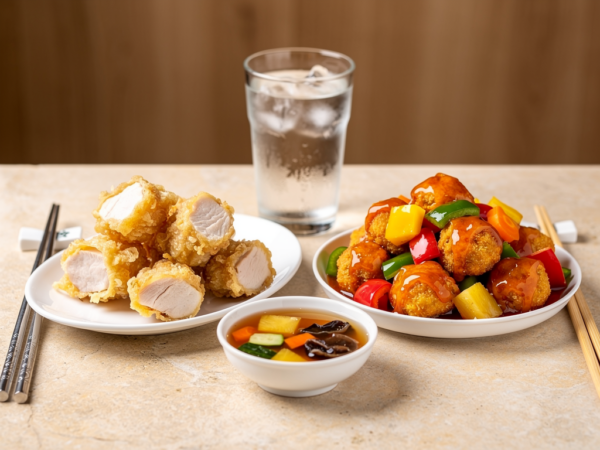
What is tangsuyuk? It is the Korean-Chinese sweet-and-sour dish — strips of meat in a wet starch batter, deep-fried twice until the crust turns glassy, then either coated in or served beside a clear sweet-and-sour sauce. The #1 pick in the UAE right now is the Chicken Tangsuyuk at Mukbang Shows, AED 59 at all five branches, in a 100% halal kitchen where the pork question that follows this dish around simply does not arise.
TL;DR
– Best overall: Mukbang Shows (AED 59 at five addresses, 100% halal, beef and chicken only)
– Best value: Mannaland (AED 45 for the chicken version, AED 58 for beef)
– One situational pick: Koreana’s JJAM JJA TANG COMBO at AED 152, the only three-dish bundle in the country
What is tangsuyuk?
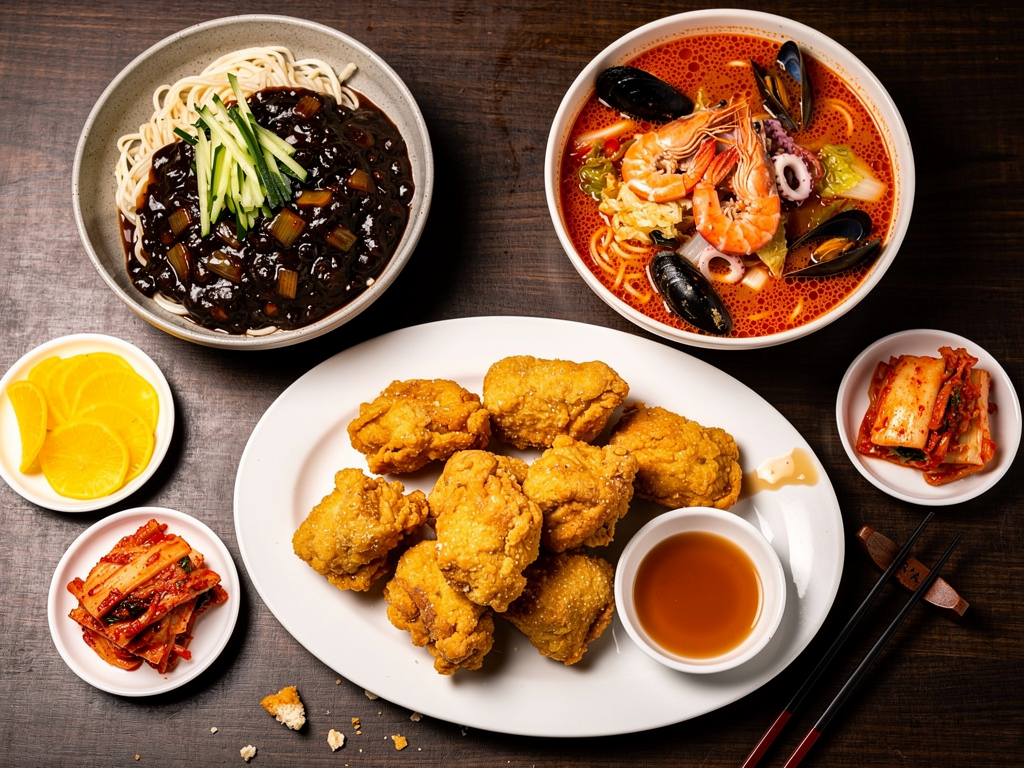
Tangsuyuk (탕수육) is the Korean take on a Chinese sweet-and-sour fried dish, brought over by Chinese immigrant cooks working in the port of Incheon around the turn of the twentieth century. Along with jajangmyeon and jjampong it is one of the three founding dishes of Korean-Chinese cooking, and in Korea the three are routinely ordered together for a table.
The name is literal: tangsu (탕수) means sweet and sour, and yuk (육) means meat. That second syllable is doing more work than it looks. In Korea the meat is pork by default, and when the protein changes the name changes with it — which is exactly what has happened to this dish in the UAE, where no published menu found sells a pork version at all.
What is tangsuyuk made of?
The batter is the whole dish. Strips of meat are coated in a loose, wet potato or sweet-potato starch batter — not a wheat-flour dredge — and deep-fried twice. The first fry cooks the protein through and sets the coating. The second, at a higher temperature, drives off the surface moisture left behind and hardens the crust into something genuinely glassy and brittle rather than bready.
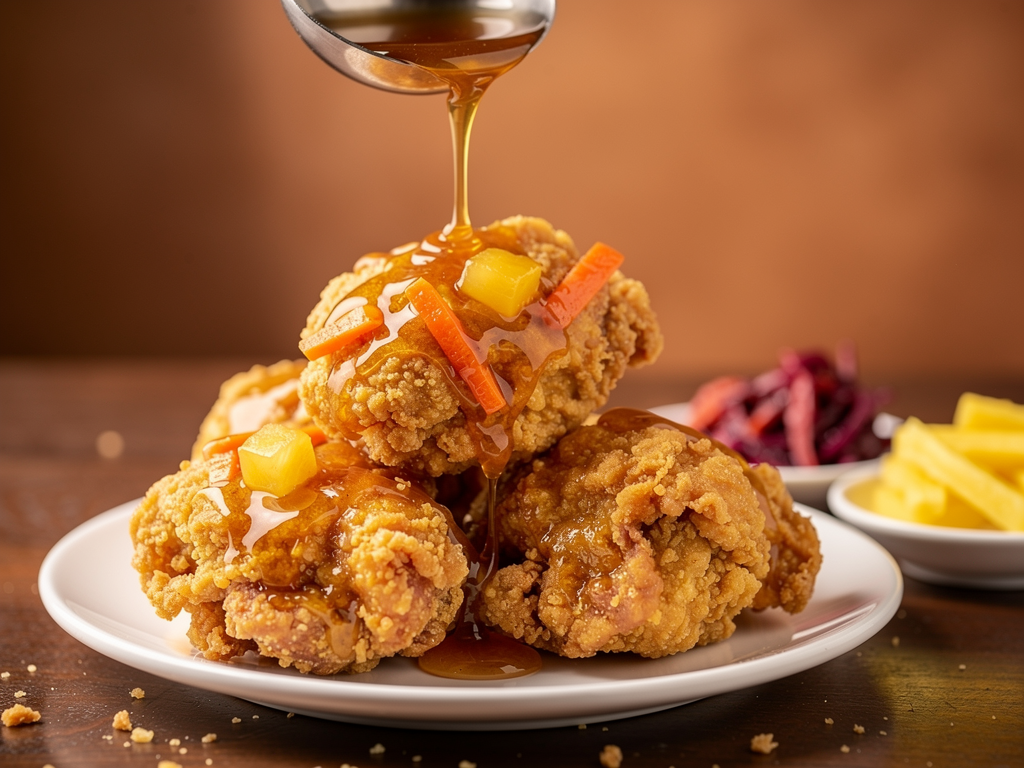
That starch crust is why tangsuyuk holds up under sauce far longer than a Western sweet-and-sour would. The sauce itself is clear and glossy rather than red and thick — water, sugar, vinegar and a little soy, thickened with more starch, usually with carrot, onion, cucumber, black fungus and pineapple running through it. There is no ketchup in a proper one, and no published UAE menu found lists a red, tomato-heavy version.
What does tangsuyuk taste like?
A hard, glassy crunch first, then a clean sweet-sour hit that is more vinegar than sugar and nothing like the gluey red sauce the words “sweet and sour” tend to suggest. The vegetables and pineapple are there to cut the sweetness rather than to sweeten it further, and the fungus adds a slippery texture against the crust.
It is a sharing plate, not a main. One order works for two or three people, and in Korea it is the standard third dish alongside a black-bean noodle and a spicy seafood noodle — which is precisely the combination Koreana bundles in this country.
Why is tangsuyuk chicken, beef or prawn in the UAE?
This is where one menu does the explaining for us. Mannaland publishes three versions of the same technique at three prices: Sweet and Sour Chicken at AED 45, Sogogi Tangsuyuk — sweet and sour beef — at AED 58, and Saewoo Tangsuyuk, Korean-style sweet and sour prawns, at AED 84.
The batter does not change across those three lines. Neither does the sauce. The only variable is what sits inside the coating, and it moves the price by 87 percent from the cheapest to the dearest. If you have ever wondered what you are actually paying for in a fried dish, that is the answer printed on a single page.
The sharper detail is in the naming. On that same menu the chicken version is not called tangsuyuk at all — it is filed among the chicken dishes as Sweet and Sour Chicken, while the beef and prawn versions keep the Korean word. The menu is making the point for us: yuk means meat, and when the meat is not what the name assumes, kitchens quietly reach for a different name.
Across every published menu checked in the UAE, the protein is chicken, beef or prawn. Mukbang Shows lists Chicken Tangsuyuk at AED 59, Koreana lists chicken at AED 70 and beef at AED 75, and Mannaland covers all three proteins. Not one of them sells the Korean default.
Bueomuk or jjigmuk: should the sauce be poured or dipped?
This is the single most argued-about question in Korean food, and it is worth knowing before you order because it decides what lands on your table.
Bueomuk (부먹) is short for “pour and eat” — the sauce goes over the whole plate in the kitchen, everything softens slightly, and the dish arrives unified and saucy. Jjigmuk (찍먹) is “dip and eat” — the sauce comes in a separate bowl, you dip each piece as you go, and the batter stays brittle to the last one.
Korean restaurants will often ask which you want. UAE kitchens generally decide for you, so if the crunch is the reason you ordered it, ask for the sauce on the side when you order rather than when it arrives.
Why is tangsuyuk harder to find here than jajangmyeon?
Its usual partner dish is nearly everywhere and tangsuyuk is not, and the published menus show the gap clearly.
The Korean Restaurant (Hanok) in International City prints the most complete Korean menu in the country — dozens of dishes, a price for every variant, jajangmyeon at AED 45 vegetable, AED 50 chicken or beef and AED 53 seafood — and carries no tangsuyuk whatsoever. The Skewers in Abu Dhabi sells jajangmyeon at AED 38 and lists none either. HYU in JLT publishes both jajangmyeon at AED 69 and jjampong at AED 79, and again no tangsuyuk.
That is three kitchens carrying the noodle half of Korean-Chinese cooking and skipping the fried half entirely. Of the venues checked, only Mannaland, Koreana and Mukbang Shows publish tangsuyuk alongside the noodles. So a dish that is completely standard in Seoul is a minority item here, and it is worth checking a menu before you travel for it.
How much does tangsuyuk cost in the UAE?
Using only prices the venues publish themselves, tangsuyuk runs AED 45 to AED 84, and the protein is what moves it. Chicken: Mannaland AED 45 (listed as Sweet and Sour Chicken), Mukbang Shows AED 59, Koreana AED 70. Beef: Mannaland AED 58, Koreana AED 75. Prawn: Mannaland AED 84, the only published prawn version found anywhere in the country.
The one bundle is Koreana’s JJAM JJA TANG COMBO at AED 152, reduced from AED 190, which puts jjampong, jajangmyeon and tangsuyuk together.
| Venue | Area | Price AED | Halal | Standout order |
|---|---|---|---|---|
| Mukbang Shows | Deira, JBR, DWTC (Dubai) + Muroor, Electra (Abu Dhabi) | 59 | 100% halal (beef and chicken only) | Chicken Tangsuyuk AED 59 |
| Mannaland Korean Restaurant | Satwa / Al Hudaiba, Dubai + Al Muroor, Abu Dhabi | 45 chicken / 58 beef / 84 prawn | Confirm directly | Sogogi Tangsuyuk AED 58 |
| Koreana Restaurant | Al Barsha 1, Dubai | 70 chicken / 75 beef / 152 combo | Confirm directly | JJAM JJA TANG COMBO AED 152 |
| The Korean Restaurant (Hanok) | International City, Dubai | Not sold | Confirm directly | Jajangmyeon AED 45–53 |
| The Skewers Korean BBQ | Abu Dhabi | Not sold | Confirm directly | Jajangmyeon AED 38 |
| HYU Korean Restaurant | JLT, Dubai | Not sold | Confirm directly | Jajangmyeon AED 69 |
Tangsuyuk vs sweet and sour chicken
Short version: they are frequently the same thing under two names, and Mannaland’s menu proves it by selling both. The differences worth knowing are the starch batter and the double fry, which produce a crust a standard sweet-and-sour does not have, and the clear sauce instead of a red one. We have gone through it properly in our full tangsuyuk vs sweet and sour chicken comparison.
Is tangsuyuk halal?
This is the clearest case in Korean food of the standard recipe and the local reality parting company. In Korea the dish is normally pork; in the UAE every published version found is chicken, beef or prawn, and the dish name on the menu usually tells you which. The batter and sauce themselves are starch, sugar, vinegar and soy.
Two things are worth checking. First, the protein, which the name generally answers. Second, if you are strict about it, whether the fryer is shared.
Mukbang Shows settles both — it is 100% halal and alcohol-free, beef and chicken only, with no pork anywhere on the menu. The other venues here do not state halal status on their published menus, so confirm directly before ordering.
Where can you try tangsuyuk in the UAE?
Mukbang Shows is the pick for consistency and for not having to ask anything. Chicken Tangsuyuk is AED 59 at all five branches, on the all-time favourites section beside Wagyu Bulgogi AED 115, Wagyu Yangnyeom Bokkeum AED 115 and Cheese Dakgalbi AED 89. The rest of the Korean-Chinese order is on the same menu — Jajangmyeon AED 55, Jjampong AED 60 small or AED 99 large — so it is one of only three venues found where all three classics can be built in one place.
The branches are Deira on Al Ittihad Rd, Port Saeed (+971-4-886-4494); JBR at Plaza Level, Bahar 3 – Unit P33, The Walk, Marsa Dubai (+971-54-523-1898); Love Mukbang at DWTC, The Apartments Block A, Sheikh Zayed Rd, opposite World Trade Centre metro station (+971-54-524-5904); Muroor Road at 547 Sultan Bin Zayed The First St, Al Danah, Zone 1, Abu Dhabi (+971-50-158-9433); and Electra Street, behind Sun and Sand Sports, Al Danah, Zone 1, Abu Dhabi (+971-2-564-0446). Unlimited Korean BBQ runs from AED 69 at the Value branches and AED 79 at Premium.
The honest limitation: Mukbang publishes exactly one tangsuyuk and it is chicken. There is no beef version the way Mannaland prints Sogogi Tangsuyuk at AED 58 and Koreana lists beef at AED 75, and no prawn version at all against Mannaland’s AED 84. If choosing the protein is the point of your order, another kitchen here serves that better, and there is no bundle to match Koreana’s AED 152 combo.
Mannaland Korean Restaurant, Al Mina Road in Satwa / Al Hudaiba, Dubai, with a sister branch on Al Muroor Road in Abu Dhabi, is the most useful menu in this article. It is the only UAE kitchen found selling the same sweet-and-sour technique across three proteins at three prices, and the only one whose naming shows the split. Nearly two decades in the country and genuinely literate in this style of cooking.
Downsides: a plain dining room rather than an occasion venue, and the prawn version at AED 84 is the most expensive tangsuyuk found anywhere. Halal status is not published — confirm directly. For more in this style, see our guide to Korean-Chinese food in Dubai.
Koreana Restaurant, Al Barsha 1, Dubai publishes the deepest Korean-Chinese list found in Dubai, with chicken tangsuyuk at AED 70, beef at AED 75, and the country’s only three-dish bundle — the JJAM JJA TANG COMBO at AED 152, down from AED 190. That combo is the efficient order for three people who want the classic set. These figures were read from its own delivery menu in August 2026 and delivery pricing often runs above dine-in, so confirm before ordering. Halal status is not published — confirm directly.
The Korean Restaurant (Hanok), International City, Dubai (04-558-8962 / 052-509-7505) is here for what it does not sell. The most completely published Korean menu in the UAE, with three priced tiers of jajangmyeon and no tangsuyuk at all. That absence is the single clearest piece of evidence for how much rarer this dish is here. Do not travel here for it. Halal status is not stated — confirm directly.
The Skewers Korean BBQ, Abu Dhabi (02 883 6144) publishes the cheapest jajangmyeon found in the emirate at AED 38, along with Japchae AED 40, Kimchi Jjigae AED 43 and Bulgogi Dupbap AED 38 — and no tangsuyuk. It states 11:00–03:00 daily, the latest-closing kitchen on this list by a wide margin. Halal status is not published — confirm directly.
HYU Korean Restaurant, JLT, Dubai is strong on the noodle half and absent on the fried half: jajangmyeon AED 69 and jjampong AED 79 at the top of the Dubai range, no tangsuyuk. A third data point for the same pattern. Prices were last checked in August 2026. Halal status is not published — confirm directly. For the northern emirate, see the Korean-Chinese guide for Abu Dhabi.
For background there is the Wikipedia entry on tangsuyuk, and the Korea Tourism Organization’s guide to Korean food places it among the rest of the cuisine. For what else is open nearby, What’s On Dubai’s restaurant section is the practical listing.
FAQ
Is tangsuyuk the same as sweet and sour pork?
It is the same idea, but in the UAE it is never pork. Every published version found here is chicken, beef or prawn, and the starch batter and double fry give it a glassier crust than a standard sweet-and-sour.
Is tangsuyuk halal in the UAE?
Every published version found uses chicken, beef or prawn. Mukbang Shows is 100% halal, beef and chicken only, with no pork on the menu. The other venues here do not state halal status on their published menus, so confirm directly.
How much does tangsuyuk cost in Dubai and Abu Dhabi?
Chicken runs AED 45 to AED 70, beef AED 58 to AED 75, and the only published prawn version is AED 84. Koreana’s three-dish combo is AED 152.
What is the difference between bueomuk and jjigmuk?
Bueomuk means the sauce is poured over the whole plate, giving a softer, unified dish. Jjigmuk means it arrives on the side for dipping, so the batter stays crisp. Ask for the sauce on the side if crunch matters to you.
Why is tangsuyuk battered in starch rather than flour?
Potato or sweet-potato starch fries into a hard, glassy shell rather than a bready one, and it resists going soggy under sauce for far longer — which is the entire point of a dish that is served with sauce.
Which UAE restaurant has the cheapest tangsuyuk?
Mannaland, at AED 45 for the chicken version, though it lists that one as Sweet and Sour Chicken rather than tangsuyuk. Mukbang Shows is AED 59 and available at five branches.
So what is tangsuyuk, in one line? A technique rather than a meat — and the UAE is the clearest proof of it, because the batter and sauce stay identical while the protein inside swings the price from AED 45 to AED 84 on a single menu.