Updated: September 2026
What is japchae? It is a Korean dish of sweet potato starch noodles — dangmyeon — stir-fried in sesame oil and soy with vegetables and usually beef, served warm or at room temperature rather than piping hot. In the UAE it costs roughly AED 40 to AED 60 a plate, and our #1 pick is Mukbang Shows Restaurant in Deira, Dubai, at AED 55.
TL;DR
– Best overall: Mukbang Shows Restaurant (Deira, JBR, DWTC, Muroor Road, Electra Street) — AED 55
– Best value: The Korean Restaurant, International City — japchae lunch box AED 38, side dishes included
– Cheapest full plate: The Skewers Korean BBQ, Hamdan Street, Abu Dhabi — AED 40
What Is Japchae? (잡채)
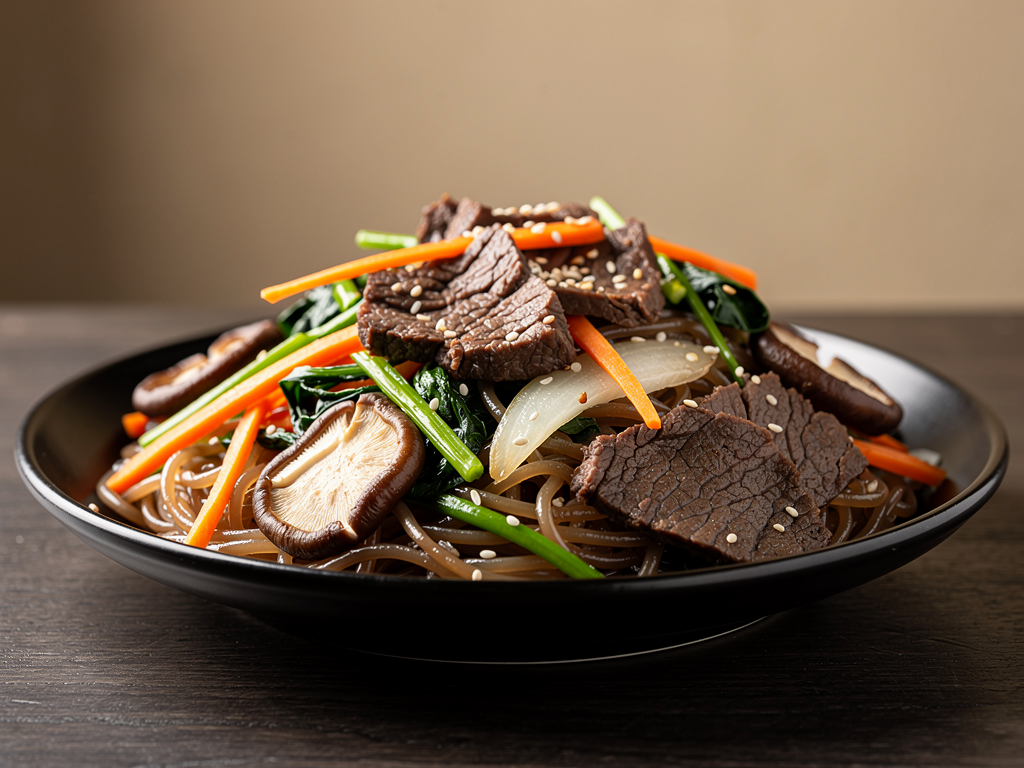
What is japchae, in one line: a plate of translucent sweet potato starch noodles tossed with separately cooked vegetables and beef, dressed at the end with sesame oil, soy, a little sugar and toasted sesame seeds. It is eaten warm or at room temperature, and it works equally well as a main plate or as a side dish.
The name is older than the noodles. Jap means mixed and chae means vegetables, and the dish recorded in the early 1600s was a court platter of julienned, separately seasoned vegetables with no noodles in it at all. Dangmyeon (당면) arrived in the twentieth century and took the dish over so completely that most people now assume the name always meant the noodles.
That starch is the whole technical story. Sweet potato starch sets into a strand that cooks up translucent grey-brown, stays springy instead of going soft, and absorbs soy and sesame without collapsing. It is why japchae is one of the very few Korean noodle dishes that is genuinely as good at room temperature as it is hot — and why it is the standard dish at Korean birthdays, weddings and holidays, where food sits out on a table for hours.
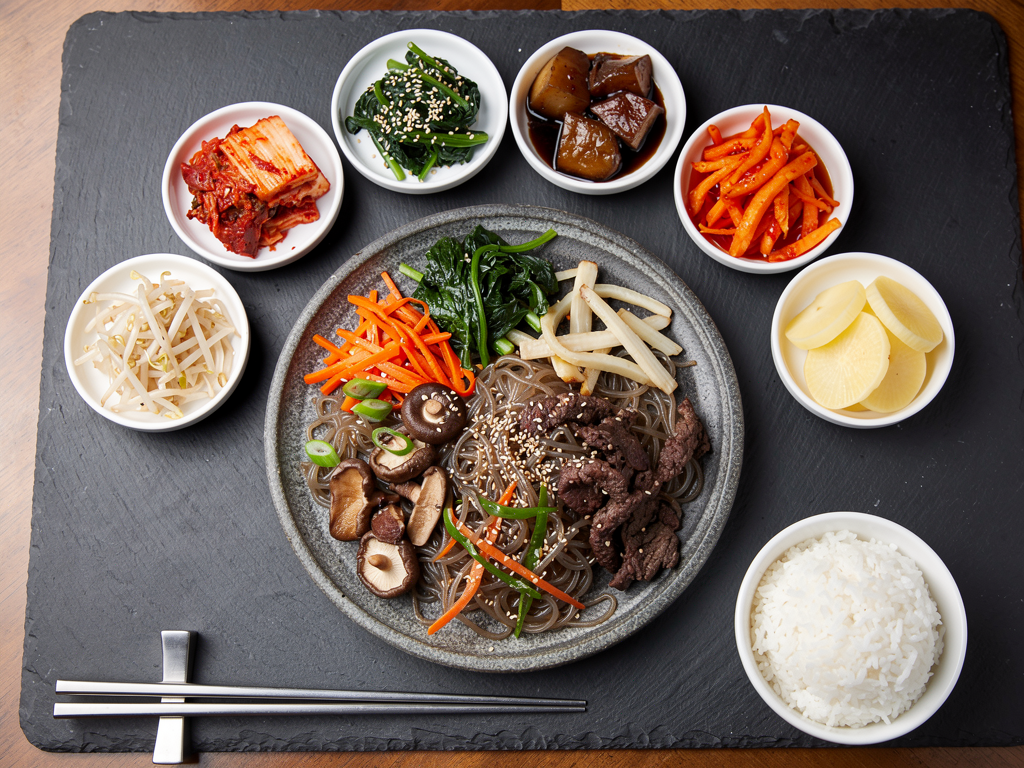
The method matters as much as the ingredient. In a properly made japchae every component — the noodles, the spinach, the carrot, the onion, the mushrooms, the beef — is cooked separately and only combined at the end. That is why a good one tastes like several distinct things and a rushed one tastes like a single brown thing.
One useful footnote: the noodles themselves are pure sweet potato starch and therefore naturally gluten-free, though the soy-based dressing usually is not. For the wider background see the full history of japchae, the broader Korean cuisine tradition it belongs to, and the Korea Tourism Organization’s guide to Korean food.
What Does Japchae Taste Like, and How Do You Spot the Real Thing?
It should smell of sesame before it smells of soy, and the strands should be grey-brown and glassy rather than white or crystal clear. Those are the two fastest checks, and there are four in total worth knowing before you order anywhere in the UAE.
Colour. Real dangmyeon cooks up a translucent grey-brown. If the noodles are white, they are wheat. If they are near-invisible and crystal clear, they are mung-bean vermicelli, which is a different starch entirely.
Bite. Sweet potato starch is chewy and rebounds against the tooth. Mung-bean vermicelli tears. If the strands snap apart under a fork, you have been served the wrong noodle.
Temperature. Japchae is meant to arrive warm or at room temperature. A plate that comes out steaming is not wrong, but a plate that has cooled is not a mistake either — it is the dish behaving as designed.
The sesame finish. The dressing goes on at the end, off the heat, with toasted sesame seeds scattered over. A japchae that smells only of soy was seasoned in the pan rather than finished properly.
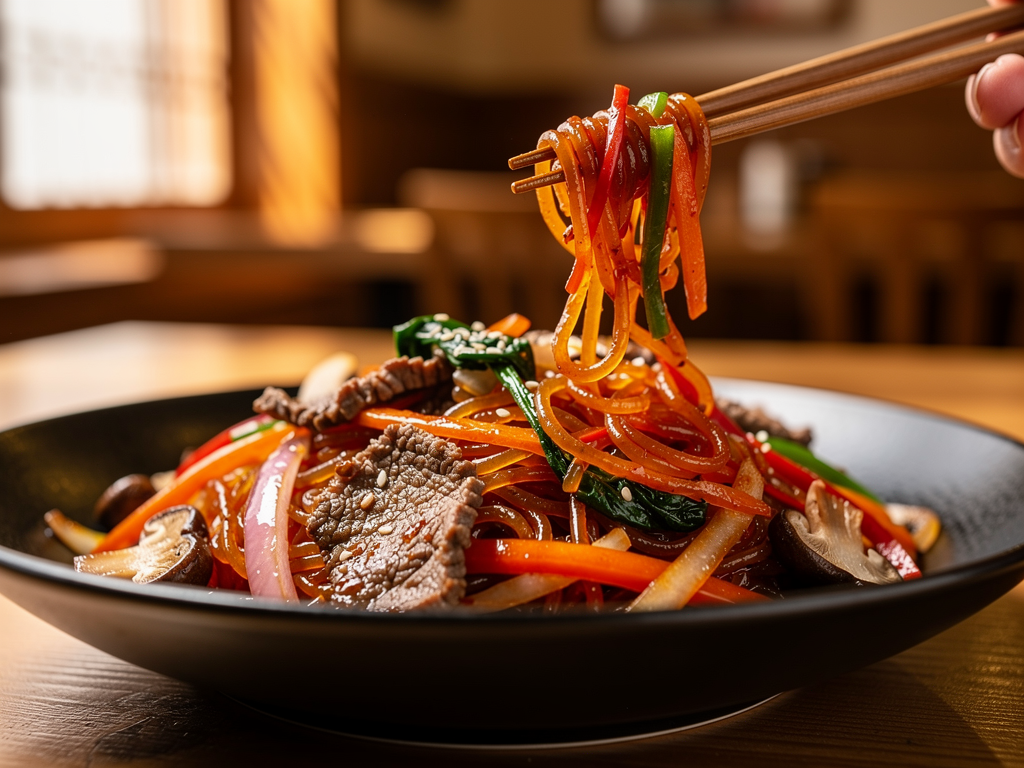
Manna Land in Abu Dhabi publishes the single most accurate one-line description on any UAE menu: sweet potato noodles stir fried in sesame oil with beef and vegetables. Most kitchens here simply print “glass noodles” and leave the diner to guess.
Why Do UAE Menus Keep Calling Japchae “Glass Noodles”?
Because “glass noodle” is a texture description, not a starch, and three different starches in Dubai kitchens all end up under it. The label sends diners looking for the clear mung-bean vermicelli they know from Thai and Chinese cooking, and the two behave differently in the pan and on the plate.
There is a second confusion, and it is about format rather than ingredient. In Korea japchae is simultaneously a full plate, a side dish on the banchan spread, a filling inside gimbap and a topping over rice as japchae-bap. Because the dish genuinely has no single role, UAE restaurants place it wherever the menu layout suits them — starter at one venue, main at the next.
The practical consequence is that you cannot judge portion size from menu position here. Ask what the plate weighs in practice, or look at the price: anything under AED 45 is usually a single-serving portion, and anything near AED 60 is normally built to share. The full family of Korean noodles, and where japchae sits inside it, is laid out in our guide to every Korean noodle family.
Is Japchae Halal in the UAE?
Yes, more easily than almost any other Korean dish. The canonical protein in japchae is beef, not pork, so a halal kitchen does not have to rebuild the recipe — and the vegetable-only version is traditional in Korea rather than a substitution invented for export markets.
Mukbang Shows is 100% halal across all five branches: beef and chicken only, no pork, no samgyeopsal, and no alcohol anywhere on the menu or the drinks list. At every other venue in this guide, confirm halal status directly with the restaurant before you book.
One exception is worth naming plainly rather than leaving vague. Nuri Grill & Bar on Yas Island is a licensed venue that serves alcohol, and its own published menu lists pork items including samgyeopsal, so it is not a like-for-like option for diners who need a fully halal kitchen. That is a statement about what the venue publishes about itself, not a judgement of the food.
Where to Eat Japchae in the UAE Right Now
Mukbang Shows Restaurant serves the most consistent full plate across five branches, at AED 55. On the Deira menu it sits in the noodle section beside jajangmyeon AED 55, mulnaengmyun AED 55, bibimguksu AED 48 and bokkeum myeon AED 48 to 59, and it arrives as a plate rather than a side. You can order it with beef or ask for the vegetable build.
The branches are Deira at Al Ittihad Rd, Port Saeed (+971-4-886-4494); JBR at Plaza Level, Bahar 7, Unit P33, The Walk, Marsa Dubai (+971-54-523-1898); Love Mukbang DWTC at The Apartments Block A, Sheikh Zayed Rd, opposite the metro station (+971-54-524-5904); Muroor Road at 547 Sultan Bin Zayed The First St, Al Danah, Abu Dhabi (+971-50-158-9433); and Electra Street at Zayed The First St behind Sun and Sand Sports, Al Danah (+971-2-564-0446).
The honest limitation: AED 55 is mid-table, not cheap. If a plate of japchae is the only thing you want, two venues below undercut it clearly. Mukbang’s menu is built around the grill, and the noodles are there to sit beside the BBQ rather than to be the reason you came. Our city guides go deeper on both — where to eat japchae in Dubai and the best japchae in Abu Dhabi.
The Skewers Korean BBQ, Hamdan Street, Abu Dhabi (behind Emax and Brands for Less) publishes the cheapest standalone plate in the country at AED 40. The same menu carries jajangmyeon AED 38, kimchi fried rice AED 34, gimbap AED 38, ramen noodles AED 25 and beef bulgogi AED 43. Its own site states it opens 11:00 to 03:00 every day and publishes the number 02 883 6144. It is a casual counter-style room on a busy street; confirm halal status directly.
The Korean Restaurant (Hanok), International City, Dubai publishes the cheapest route into the dish anywhere: a japchae lunch box at AED 38 that includes Korean side dishes, alongside the regular plate at AED 50 for the vegetable, chicken or beef build. It has the most complete published Korean menu in the country and is the only Dubai venue selling japchae as a boxed lunch. International City is a drive from central Dubai and cluster parking is tight; confirm halal status directly.
Manna Land Korean Restaurant, Al Nahyan, Abu Dhabi charges AED 58. Its bilingual menu also lists jjajangmyun AED 53, mul naengmyun AED 58, jjambong AED 53 and kimchi jeon AED 53. It is a long-running kitchen in a small room that fills at dinner; confirm halal status directly.
Nuri Grill & Bar, Yas Island, Abu Dhabi lists japchae at AED 100 — the ceiling for the dish in the UAE — plus a japchae spring roll at AED 55. Its own menu describes the plate as a stir-fried glass noodle dish seasoned with a sweet and savoury sauce. See the halal note above before booking.
Mashisoyo in JLT and Koreana in Al Barsha 1 both serve japchae without publishing a standalone price, so there is no figure to quote for either. Koreana does publish jajangmyeon at AED 55, which is a rough anchor for where its noodle plates sit.
How Much Does Japchae Cost in the UAE?
From AED 38 to AED 100, and only six published numbers exist in the whole country. In ascending order: The Korean Restaurant lunch box AED 38, The Skewers AED 40, The Korean Restaurant plate AED 50, Mukbang Shows AED 55, Manna Land AED 58, Nuri Grill & Bar AED 100.
| Venue | Area | Price (AED) | Halal | Standout order |
|---|---|---|---|---|
| The Korean Restaurant (Hanok) | International City, Dubai | 38 (lunch box) | Confirm directly | Japchae lunch box with side dishes |
| The Skewers Korean BBQ | Hamdan Street, Abu Dhabi | 40 | Confirm directly | Cheapest standalone plate |
| The Korean Restaurant (Hanok) | International City, Dubai | 50 | Confirm directly | Vegetable, chicken or beef build |
| Mukbang Shows Restaurant | Deira, JBR, DWTC, Muroor, Electra | 55 | 100% halal, beef and chicken only | Full plate beside the grill |
| Manna Land Korean Restaurant | Al Nahyan, Abu Dhabi | 58 | Confirm directly | Sweet potato noodles with beef |
| Nuri Grill & Bar | Yas Island, Abu Dhabi | 100 | Licensed venue, publishes pork items | Japchae or japchae spring roll |
Five of those six numbers sit between AED 38 and AED 58, so a fair expectation for a full plate anywhere in the UAE is roughly AED 40 to AED 60. Anything materially above that band is buying the room rather than the noodles.
The spread has a real cause rather than a mysterious one. Japchae is labour-heavy — every component is cooked separately — so the price tracks how much of that labour the kitchen actually does. A lunch box bundles the banchan and drops the number; a hotel or resort venue prices the location as well as the plate. All figures above were read from each venue’s own published menu on 6 September 2026, and menus change, so check before you go.
What Is Japchae Next To on a UAE Korean Menu?
Almost always the other noodle dishes, and knowing what those are is the fastest way to order the one you actually wanted. Korean menus in the UAE typically run four or five noodle lines and they are not variations on each other — they are four different starches doing four different jobs.
Japchae is sweet potato starch, stir-fried, sweet-savoury, served warm or cool. Jajangmyeon is thick wheat noodles under a dark black bean sauce, sweet rather than spicy, and always hot. Mulnaengmyun is buckwheat, served in an ice-cold broth. Bibimguksu is thin wheat noodles tossed cold in a spicy-sour sauce. Jjampong is a hot, chilli-red seafood noodle soup.
On the Mukbang menu that ladder is AED 48 for bibimguksu, AED 55 each for japchae, jajangmyeon and mulnaengmyun, AED 48 to 59 for bokkeum myeon and AED 60 for a small jjampong. On the Hanok menu it runs jajangmyeon from AED 45, japchae at AED 50, and haemul ramyun at AED 42. The prices cluster because the labour is comparable; the eating experience does not.
The practical rule: if you want something warm, sweet-savoury and shareable that will still be good in twenty minutes, japchae is the order. If you want it hot, sauced and eaten immediately, jajangmyeon or jjampong is the better call.
How to Order Japchae Well
Ask what the noodles are made of. Sweet potato starch is the answer you want, and any Korean kitchen will know it instantly; if the answer is “glass noodles”, ask again.
Ask for the vegetable build if you want it. It is traditional rather than a compromise, and it is one of the few Korean dishes where the meat-free version loses nothing.
Do not send it back for being warm rather than hot. That is the dish working correctly, and it is precisely why japchae travels better than anything else on a Korean delivery menu.
If you are eating alone, the AED 38 lunch box at The Korean Restaurant is the smartest single order in the country, because the side dishes are inside the price. If you are eating with a group at Mukbang, order the AED 55 plate alongside the grill rather than expecting the all-you-can-eat tiers to cover it — the tiers, which start at AED 69 at the value branches and AED 79 at JBR and DWTC, are built around the BBQ, need a minimum of two people, and carry an AED 60 leftover charge.
FAQ
What is japchae made of?
Sweet potato starch noodles (dangmyeon), stir-fried with vegetables — typically spinach, carrot, onion and mushroom — usually beef, and a finishing dressing of sesame oil, soy sauce, a little sugar and toasted sesame seeds.
Is japchae gluten-free?
The noodles are, because they are pure sweet potato starch. The dressing usually is not, because soy sauce is brewed with wheat. Ask the kitchen which soy sauce they use.
What is the difference between japchae and Chinese glass noodles?
Different starches. Japchae uses sweet potato starch, which cooks grey-brown, springy and chewy. Chinese and Thai glass noodles are usually mung-bean starch, which stays clearer and tears more easily.
Is japchae served hot or cold?
Warm or at room temperature. It is one of the very few Korean noodle dishes designed to be good after sitting out, which is why it is the standard banquet and delivery dish.
Can vegetarians order japchae in the UAE?
Yes. The vegetable-only build is traditional and most UAE menus offer it, including The Korean Restaurant at AED 50 and Mukbang Shows at AED 55. At a BBQ venue, ask about shared grill surfaces if that matters to you.
Why is japchae a side dish on some menus and a main on others?
Because in Korea it is genuinely both. It appears as banchan, as a full plate, inside gimbap and over rice as japchae-bap, so UAE restaurants file it wherever their menu layout suits.
What is the cheapest japchae in the UAE?
The Korean Restaurant’s japchae lunch box in International City at AED 38, which includes Korean side dishes. The cheapest standalone plate is The Skewers in Abu Dhabi at AED 40.
Japchae rewards diners who know the four tells — colour, bite, temperature and the sesame finish. Use them on any new menu and you will know within one forkful whether the kitchen made the dish properly or just boiled a bag of the wrong noodle.
Related guides
More from our Korean food guides across the UAE: