Updated: September 2026
Jjigae vs harees is a comparison of two slow, soft, spoon-eaten comfort dishes built on opposite ideas about seasoning. A jjigae is loud on purpose and needs plain rice beside it to be bearable. Harees is quiet on purpose and needs nothing at all. Neither is over-salted or under-seasoned — each is doing precisely what it was designed to do.
The short version
- Cheapest dish on this page by a distance: harees at Arabian Tea House, AED 37
- Widest Korean stew range: Mukbang Shows, four jjigae from AED 50 to 99, five branches
- Cheapest jjigae: Manna Land in Abu Dhabi, three of them at a flat AED 58
- The fairest like-for-like is not harees at all — it is Emirati saloona, and the prices land within a few dirhams
The loud one and the quiet one
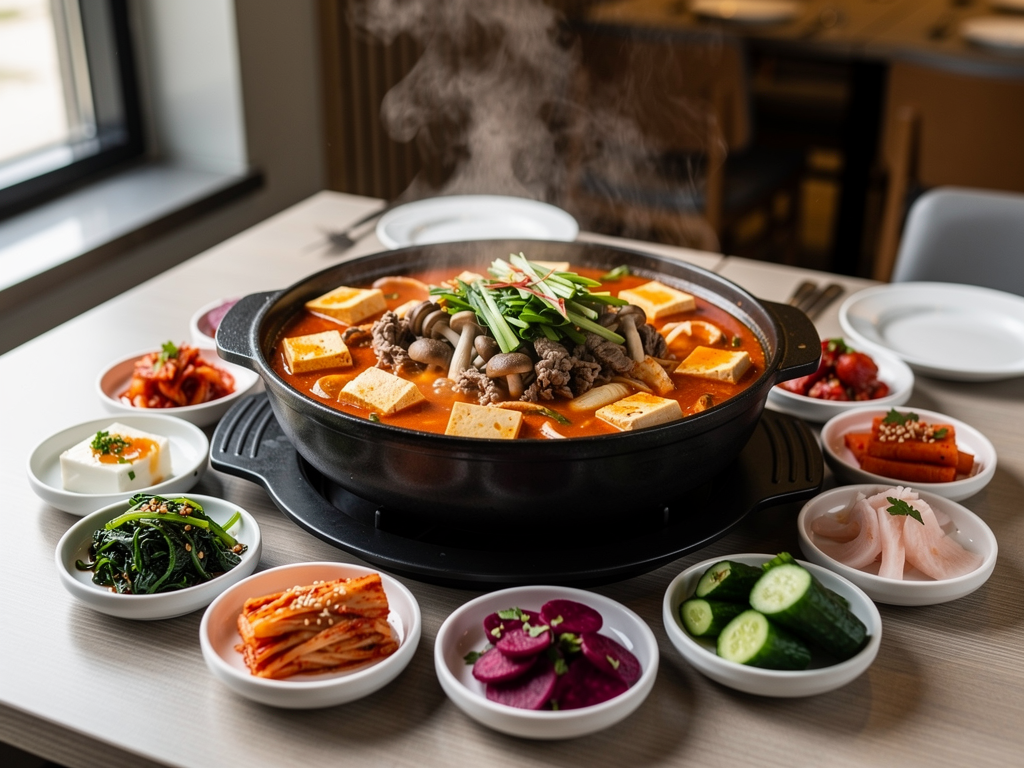
A jjigae gets its flavour from fermented things stirred into the broth — gochujang and gochugaru in the kimchi version, doenjang in the soybean-paste one, aged kimchi in both. It arrives salty, sour and sharp, and it keeps bubbling in its pot on the table so the intensity never lets up.
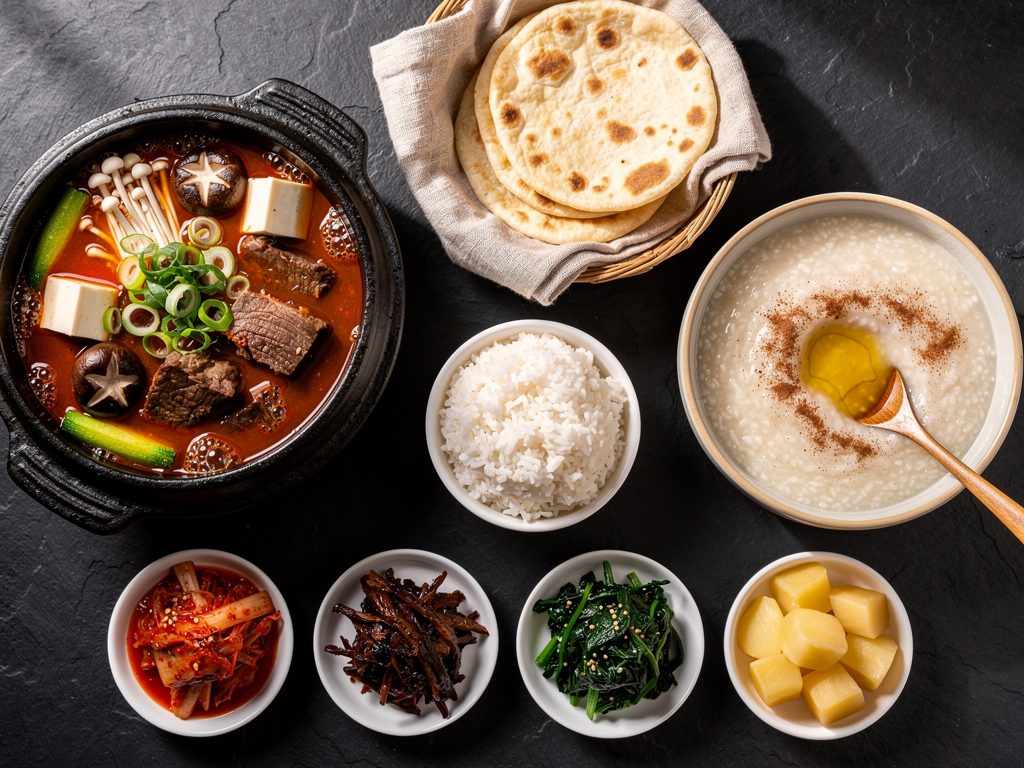
That intensity is deliberate, because a jjigae is not the meal. It is what you eat with plain white rice — one spoonful of stew to several of rice. The neutral rice is the thing that makes a very strong pot survivable across a whole dinner. Remove the rice and the dish stops making sense.
Harees is the exact inverse. Wheat and meat cook together for hours and are then beaten until neither is identifiable — one smooth, pale, savoury mass, closer to a porridge than a stew. It is barely seasoned while it cooks. Salt, ghee, sometimes cinnamon, go on at the table, by the person eating it. Nothing is served beside it because nothing needs to be. Harees is the meal, and the mildness is the point rather than an omission.
That is the whole of jjigae vs harees in one sentence: one dish was engineered to be too strong to eat alone, and the other was engineered to be eaten alone. If you want to be woken up, order the Korean pot. If you want to be settled, order the Emirati one.
They are judged on completely different things
Harees is judged on texture, full stop. The wheat has to break down completely. Khaleej Times, writing about the dish, puts the whole process at around twenty-four hours, beginning the day before with the wheat soaked overnight so the grains go tender enough to disappear. A harees with grain still recognisable in it has failed, however good the meat was. Nobody ever discusses the broth of a harees, because there isn’t one.
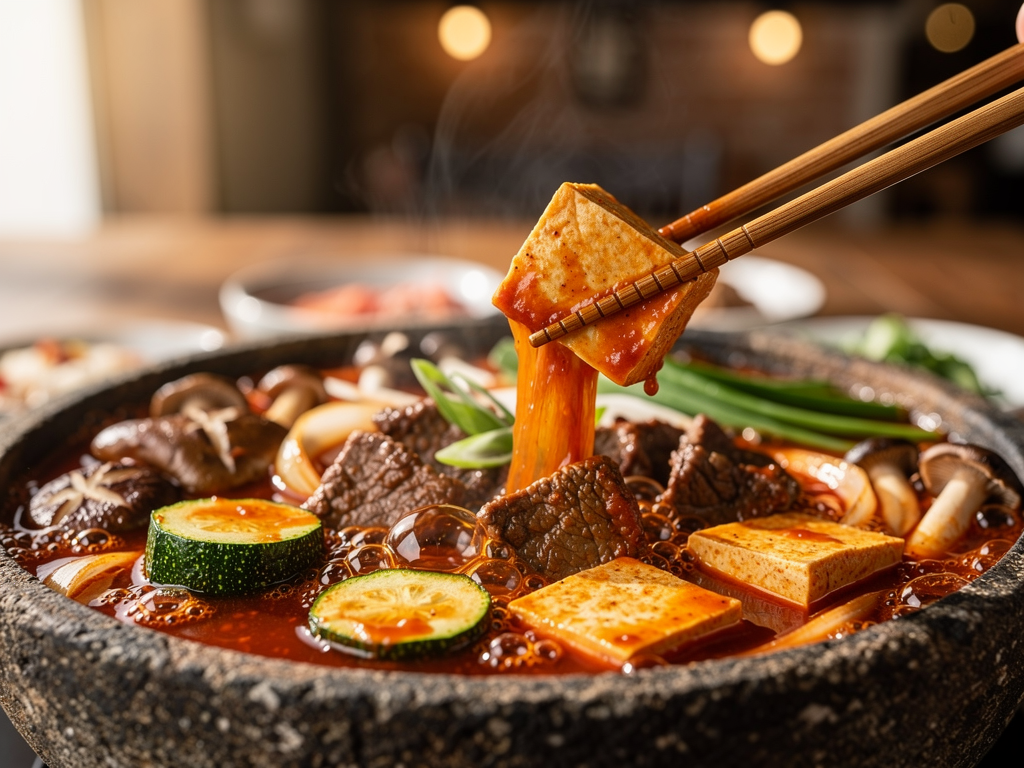
A jjigae is judged on the broth, and its solids are supposed to stay recognisable. Soondubu jjigae makes this explicit: it uses soft, uncurdled tofu that was never pressed into a block, so it arrives in loose folds and collapses gently into the liquid without vanishing into it.
Which means the two fail in opposite directions. You ruin a harees by stopping too early. You ruin a jjigae by boiling it too long.
The availability problem, which is the real story
Here is the practical difference that decides most of these searches, and it has nothing to do with taste.
Harees is occasion food in the UAE — Ramadan, Eid, weddings, National Day. Most residents have eaten it at somebody’s table rather than ordered it in a restaurant, and year-round restaurant availability is genuinely thin. If you have never had harees, the barrier was never the price. It was knowing where it sits on a menu in September.
Arabian Tea House solves that. It prints Harees, meat or chicken, at AED 37 on its standing appetiser menu — not a seasonal list — at five UAE sites, with the Al Fahidi branch open every day from 7:00 to 23:00. That is a sixteen-hour window in which you can simply walk in and order it.
A jjigae is the opposite: relentlessly everyday. In Korea it is weekday lunch rather than celebration food, and that carries over here. Every Korean restaurant on this page prints at least three of them, all year, with no season attached.
Where to eat jjigae in the UAE
Mukbang Shows has the widest published range: Soondubu Jjigae AED 59, Doenjang Jjigae AED 59, Kimchi Jeongol AED 89 sharing or AED 50 solo, and Budae Jjigae AED 99, across five branches in two emirates.
The halal point matters more here than on most pages. Budae jjigae is traditionally built on ham and sausage; this version is made without them, which is the only reason it can appear on a 100% halal menu with no pork and no alcohol anywhere on it. The branches are Deira (Al Ittihad Road, Port Saeed), JBR (Plaza Level, Bahar 7 Unit P33, The Walk), DWTC (The Apartments Block A, Sheikh Zayed Road, opposite the metro station), and Muroor Road and Electra Street in Al Danah, Abu Dhabi.
Two honest caveats. The kimchi stew is printed as Kimchi Jeongol, a wider shared hot pot rather than the single-portion kimchi jjigae most people picture — the AED 50 solo size is the closest match. And the jjigae are à la carte; they are not part of the all-you-can-eat BBQ tiers, which run AED 69, 89, 99 and 129 depending on tier and branch.
Manna Land Korean Restaurant in Al Nahyan, Abu Dhabi has the cleanest line-up in the country and the cheapest: Kimchi Jjigae, Deonjang Jjigae and Soon Tofu, all three at a flat AED 58. If you want to taste the difference between the three fermented bases without a price variable in the way, this is the menu that lets you do it. One address, Abu Dhabi only.
Nuri Grill & Bar at the Hilton Abu Dhabi Yas Island prints Kimchi Stew at AED 80, Sundubu Stew at AED 80 and Budae Jjigae at AED 270 for two — the only menu here that prices a budae jjigae explicitly as a two-person dish. Two things to know: its kimchi stew is listed as pork or beef, so specify beef if that matters, and it is a licensed venue publishing a wine menu alongside its food menu, so alcohol is served.
We cover the Korean side venue-by-venue on separate pages for best soondubu jjigae in Dubai, kimchi jjigae in Dubai and halal budae jjigae in Dubai.
Where to eat harees in the UAE
Arabian Tea House is the most useful address on this page, because it publishes a harees price on a standing year-round menu rather than a Ramadan one. Harees, meat or chicken, AED 37. Its own site describes it as the first authentic Emirati cuisine restaurant since 1997, and describes its food as middle eastern halal food.
The same menu carries the Emirati dishes that sit closest to a jjigae in function: Saloona Deyay AED 62, Saloona Laham AED 76 and Vegetable Saloona AED 58 — all served with white rice or tanoor bread — plus Jareesh Robian at AED 62, shrimp cooked with crushed wheat and black loomi. Jareesh is the coarser relative of harees, where the wheat is cracked rather than beaten smooth.
The honest caveat: harees is on the appetiser section, not the mains. Treat AED 37 as a starter portion rather than a full dinner, and expect a heritage-restaurant pace rather than a quick counter.
Al Fanar Restaurant & Cafe runs five sites — Dubai Festival City, Al Seef, Al Barsha Pond Park, Yas Mall in Abu Dhabi and Al Ain. It describes its harees as rich in creamy texture, made with wheat and slow-cooked meat, and its thareed as a traditional Emirati stew with fresh meat and vegetables. Its own website says the Al Seef branch is selected in the Michelin Guide. It publishes descriptions but no prices, so ask rather than budgeting in advance.
For background there is the harees entry, and Khaleej Times has a piece on harees and where it sits in local food culture.
Thareed and saloona: the closer comparison
If you came here wondering which Emirati dish is genuinely the equivalent of a Korean stew, the honest answer is not harees. It is thareed, or saloona.
Thareed — also spelled tharid, and called fareed or fareeth in some UAE kitchens — is a meat and vegetable stew ladled over a base of thin flatbread that has been torn up and left to soak. Khaleej Times describes it as layers of bread, meat and vegetables, with the meat and vegetables boiled until soft and the stew poured over a thick layer of bread.
Structurally that is exactly what a jjigae does: an intensely flavoured pot that is not eaten alone, poured over a bland starch that soaks it up and turns the whole thing into a meal. Swap the torn bread for a bowl of white rice and the architecture is identical.
The one real difference is timing. In a jjigae the starch stays separate on the side and you alternate, which is why the pot can sit bubbling for twenty minutes and still work. In a thareed the bread is submerged from the moment it is served, so it has to be eaten straight away.
Saloona is the third dish worth naming — a thinner tomato, potato, onion, coriander, lentil and Gulf-spice stew, served with white rice or tanoor bread. And this is where the price comparison finally becomes fair: Vegetable Saloona is AED 58 against Manna Land’s AED 58 jjigae, and Saloona Deyay is AED 62 against Mukbang’s AED 59 soondubu. Three dirhams apart.
So if anyone tells you there is no Emirati equivalent to a Korean stew-and-rice dinner, saloona is the answer, it is on menus all year, and it costs almost exactly the same.
Price at a glance
| Dish | Venue | Where | Price (AED) | Halal status |
|---|---|---|---|---|
| Harees (meat or chicken) | Arabian Tea House | Al Fahidi + 4 UAE sites | 37 | Describes its food as halal |
| Kimchi Jeongol (solo) | Mukbang Shows | 5 branches, Dubai and Abu Dhabi | 50 | 100% halal, no pork, no alcohol |
| Vegetable Saloona | Arabian Tea House | Al Fahidi + 4 UAE sites | 58 | Describes its food as halal |
| Kimchi / Doenjang / Soon Tofu | Manna Land | Al Nahyan, Abu Dhabi | 58 each | Confirm directly |
| Soondubu / Doenjang Jjigae | Mukbang Shows | 5 branches, Dubai and Abu Dhabi | 59 | 100% halal, no pork, no alcohol |
| Saloona Deyay · Jareesh Robian | Arabian Tea House | Al Fahidi + 4 UAE sites | 62 | Describes its food as halal |
| Kimchi Stew · Sundubu Stew | Nuri Grill & Bar | Hilton Abu Dhabi Yas Island | 80 | Licensed venue, alcohol served |
| Budae Jjigae | Mukbang Shows | 5 branches, Dubai and Abu Dhabi | 99 | 100% halal, made without ham or sausage |
All prices were read from each venue’s own published menu on 5 September 2026.
The honest limitation on our side
Read that table from the top and the awkward fact is unmissable: at AED 37, harees is cheaper than every jjigae in this comparison. Cheaper than Manna Land at AED 58, cheaper than our own soondubu at AED 59, and less than half the AED 80 hotel versions.
Some of that is portion — harees is sold as an appetiser and the jjigae are mains-sized pots — but not all of it, and it would be dishonest to pretend otherwise.
There is a second limitation worth stating plainly. Mukbang Shows has nothing on its menu that does what harees does. Korean cooking has its own answer to the gentle, barely seasoned, slow-cooked comfort bowl — it is juk, a rice porridge — and it is not on our menu. If harees is what you actually want tonight, go to Arabian Tea House. We would rather say that than pretend the Korean stew is the same thing.
Which one should you order?
Order a jjigae when you want to be woken up, when there are two or more of you, and when there is plain rice on the table. Pick the doenjang version if you want the format without the chilli — the soybean-paste one is savoury and salty rather than hot, and it is the one to give a table that includes children.
Order harees when you want the opposite: something warm, mild and smooth that asks nothing of you, at the start of a meal or on its own late in the evening. Season it yourself once it arrives. That is not a garnish step, it is how the dish is meant to be finished.
And if what you actually want is a strongly flavoured pot poured over something bland — the real shape of jjigae vs harees as most people imagine it — then order a thareed or a saloona, because that is the dish doing the same job in the local kitchen.
Some background on the Korean side if you want the taxonomy that separates a jjigae from a thinner guk soup and a larger shared jeongol hot pot — a distinction that explains why Mukbang’s kimchi version is printed as a jeongol rather than a jjigae.
FAQ
What is the difference between jjigae and harees?
Seasoning philosophy. A jjigae is a strongly fermented, salty, sour stew designed to be eaten with plain rice. Harees is a deliberately mild wheat-and-meat porridge designed to be eaten alone and seasoned at the table.
Is harees a soup or a porridge?
Neither exactly. It is wheat and meat cooked together for hours and then beaten until they merge into one smooth mass — closer to a savoury porridge than a stew, and eaten with a spoon.
Can you get harees in Dubai outside Ramadan?
Yes, though not in many places. Arabian Tea House prints Harees, meat or chicken, at AED 37 on its standing menu at five UAE sites, with the Al Fahidi branch open every day from 7:00.
Which is cheaper?
Harees, clearly — AED 37 against AED 50 to 80 for the Korean stews here. It is also a smaller, appetiser-sized portion, which is part of the reason.
Is jjigae halal in Dubai?
It depends on the kitchen and on the specific stew. Budae jjigae traditionally uses ham and sausage; Mukbang Shows makes its version without them and is 100% halal with no pork and no alcohol. Some Korean venues here are licensed and list pork options. Our guide to halal Korean food covers what to ask.
What is the Emirati dish closest to a Korean stew?
Thareed or saloona, not harees. Both are a strongly flavoured pot served over a bland starch — bread for thareed, rice or bread for saloona — which is exactly what a jjigae does with white rice.
Is jjigae very spicy?
Kimchi and soondubu versions usually are. Doenjang jjigae, the soybean-paste one, is savoury and salty rather than hot, and is the one to order if you want the format without the chilli.
How long does harees take to make?
Khaleej Times puts the full process at around twenty-four hours, with the wheat soaked overnight before cooking even starts.
Jjigae vs harees is not a contest with a winner. It is two cuisines answering the same question — what do you eat slowly, with a spoon, when you want comfort — and arriving at opposite conclusions. One decided the pot should be overwhelming and handed you rice to manage it. The other decided the bowl should be gentle and handed you the salt.
Related guides
More from our Korean food guides across the UAE: