
Updated: August 2026
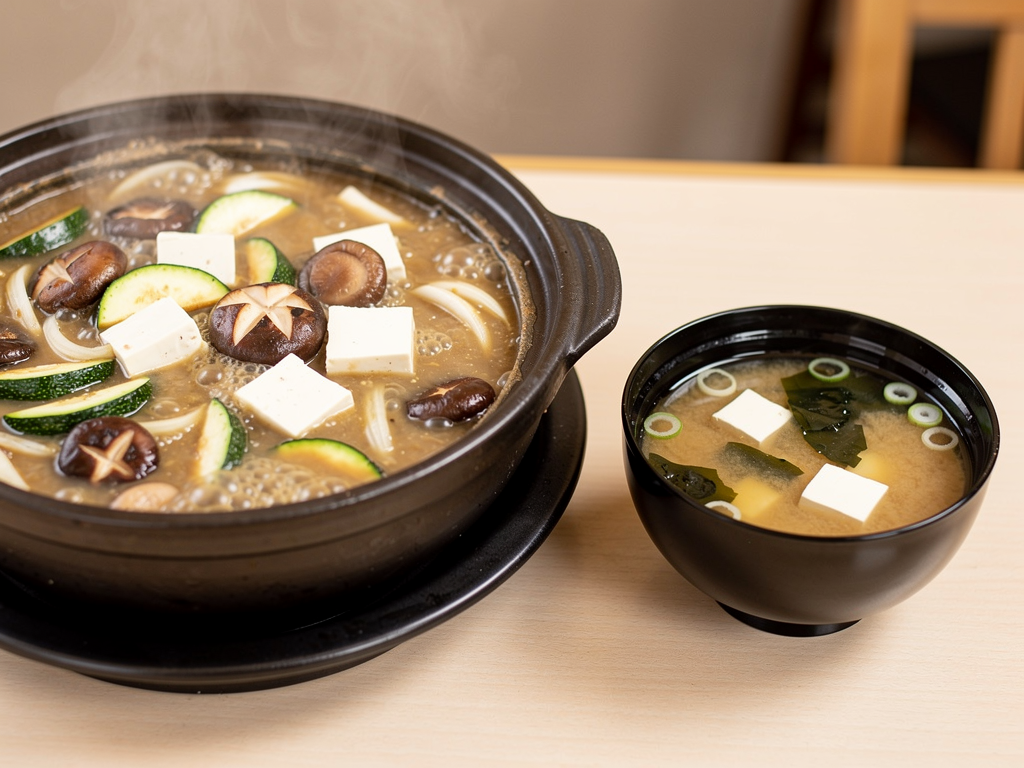
The short version of doenjang jjigae vs miso soup: both are fermented soybean paste in a fish-based broth, so the confusion is fair, but one is a shared main course and the other is a small individual side. Order doenjang jjigae and you are ordering dinner, usually AED 48 to 59 in the UAE.
TL;DR
– Same family: both are fermented soybean paste dissolved in a broth built on dried fish and kelp
– Different pastes: miso is fermented with a mould on rice or barley; doenjang starts as meju blocks and shares a crock with soy sauce
– Different jobs: miso soup is a thin side you drink from the bowl; doenjang jjigae is a thick stew you eat with rice and a spoon
– Different money: miso soup usually arrives inside a Japanese meal; doenjang jjigae is a AED 48 to 59 dish in its own right
What is the real difference between doenjang jjigae vs miso soup?
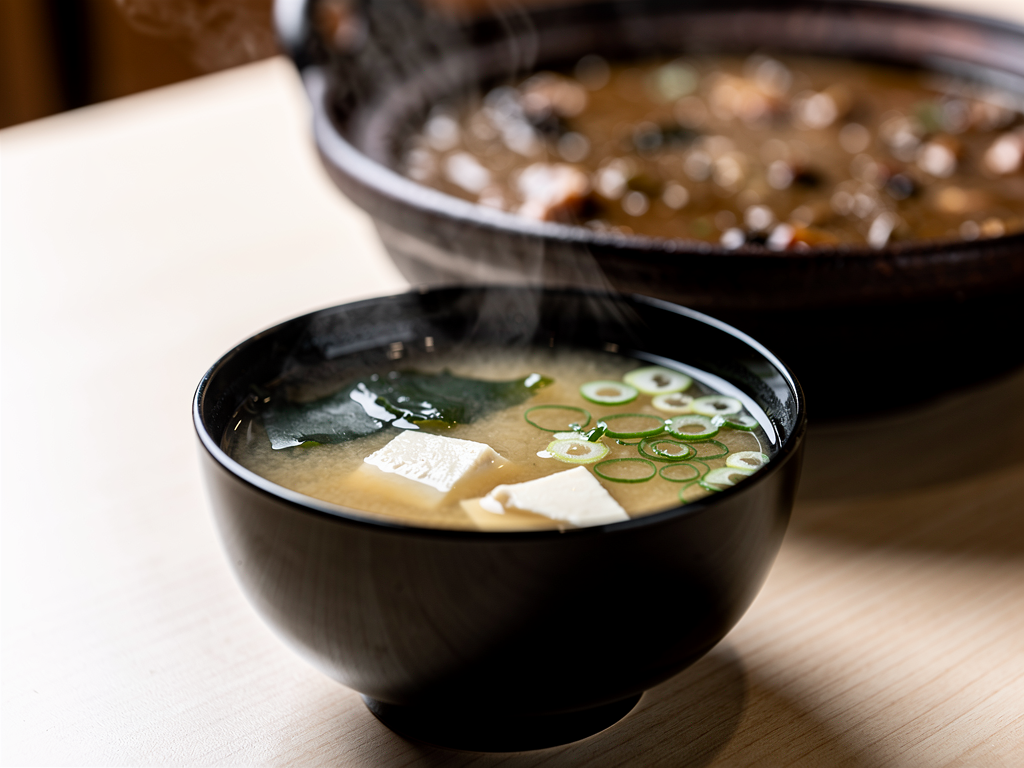
They are not the same category of food. Miso soup is a thin liquid served in a small lidded lacquer bowl that you drink directly, with the few solids picked out using chopsticks. Doenjang jjigae is a thick stew, served bubbling in an earthenware pot, loaded with tofu, potato, courgette, onion and often beef brisket or shellfish, and eaten with rice.
The reason people mix them up is genuinely good: both are fermented soybean paste in a broth made from dried fish and kelp. If your only reference point is the small bowl that arrives with sushi, a Korean menu listing “soybean paste stew” reads like the same thing at a different restaurant.
It is not. Someone expecting a light soup and receiving a bubbling pot of stew is not disappointed so much as ambushed. That is worth knowing before you order, particularly if you have already ordered a main.
How are the two pastes actually made?
This is where doenjang jjigae vs miso soup separates, and it explains everything you taste later. Miso is produced by fermenting soybeans with salt and the mould Aspergillus oryzae, known as kōjikin, and the ferment usually includes rice or barley too. Longer fermentation gives darker, stronger miso; shorter gives the pale, mild styles.
Doenjang takes a different route. It starts as meju: blocks of cooked, mashed soybeans that are formed, dried and fermented before they are ever brined. The blocks then age in salt water, and the crock is eventually separated. The liquid drawn off becomes ganjang, Korean soy sauce. The solids left behind become doenjang.
That split is unusual in the world of fermented seasonings, and it is the useful fact here: Korean soy sauce and Korean soybean paste are siblings from the same vessel. Miso has no such relationship — the paste is the whole product.
The result is a paste that is coarser, saltier and more openly funky than miso, which lands rounder and faintly sweet from its rice or barley component. The background on doenjang jjigae and its anchovy-and-radish broth goes further into the fermentation if you want the detail.
Why one gets boiled hard and the other does not
Doenjang jjigae is built by boiling the paste into the stew. That is why it arrives at a rolling boil and keeps concentrating at the table — and why it tastes progressively saltier the longer it sits, which is the single most common complaint from people eating it for the first time.
Miso soup is built the other way round. The paste is dissolved into a finished dashi. Heating miso does kill the live microorganisms in it, which — contrary to a widely repeated claim — does not remove its nutritional value.
The practical consequence at the table: a doenjang jjigae wants to be eaten steadily and with rice, in the first few minutes. A bowl of miso soup can sit next to your food for the whole meal and be fine.
Are the broths the same?
Closer than most people expect. A doenjang jjigae broth is made by boiling dried anchovies and white radish, then stirring in the paste and Korean chilli before the vegetables and tofu go in. Miso soup’s dashi is usually niboshi — dried baby sardines — or kombu kelp, katsuobushi bonito shavings, or dried shiitake, with kelp or mushroom being the vegetarian route.
So both are, at heart, a fish-and-seaweed stock carrying a soybean paste. Neither is built on a meat broth. That matters for the question UAE diners actually ask about Korean stews: the pork issue that comes up with budae jjigae or with canonical restaurant kimchi jjigae does not arise with either of these two dishes.
It also matters for vegetarians in the opposite direction. Both default broths contain fish, so “no meat” and “vegetarian” are not the same request here, and you have to ask about the stock rather than the toppings. The detail on how miso soup and its dashi stock are made is worth a look if you are cooking either at home.
What each dish is doing in its own cuisine
Miso soup is structural. In a traditional Japanese meal it is the soup component sitting alongside rice and a main, and it turns up at breakfast as readily as at dinner. Nobody builds an evening around it. Its job is to be reliably there, warm and savoury, while the rest of the meal changes around it.
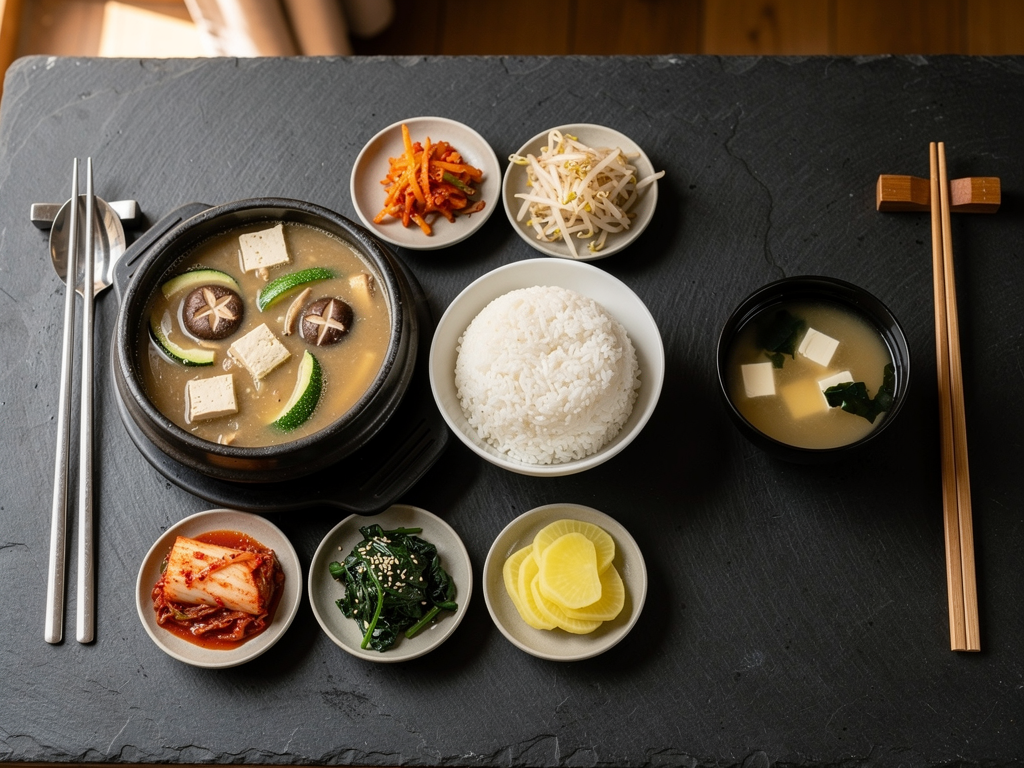
Doenjang jjigae is the opposite. It is a centrepiece of Korean home cooking — the pot that goes in the middle of the table with rice and banchan around it, and the dish a lot of Koreans name when asked what their mother cooks. It is not a component of a meal; it is the meal, which is why it comes in a vessel built to keep boiling.
That difference in status explains why the pricing looks so strange when you line the two up in the UAE. A restaurant charges AED 48 to 59 for the Korean stew because it is selling you dinner. It charges nothing separately for miso soup because that soup is part of the format of the meal you already ordered.
It also explains portion logic. A doenjang jjigae is comfortably shared between two people with rice, and one person can finish it alone if they are hungry. A miso soup is a single serving, always, and asking for a large one misunderstands what it is for. The Korea Tourism Organization’s Korean food guide sets the Korean side of that in the context of everyday eating.
Doenjang jjigae vs miso soup: the side-by-side comparison
| Doenjang jjigae (된장찌개) | Miso soup (味噌汁) | |
|---|---|---|
| Cuisine | Korean | Japanese |
| Paste | Doenjang, from meju blocks fermented before brining; shares its crock with soy sauce | Miso, fermented with Aspergillus oryzae mould, usually on rice or barley |
| Taste | Coarser, saltier, openly fermented | Smoother, rounder, faintly sweet |
| Broth | Boiled dried anchovy and white radish | Dashi: niboshi, kombu, katsuobushi or dried shiitake |
| Body | Thick, murky, full of solids | Thin, holds a few small pieces |
| Typical contents | Tofu, potato, courgette, onion, chilli, often beef brisket, prawns or clams | Tofu, wakame, spring onion, sometimes mushroom, daikon or abura-age |
| Heat handling | Paste is boiled into the stew | Paste is dissolved into a finished stock |
| Vessel | Earthenware pot, arrives bubbling | Lidded lacquer bowl, drunk from the bowl |
| Role in the meal | Shared main course, eaten with rice | Individual side, including at breakfast |
| UAE price | AED 48 to 59 where published | Rarely sold alone; part of a Japanese meal |
What does each one cost in the UAE?
Only a handful of UAE kitchens publish a price for doenjang jjigae at all. The cheapest published bowl is at The Korean Restaurant, also trading as Hanok, in International City, at AED 48 for the vegetarian version and AED 53 with chicken or beef. Manna Land in Abu Dhabi publishes AED 58. Mukbang Shows publishes AED 59 across all five of its branches.
Seoul Garden in Al Karama, trading since 1999, serves a chadol doenjang — the beef brisket build — and its Korean food-mall arm sells a retail pack of two 700ml portions at AED 68, though it does not publish a dine-in price. Madang in Abu Dhabi lists a soybean paste stew on its own website with no price attached.
Miso soup cannot be compared on price in any meaningful way, and that is the clearest evidence that these are different categories. It is not usually sold as a standalone dish — it arrives as part of a Japanese meal or as a small side. A dish you order and a dish that arrives are not competing with each other.
Is either dish halal in the UAE?
Neither dish is built on pork or a meat stock, which removes the question people usually arrive with. Doenjang jjigae’s standard proteins are beef brisket, clams, prawns or nothing at all, and both broths are fish, kelp or mushroom based.
What varies is the rest of the kitchen. Cooking sake and mirin are routine ingredients in Japanese cooking, so if you need an alcohol-free kitchen, that is a question to ask the venue rather than an assumption to make from the dish name. Korean kitchens vary too, and almost no Korean restaurant in the UAE publishes a halal certificate — the honest instruction everywhere is to confirm directly.
The one venue in this guide publishing a clear position is Mukbang Shows: 100% halal, beef and chicken only, no pork and no alcohol anywhere on the premises, with the stew at AED 59. Its honest limitation is that it does not serve miso soup, because it is a Korean kitchen — you cannot taste both sides of this comparison at one table there. For the wider halal picture, see our guide to whether Korean food is halal.
Which should you order?
If you want something warm and light alongside other food, miso soup. It is a side, it stays a side, and asking it to be dinner will disappoint you.
If you want dinner, doenjang jjigae. With rice and banchan it is a full meal for one person and a comfortable shared dish for two. It is also the better order if you actively like fermented flavours — it goes further in that direction than miso does, and it does not hide behind chilli the way the redder Korean stews do.
If you are new to Korean stews altogether and want something closer to the comfort of miso soup, soondubu jjigae is the softer, silkier option, built on uncurdled tofu. Our soondubu jjigae explainer covers how it differs from both dishes here.
And if you are ordering for a table where someone wants a light soup and someone else wants a main, order both. They were never in competition — that is the whole point of this comparison.
Where to try doenjang jjigae in Dubai and Abu Dhabi
In Dubai, the cheapest published bowl is The Korean Restaurant in International City at AED 48 to 53, and the most convenient options are Mukbang’s three branches — Deira on Al Ittihad Road, JBR on The Walk, and Love Mukbang opposite World Trade Centre metro station — all at AED 59. Seoul Garden in Al Karama is the one to pick if you specifically want brisket in it. Our Dubai doenjang jjigae guide has the full comparison.
In Abu Dhabi the field is narrower. Manna Land on Al Muroor Road publishes AED 58 and is the stew-first kitchen in the city; Mukbang’s Muroor Road and Electra Street branches publish AED 59; Madang in Al Sa’adah lists the dish on its own site without a price. Several other Korean venues in the capital do not carry a stew section at all, which our Abu Dhabi doenjang jjigae guide sets out venue by venue.
Miso soup, by contrast, is on effectively every Japanese menu in both cities, which is exactly why the comparison comes up so often in the first place.
Four things worth knowing before you order
Ask about the stock, not the toppings, if you are cooking around a vegetarian. Both dishes default to a fish-based broth, and the visible ingredients tell you nothing about that.
Get rice to the table with the stew, not after it. Doenjang jjigae concentrates as it reduces, and rice is what keeps it balanced from the first spoonful to the last.
Do not order doenjang jjigae as a starter. It is a main course in Korea and it will fill you before the grilled food arrives. If you want a soup-shaped opener, that is what miso soup does well.
Check the price before you assume. Most UAE Korean kitchens do not publish dish-level prices, so the AED 48 to 59 range quoted here comes only from the venues that do. A two-minute phone call is the difference between a plan and a guess. The full Mukbang Shows menu is published if you want a fixed reference point.
FAQ
Is doenjang jjigae just Korean miso soup?
No. Doenjang jjigae is a thick shared stew eaten with rice as a main course; miso soup is a thin individual side. The pastes are also made differently — one by mould fermentation on rice or barley, the other from meju blocks.
Which is saltier, doenjang or miso?
Doenjang generally tastes saltier and funkier, and a doenjang jjigae gets saltier still as it reduces at the table. Miso is rounder and slightly sweeter, and miso soup does not concentrate in the same way.
Can I substitute miso for doenjang in a stew?
You can, but it will not taste like doenjang jjigae. Miso is smoother and sweeter, and it is not built to be boiled hard the way doenjang is in a jjigae.
Are doenjang jjigae and miso soup vegetarian?
Usually not. Both are traditionally built on fish stocks — dried anchovy and radish for the Korean stew, and a dashi that commonly uses dried sardines or bonito for the soup. Ask about the stock directly.
Is doenjang jjigae spicy?
Only mildly. It carries some Korean chilli, but its character is fermented and savoury rather than hot. Kimchi jjigae and soondubu jjigae are the spicier Korean stews.
How much is doenjang jjigae in the UAE?
Where it is published: AED 48 vegetarian or AED 53 with chicken or beef at The Korean Restaurant in International City, AED 58 at Manna Land in Abu Dhabi, and AED 59 at Mukbang Shows across five branches.
Does any UAE restaurant serve both dishes?
Some Korean-Japanese menus do, but the two guides linked above cover Korean kitchens specifically. Mukbang Shows serves doenjang jjigae and does not serve miso soup.
The honest summary of doenjang jjigae vs miso soup is that the family resemblance is real and the meal they belong to is not. Both are soybean paste in a fish broth; one is the meal, the other keeps it company.
Related guides
More from our Korean food guides across the UAE:
Comments are closed.