Updated: September 2026
Japchae vs pancit comes down to one word: pancit names a family of Filipino noodles, and the second word on the menu tells you which one, while japchae names one Korean dish made with sweet-potato glass noodles. On UAE menus read in September 2026, a pancit costs AED 25–52 and a japchae AED 50–58.
Quick answer
- Same idea: noodles stir-fried with soy, vegetables and a little protein, served at birthdays and family tables.
- Different noodle: japchae is always sweet-potato glass noodle (dangmyeon); pancit is rice (bihon), wheat-and-egg (canton) or cornstarch under shrimp sauce (palabok/luglug).
- Different price shape: Filipino menus price three pancit at one flat figure (AED 25 at Gerry’s Grill, AED 37 at Max’s); Korean menus print one japchae line (AED 50–58).
- Halal: Mukbang Shows cooks beef and chicken only, with no pork and no alcohol; for every Filipino kitchen below, read the printed protein and confirm directly.
What is the real difference between japchae vs pancit?
The real difference is that pancit is a category and japchae is a single dish. Wikipedia defines pancit as “a general term” for Filipino noodle dishes, so a Manila waiter will ask “which one?” Japchae only ever means stir-fried sweet-potato glass noodles, so the only question in Seoul is how many plates.
That one fact explains almost everything else on this page. A Filipino menu has to add a second word (bihon, canton, palabok, luglug, sotanghon, Molo), and each one changes the noodle and sometimes the whole dish. A Korean menu writes “Japchae” and stops. Some Korean kitchens add a protein choice, but the noodle never changes.
Why do Filipinos call japchae “Korean pancit”?
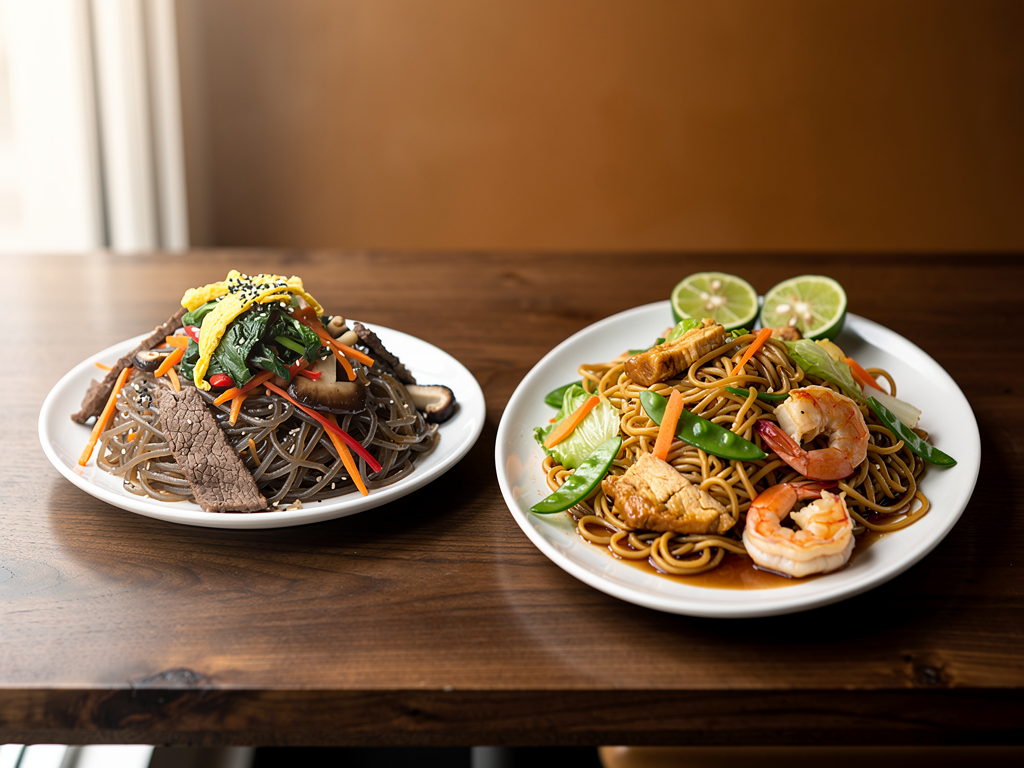
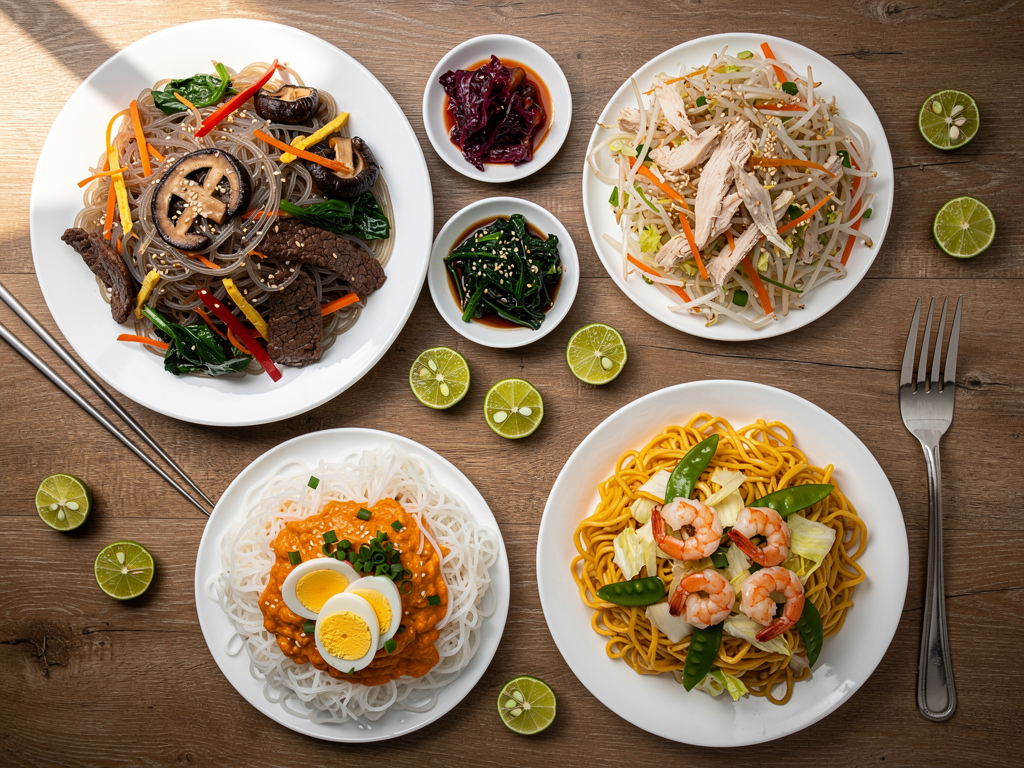
Filipino diners in the UAE already call japchae “Korean pancit”, and the nickname is half right. The technique really is the same: noodles tossed in a hot pan with soy sauce, garlic, sliced vegetables and a modest amount of meat or seafood, then served in a heap to share. Put a plate of japchae next to a plate of pancit bihon and a Filipino diner reads it as “the Korean version” immediately.
The history rhymes too. Noodles “were introduced to the Philippines by Chinese immigrants”, and the word pancit comes from Philippine Hokkien for “convenient food”. Japchae’s glass noodles were also introduced to Korea from China, although only in the 20th century. The dish itself is older. Wikipedia credits Yi Chung (1568–1619) with creating it for King Gwanghaegun’s palace banquet, where it was cooked without noodles or meat. The name means “mixed vegetables”, and the noodle came much later.
Where the nickname breaks is the noodle. The only pancit made with a cellophane (glass) noodle is pancit sotanghon, a chicken-broth soup rather than a stir-fry. None of the four Filipino menus read for this guide prints it. So “Korean pancit” is exact for the method and wrong for the noodle.
What noodle is used in japchae and in each pancit?
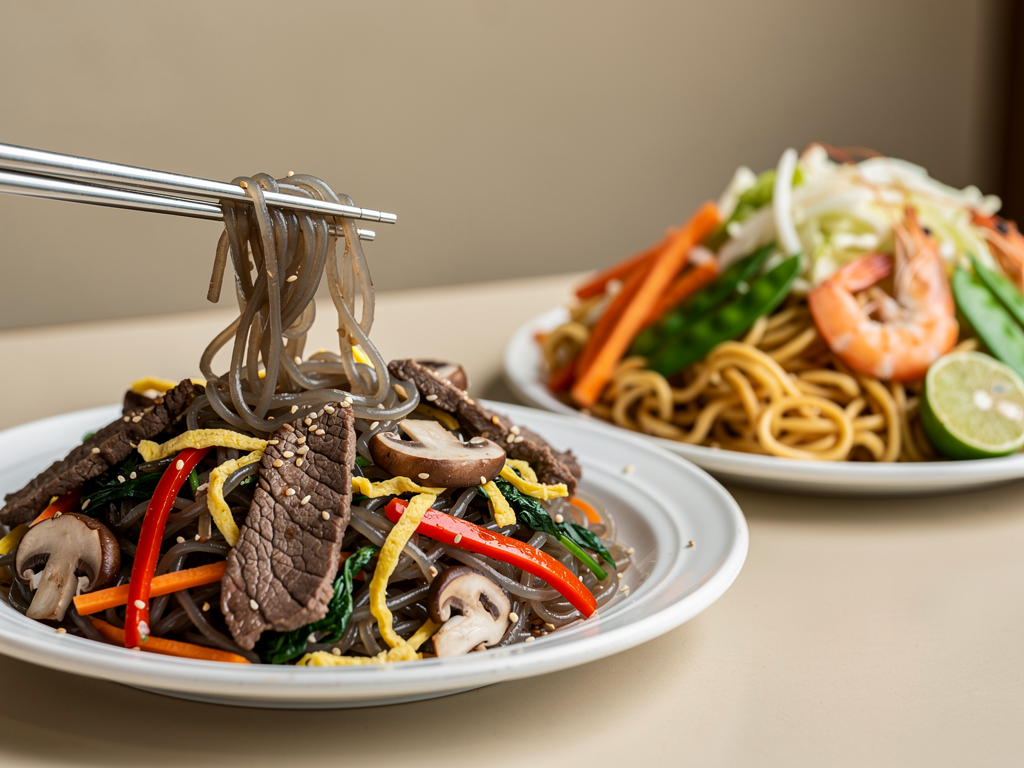
Japchae always uses dangmyeon, cellophane noodles made from sweet-potato starch. They cook up translucent grey-brown, springy and slightly slippery, and they stay chewy even at room temperature. They contain no wheat, which is why japchae is often suggested to gluten-conscious diners (the soy sauce is still worth asking about).
Pancit changes noodle with its second word:
| Pancit on the menu | Noodle | How it is served | UAE example read |
|---|---|---|---|
| Pancit bihon | very thin rice vermicelli | stir-fried with soy, vegetables, chicken or seafood | Max’s AED 37, Kooya AED 45, Gerry’s AED 25 |
| Pancit canton | wheat and egg noodle | stir-fried, a Filipino take on lo mein and chow mein | Max’s AED 37, Kooya AED 44 (crispy), Chowking AED 42 |
| Pancit palabok / luglug | thin or thick cornstarch or rice noodle | under an orange shrimp sauce with egg and toppings | Kooya AED 52, Max’s AED 37, Gerry’s AED 25 |
| Pancit sotanghon | glass (cellophane) noodle | a chicken-broth soup | not printed on the menus read |
| Pancit Molo | none; wonton wrappers | a wonton soup | Kooya AED 43 |
| Japchae | sweet-potato glass noodle | stir-fried, served warm, room-temperature or cold | Mukbang AED 55, Hanok AED 50, Manna Land AED 58 |
Pancit Molo is the clearest proof that pancit is a family name, not a noodle. It carries the word on Kooya’s menu without containing any noodle at all.
How do japchae and pancit taste different?
Japchae tastes sweeter, nuttier and more delicate. It is seasoned with soy sauce and sesame oil plus a little sugar, and it gets its savoury depth from mushrooms and thin strips of beef. The glass noodle carries flavour on its surface rather than soaking it up, so every strand stays glossy and separate.
Pancit tastes saltier and brighter. Bihon and canton lean on soy and garlic, and pancit is traditionally served with calamansi to squeeze over, which adds a sharp citrus note japchae never has. Palabok is a different animal again: a rich, orange, shrimp-forward sauce over soft noodles, topped with egg and crunchy bits.
Texture is where most people notice the gap. Bihon is fine and soft, canton is springy and wheaty, and japchae is bouncy, a chew some first-timers compare to jelly. If you like al dente noodles, japchae usually wins. If you like noodles that soak up the sauce, go for bihon.
Where can you order pancit in Dubai and Abu Dhabi?
You can order pancit at every Filipino restaurant in the UAE. Four menus were read in full for this guide. Time Out Dubai’s guide to the best Filipino food in Dubai lists many more kitchens, including Dampa, Lamesa, Luneta, Manila 21 and Tapa King, but it prints no prices, so they are not priced here.
Max’s Restaurant: Karama and Reef Mall Deira in Dubai, the Abu Dhabi Corniche and Mega Mall Sharjah. Max’s own menu prints Pancit Bihon (“stir-fried rice noodles with vegetables and chicken”), Pancit Canton (“egg noodles with chicken, chicken balls, and shrimp”) and Pancit Luglug (“thick rice noodles in rich shrimp sauce”), all at AED 37. Rice is a separate line (plain AED 9, unlimited AED 11). Max’s Family Meals A and B each include a pancit tray: Family Meal A with bihon is AED 290 for 4–5 people and AED 570 for 8–10.
Kooya Filipino Eatery: Jannah Place Hotel, Dubai Marina. It has the widest and most carefully described pancit list read: Palabok ni Kooya (annatto shrimp sauce, fried chicken skin) AED 52, Pancit Bihon Guisado (shrimp, squid ball, chicken) AED 45, Crispy Pancit Canton with chicken inasal AED 44, and Pancit Molo AED 43. Its PDF menu states that prices include 5% VAT.
Gerry’s Grill: Al Karama in Dubai and Al Wahda Mall in Abu Dhabi. Its Talabat listing files Pancit Palabok, Canton and Bihon under Merienda, the Filipino afternoon snack, at AED 25 each, with Lomi soup at AED 29. These are delivery-app prices.
Chowking: branches across the UAE, including Al Barsha 1. This Filipino-Chinese chain prints Stir-Fry Canton Noodles at AED 42 on Deliveroo, and its group packages treat “Canton Guisado / Bihon / Chicken Hakka” as one interchangeable slot. That is the pancit-as-category idea printed on a menu.
Where can you order japchae in Dubai and Abu Dhabi?
Japchae is on every Korean menu in the UAE, always as one line. Three were read for this guide.
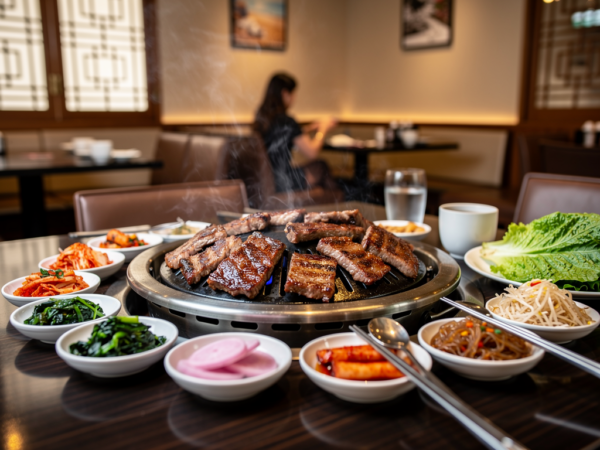
Mukbang Shows prints Japchae at AED 55 across five branches: Deira (Al Ittihad Rd, Port Saeed), JBR (The Walk) and DWTC (Sheikh Zayed Rd) in Dubai, plus Muroor Road and Electra Street in Abu Dhabi. It is beef and vegetables on sweet-potato glass noodle, from a kitchen that serves beef and chicken only, with no pork and no alcohol. The same table can add unlimited Korean BBQ from AED 69 a person. For the full dish breakdown, see our guide to japchae.
The Korean Restaurant (Hanok), International City, Dubai, prints “JAPCHAE — Stir-fried Sweet Potato Noodles and Vegetables” at AED 50 with a veg, chicken or beef choice at the same price. It also sells a Japchae Lunch Box with side dishes at AED 38, the cheapest way to try the dish that we found.
Manna Land, Al Nahyan, Abu Dhabi, prints Japchae “stir fried in sesame oil with beef and vegetables” at AED 58.
More options by city are in our guide to japchae in Dubai and our guide to japchae in Abu Dhabi.
How do japchae vs pancit prices compare in the UAE?
On every menu read, pancit is cheaper. The Filipino plates run AED 25–52 and the Korean plates AED 50–58, with Hanok’s AED 38 lunch box as the one exception. The gap comes from where each dish sits on the menu, not from portion claims, since no menu read states a weight.
| Venue | Dish | Price (AED) | Source |
|---|---|---|---|
| Gerry’s Grill, Karama | Pancit Palabok / Canton / Bihon | 25 each | Talabat (delivery app) |
| Max’s Restaurant | Pancit Bihon / Canton / Luglug | 37 each | own menu |
| Chowking | Stir-Fry Canton Noodles | 42 | Deliveroo (delivery app) |
| Kooya, Dubai Marina | Canton 44 · Bihon 45 · Palabok 52 | 44–52 | own menu, VAT incl. |
| Hanok, International City | Japchae Lunch Box · Japchae | 38 · 50 | own menu, VAT incl. |
| Mukbang Shows | Japchae | 55 | own menu |
| Manna Land, Abu Dhabi | Japchae | 58 | own menu |
Two patterns stand out. Filipino kitchens price the family flat: Max’s charges AED 37 whatever the noodle, and Gerry’s charges AED 25. Only Kooya lets the shrimp-sauce palabok cost more. Korean kitchens price the dish flat: Hanok charges AED 50 whatever the protein. Neither side charges you for choosing a noodle.
Is pancit a snack and japchae a side dish?
Partly, and the menus show it. Gerry’s Grill files pancit under Merienda, the afternoon snack. Max’s and Kooya file it with rice, and Max’s and Chowking fold a pancit tray into their family packages alongside fried chicken, soup and rice. In the Philippines, pancit at a birthday is about long life, because the long noodles symbolise it.
Japchae plays two roles in Korea. Wikipedia notes it is eaten “as a banchan (side dish) or main course” and is one of the most popular celebration dishes at weddings, birthdays and holidays. At a Korean BBQ table in the UAE, one plate is usually shared as a side while the grill does the heavy lifting.
Which is better for a group in the japchae vs pancit choice?
For a big Filipino family meal, pancit is built for it. Max’s Family Meal A at AED 290 feeds 4–5 people and already includes a pancit bihon tray with the rest of the spread. Chowking’s Package C at AED 264 carries a choice of noodle trays.
For a Korean group dinner, japchae works best as one shared plate beside the grill. At Mukbang that means one AED 55 japchae on the table while everyone eats unlimited beef and chicken BBQ from AED 69 a head. If the goal is noodles as the main event, pancit is the cheaper and more varied order. If noodles are the side act to a grill, japchae fits the table better.
Is japchae vs pancit halal in the UAE?
Mukbang’s japchae is halal-friendly by menu design. The kitchen cooks beef and chicken only, serves no pork and no alcohol, and uses beef in its japchae. For pancit, read the printed protein line and then confirm directly with the restaurant. In the Philippines pancit is often cooked with pork, and UAE menus vary.
Here is what the menus read for this guide actually print:
- Max’s: canton with “chicken, chicken balls, and shrimp”; bihon with “vegetables and chicken”. Max’s wider menu is not a halal-only menu, so confirm directly.
- Kooya: bihon with “shrimp, squid ball, chicken”; canton with “chicken inasal”. Confirm directly.
- Gerry’s Grill: bihon with “vegetables, meat, and seafood”, and the meat is not named. Confirm directly.
- Chowking: canton described with vegetables only. Confirm directly.
None of these lines prints pork, but printed lines are not a certification, so ask the kitchen.
Which is healthier, japchae or pancit?
In the japchae vs pancit health question, neither is a diet dish. Both are stir-fried noodles with oil, soy sauce and a modest amount of protein. The honest differences are ingredient-level. Japchae’s sweet-potato glass noodle contains no wheat, and the dish usually carries more vegetables and mushrooms than meat. Pancit canton uses a wheat-and-egg noodle, while bihon uses rice. Palabok’s shrimp sauce and crunchy toppings make it the richest pancit on the list. If sodium matters to you, ask either kitchen to go light on the soy.
Which should you order: japchae or pancit?
Order pancit if you want the cheapest good noodle plate in the city (Gerry’s AED 25), a family tray with fried chicken and rice (Max’s), or a choice of noodle textures. Kooya’s palabok is the one to try if you have never had the shrimp-sauce style.
Order japchae if you want the chewy, glossy glass noodle that stays good at room temperature, a sweeter sesame flavour, a wheat-free noodle, or a shared side next to Korean BBQ. Mukbang’s AED 55 plate is the one to pick if you want a kitchen that cooks beef and chicken only.
The honest limitation: Mukbang sells no pancit of any kind: no bihon, no canton, no palabok. At AED 55, its japchae is priced to share, not to eat alone as an afternoon snack. If you want a solo noodle plate for AED 25–37, a Filipino kitchen is the better call.
Readers comparing more noodle pairs can go on to our japchae vs chow mein comparison, our japchae vs pad thai comparison, our japchae vs yakisoba comparison or our guide to Korean noodles in Dubai.
The wider cuisine comparison is in our Korean food vs Filipino food guide. For the history of each dish, the encyclopaedia entry on japchae and the encyclopaedia entry on pancit are the best starting points.
Japchae vs pancit at a glance
| Japchae (잡채) | Pancit | |
|---|---|---|
| What the word means | one dish (“mixed vegetables”) | a family of noodle dishes (“convenient food”) |
| Noodle | sweet-potato glass noodle, always | rice, wheat-and-egg, cornstarch or glass, depending on the second word |
| Seasoning | soy, sesame oil, a little sugar | soy, garlic, calamansi to squeeze; shrimp sauce for palabok |
| Served | warm, room-temperature or cold | hot |
| Role | side dish or main; celebration food | snack, rice side or family tray; birthday food for long life |
| UAE price read | AED 50–58 (lunch box 38) | AED 25–52 |
| Came from China? | the noodle did, in the 20th century | yes, with Chinese immigrants |
FAQ
Is japchae the same as pancit?
No. Japchae is one Korean dish made with sweet-potato glass noodles, while pancit is the Filipino name for a whole family of noodle dishes. The cooking method is similar, which is why Filipinos nickname japchae “Korean pancit”, but the noodle usually differs.
Which pancit is closest to japchae?
Pancit sotanghon uses the same kind of glass noodle, but it is a chicken-broth soup rather than a stir-fry. Among the stir-fried pancit, bihon is closest in look and seasoning, although it uses a thin rice noodle.
Is japchae gluten-free?
The sweet-potato glass noodle contains no wheat, but regular soy sauce does. If you need it strictly gluten-free, ask the kitchen which soy sauce it uses.
How much does pancit cost in Dubai?
On the menus read in September 2026, pancit costs AED 25 at Gerry’s Grill on Talabat, AED 37 at Max’s Restaurant, AED 42 for canton at Chowking and AED 44–52 at Kooya in Dubai Marina.
How much does japchae cost in Dubai and Abu Dhabi?
Japchae is AED 55 at Mukbang Shows, AED 50 at The Korean Restaurant (Hanok) in International City, with a AED 38 lunch box, and AED 58 at Manna Land in Abu Dhabi.
Is japchae at Mukbang Shows halal-friendly?
Yes. Mukbang Shows cooks beef and chicken only, serves no pork and no alcohol, and makes its japchae with beef and vegetables.
Does Mukbang Shows serve pancit?
No. Mukbang Shows is a Korean restaurant and serves japchae, not pancit. For pancit, visit a Filipino kitchen such as Max’s, Kooya, Gerry’s Grill or Chowking and confirm the protein directly.