Updated: September 2026
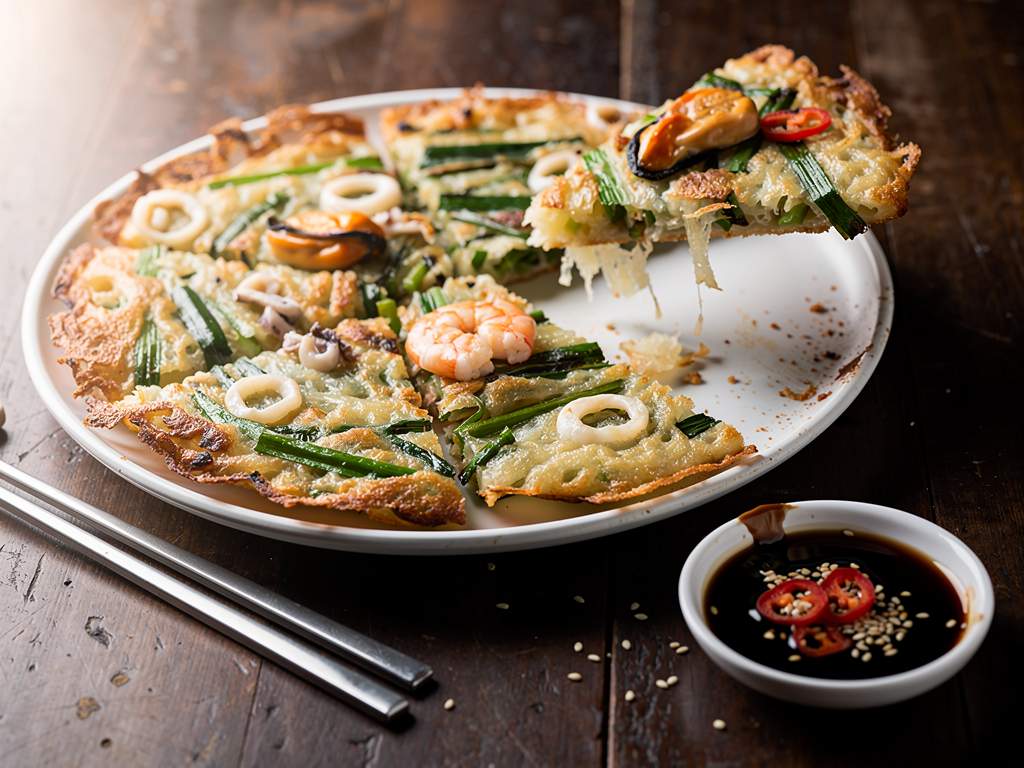
Jeon is not one dish. It is a Korean cooking method: something sliced or chopped — spring onion, kimchi, courgette, potato, oysters, seafood — is coated in flour and egg or folded into a thin batter and pan-fried in oil until the edges go crisp. The short answer to what is jeon is that the word covers a whole family of savoury pancakes, and the reason it confuses people in Dubai and Abu Dhabi is that English menus here flatten all of them into the single word “pancake”. This guide explains the family, shows what five UAE menus charge for it, and deals with the spelling mess and the halal question.
Jeon is a method, not a recipe
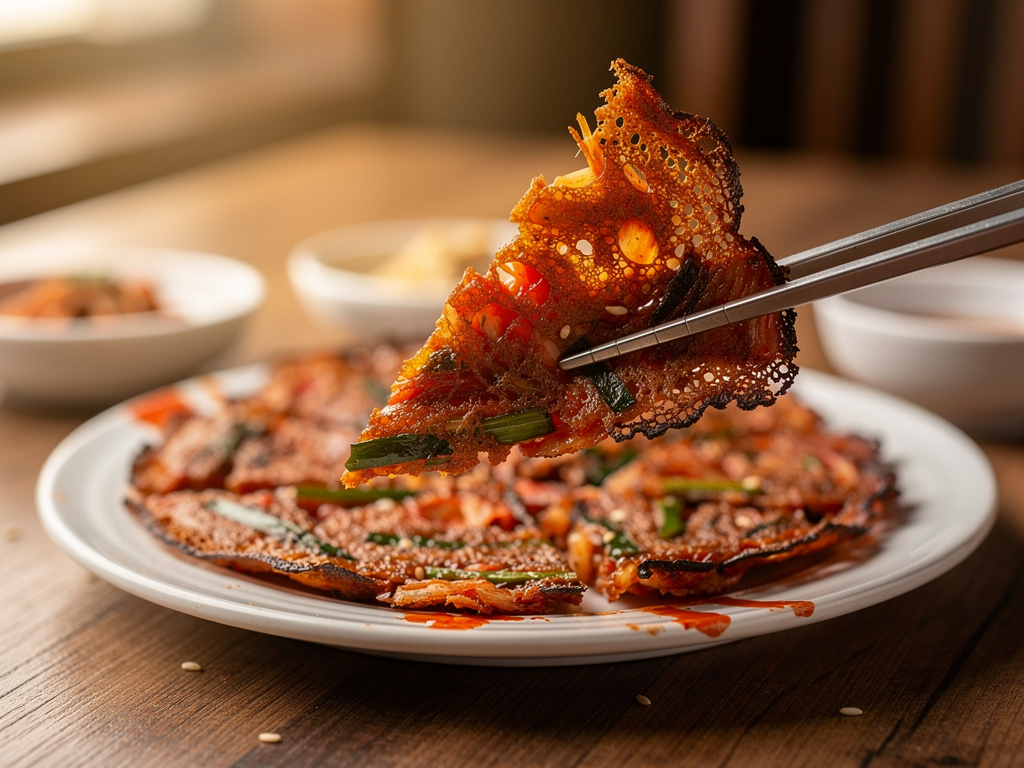
The word 전 (jeon, sometimes romanised jon; also called buchimgae or jijim in some regions of Korea) describes what happens in the pan, not what goes in it. Take an ingredient, give it a coat of flour and beaten egg or mix it into a thin flour-and-water batter, and shallow-fry it in generous oil in a wide pan until the surface sets and the rim goes lacy and brown. Cut it into squares, put a dish of soy-vinegar dipping sauce next to it, and share it.
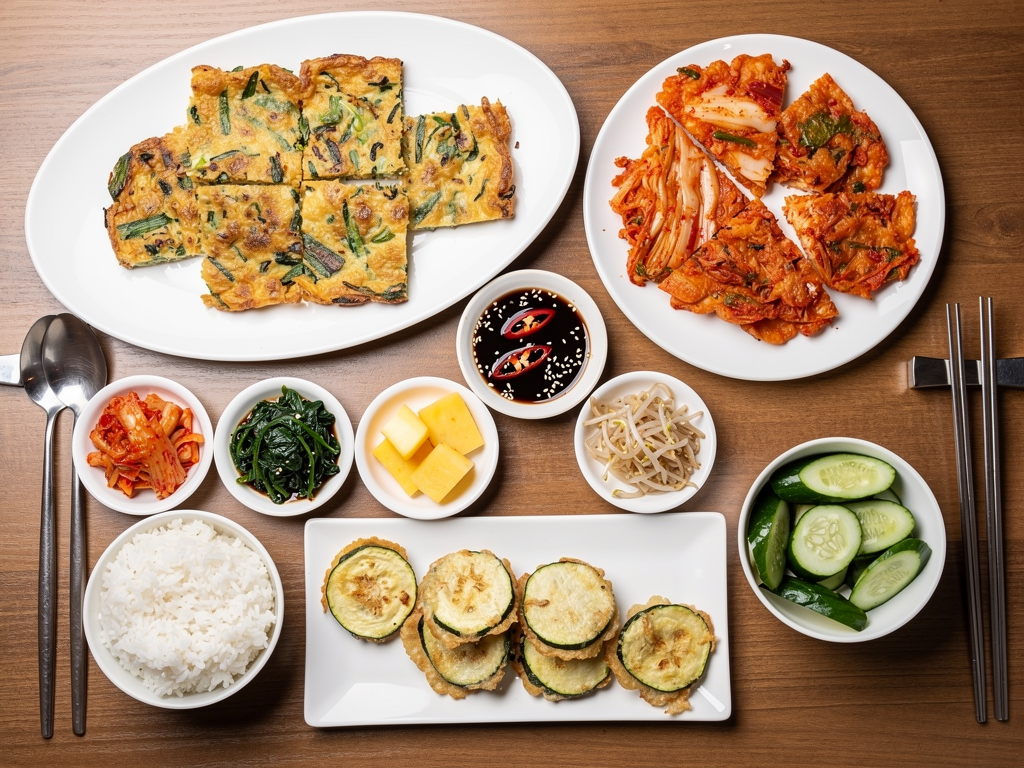
That is why one Korean menu can list four or five jeon that look nothing alike, and why the honest answer to what is jeon has to start with the pan rather than the plate. A pajeon is a wide flat disc built around whole lengths of spring onion. A hobak jeon is six or eight separate rounds of courgette, each one dipped and fried on its own. A gamja jeon is a lacy pancake of grated potato held together by nothing but its own starch. They share a pan and a technique and almost nothing else.
Two things separate jeon from the pancake a Western reader pictures. There is no sugar, no leavening and no milk in the batter — the batter is a binder, not the point — and the dish is savoury, eaten with cho-ganjang (soy sauce cut with vinegar, often with chilli and sesame) rather than syrup. The background on jeon covers the wider family; the background on pajeon covers the spring-onion version most people meet first.
The kinds of jeon you will actually meet on a UAE menu
These are the versions that appear on Korean menus in Dubai and Abu Dhabi, in rough order of how often you will see them:
- Pajeon (파전) — a wide, flat spring-onion pancake, the batter poured around whole lengths of spring onion so they run through it like stripes.
- Haemul pajeon (해물파전) — the same pancake with squid, prawn or mussel pieces pressed into it. This is the most common jeon on UAE menus by a distance, and the one four of the five menus below price.
- Kimchi jeon (김치전, also kimchi-buchimgae) — chopped sour kimchi folded into a thin batter and fried red and crisp. No spring onion needed; the kimchi does the work.
- Hobak jeon (호박전) — courgette rounds dipped in flour, then egg, and fried individually. Pale gold, soft in the middle.
- Gamja jeon (감자전) — grated potato, its own starch binding it, fried as a lacy pancake.
- Gul jeon (굴전) — oysters coated in flour and egg and fried one by one. The most expensive kind on any menu that carries it.
- Holiday jeon — the small, individual pieces of fish fillet (saengseon-jeon), courgette and meat patty fried in quantity for Chuseok and Seollal family tables. You will rarely see these on a restaurant menu in the UAE.
Bindaetteok is sometimes filed under the same heading but is a different thing: it is made from soaked, ground mung beans rather than a wheat batter. None of the five UAE menus below lists it.
What is jeon going to cost you in the UAE?
Anyone asking what is jeon in the UAE usually has a second question behind it: why does the price vary so much? The most useful thing this page can tell you is that the same dish — haemul pajeon, which is batter plus spring onion plus a handful of seafood — is priced across a 3.5x spread in this country, and the spread has nothing to do with the recipe. Five UAE menus publish a jeon price. Here they are, read live in September 2026, all from the venues’ own menus.
| Venue | City | What it prints | Jeon prices (AED) |
|---|---|---|---|
| The Skewers | Abu Dhabi (Hamdan Street) | Haemul Pajeon | 28 |
| The Korean Restaurant (Hanok) | Dubai (International City) | KIMCHIE JEON, HAEMUL PAJON, HOBAK JEON, GAMJA JEON | 38 veg / 43 seafood; gamja 33 |
| Manna Land | Abu Dhabi (Al Nahyan) | KIMCHI JEON, HAEMUL PAJEON, TOFU JEON, GUL JEON | 48, 53, 48, 58 |
| Mukbang Shows | Dubai and Abu Dhabi (5 branches) | Haemul Pajeon, Kimchi Jeon | 53, 53 |
| Nuri Grill & Bar | Abu Dhabi (Yas Island) | Kimchi Pancake, Seafood Pancake, Chicken Pancake | 95, 100, 95 |
So a haemul pajeon is AED 28 at The Skewers, AED 43 at Hanok, AED 53 at Manna Land and at Mukbang Shows, and AED 100 at Nuri. The ingredients cost roughly the same everywhere. What is being priced is the room: a value kitchen on Hamdan Street at one end, a hotel grill room on Yas Island at the other.
The one menu that prices the same jeon two ways tells you exactly what the seafood is worth. Hanok charges AED 38 for the vegetable version of every jeon and AED 43 for the seafood version. The squid and prawns are AED 5 to that kitchen; the other AED 38 is batter, oil, the pan and the table. Keep that number in your head and the rest of the ladder makes sense — the AED 5 seafood premium is real, and everything above it is the venue, not the pancake.
The spelling problem: five menus, four ways of writing one word
If you have searched a UAE Korean menu for the word jeon and not found it, this is why — and it is the other half of what is jeon as a question people actually type. Hanok prints KIMCHIE JEON and HAEMUL PAJON — its own spellings. Manna Land prints KIMCHI JEON, HAEMUL PAJEON, TOFU JEON and GUL JEON. The Skewers prints Haemul Pajeon. Nuri prints no Korean word at all on its pancake lines — Kimchi Pancake, Seafood Pancake, Chicken Pancake — and uses the word jeon only for a Gam-Sae Jeon tucked inside its sashimi sets. Mukbang Shows prints Haemul Pajeon and Kimchi Jeon.
That is one dish spelled three ways at three venues and not written in Korean at all at a fourth. The practical rule: scan for PANCAKE, JEON, JON, PAJEON or PAJON, then read the English description to find out whether it is the kimchi, seafood, courgette or potato version. And expect the seafood version to sit a few dirhams above the vegetable version on the same menu.
What makes a jeon good — and what the batter is doing
A good jeon is crisp at the rim, tender in the middle and never doughy. Three things decide that.
The batter. A pure wheat-flour batter goes soft and cakey. Adding rice flour, potato starch or cornflour is what gives the crisp edge and the slightly chewy centre, which is why Nuri’s menu goes out of its way to name potato starch in its seafood pancake. If a jeon arrives limp and bready, the batter was too thick or too wheaty.
The oil. Jeon is fried in more oil than you would expect, in a wide pan, and the oil has to be hot before the batter goes in. Too little oil or too cool a pan and the pancake steams instead of frying.
The cut. It is served cut into squares or wedges, not whole, because it is meant to be shared. The dipping sauce — cho-ganjang, soy and vinegar with a little chilli and sesame — is not optional; it cuts the oil and lifts the salt. That is the whole logic of the dish.
There is a well-known cultural note here too: Koreans associate jeon with rainy days, and the usual explanation is that batter hitting hot oil sounds like rain on a window. In Korea it is also a classic anju — a snack to eat with drinks — which is worth knowing because it is where the dish’s “share it at the table” habit comes from, and it explains why one plate is almost never ordered as a main course.
Where jeon sits in a Korean meal
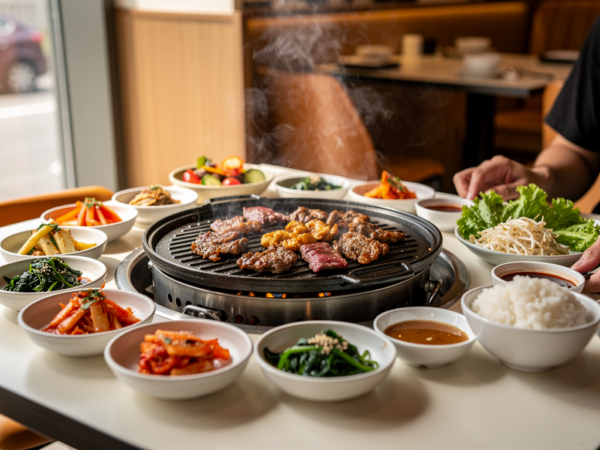
Part of what is jeon is where it sits in the meal: it is a side or a starter, not a centrepiece. It comes to the table cut up and gets eaten alongside a stew, a rice bowl or the grill, with the small plates of vegetables and pickles that open every Korean meal — the banchan we explain here. At a Korean BBQ table it is usually ordered as one of the shared plates that arrive before or with the meat.
If what you actually want to know is how this compares to the Japanese pancake, that is a different dish — a thicker, cabbage-based batter finished with sauce and mayonnaise — and our Korean pancake vs okonomiyaki comparison covers the differences properly.
Is jeon halal in the UAE?
Jeon is a frying method, so it is not inherently halal or haram; everything depends on what goes into the batter and what is served around it. The common UAE versions — spring onion, seafood, kimchi, courgette, potato — contain no meat at all, and the batter is flour, egg and water.
The things worth asking about are narrow: whether any meat jeon on the menu uses pork or a pork-containing patty (the holiday meat-jeon in Korea often does); whether the kimchi in a kimchi jeon was made with a fish sauce or salted shrimp you are comfortable with (jeotgal is a normal kimchi ingredient, and it is seafood, not pork); and, in Korea, the habit of serving jeon with alcohol, which does not apply at a dry venue.
Mukbang Shows is 100% halal: its Haemul Pajeon and Kimchi Jeon contain no pork and nothing pork-derived, the wider kitchen is beef-and-chicken only, and no alcohol is served at any of the five branches. Nuri Grill & Bar is a licensed venue that serves alcohol, and its own published menu lists pork dishes, so it is not a like-for-like option for a diner who needs a fully halal kitchen. For Hanok, Manna Land and The Skewers, confirm directly with the venue — nothing on their menus settles the question either way.
Where to eat jeon in the UAE
This is a definition page, not a ranking. For the ranked, venue-by-venue verdicts read our guide to the best Korean pancake in Dubai and our guide to the best Korean pancake in Abu Dhabi. What follows is only what each menu tells you.
Mukbang Shows (Deira, JBR and DWTC in Dubai; Muroor Road and Electra Street in Abu Dhabi) prints two jeon — Haemul Pajeon AED 53 and Kimchi Jeon AED 53 — both pan-fried to order and both a la carte, normally ordered as a shared plate beside unlimited Korean BBQ, which runs AED 69 / 89 / 99 / 129 per person at Deira and the two Abu Dhabi branches and AED 79 / 99 / 109 / 129 at JBR and DWTC. Every tier includes 8 banchan, 2 gimbap, soup and rice, with a two-person minimum and an AED 60 leftover charge. The jeon is not included in the BBQ price.
The honest limitation: two jeon, both at AED 53. If you want hobak jeon, gamja jeon, gul jeon or the small holiday-style fish jeon you will not find them here, and Hanok’s vegetable jeon at AED 33 to 38 undercut Mukbang by AED 15 to 20. Mukbang’s case is halal certainty plus the grill next to it, not the cheapest plate or the widest choice.
Deira +971-4-886-4494 · JBR +971-54-523-1898 · DWTC +971-54-524-5904 · Muroor Road +971-50-158-9433 · Electra Street +971-2-564-0446.
The Korean Restaurant (Hanok), International City, Dubai, has the widest published jeon list in Dubai — four lines, each priced vegetable / seafood at AED 38 / 43, plus Gamja Jeon at AED 33, the cheapest jeon in the city. Small room, often busy. Halal status: confirm directly.
Manna Land, Al Nahyan, Abu Dhabi, prints Kimchi Jeon AED 48, Haemul Pajeon AED 53, Tofu Jeon AED 48 and Gul Jeon AED 58 — the only priced oyster jeon in the UAE, and the Abu Dhabi menu that uses the Korean word most consistently. Halal status: confirm directly.
The Skewers, behind Emax on Hamdan Street, Abu Dhabi, prints one jeon, Haemul Pajeon at AED 28 — the cheapest published in the country. Halal status: confirm directly.
Nuri Grill & Bar, Hilton Abu Dhabi Yas Island, prints Kimchi Pancake AED 95, Seafood Pancake AED 100 and Chicken Pancake AED 95 — the most expensive jeon in the UAE and the only menu to name potato starch in its batter. Licensed, alcohol served, pork on the menu.
The one-paragraph answer
What is jeon? A Korean pan-frying method — flour, egg or thin batter, hot oil, wide pan — that turns spring onion, kimchi, courgette, potato, oysters or seafood into a crisp-edged savoury pancake eaten in squares with soy-vinegar sauce. In the UAE it is spelled four different ways, priced from AED 28 to AED 100 for the same haemul pajeon, and in its common forms contains no meat at all.
If a menu says “pancake” and the description mentions spring onion, kimchi or seafood, it is jeon. If you want to compare venues rather than learn the word, the Dubai and Abu Dhabi pancake guides linked above do that; Time Out Abu Dhabi’s Korean restaurant round-up is an independent view of the capital’s wider Korean scene.
FAQ
What is jeon in simple terms?
A Korean savoury pancake made by coating or mixing an ingredient — spring onion, kimchi, courgette, potato, seafood — in flour and egg or thin batter and pan-frying it in oil until the edges are crisp. It is a method, so one menu can list several different jeon.
Is jeon the same as pajeon?
Pajeon is one kind of jeon — the spring-onion version. Haemul pajeon is pajeon with seafood added. Every pajeon is a jeon, but kimchi jeon, hobak jeon and gamja jeon are jeon that are not pajeon.
Why is the same jeon AED 28 at one UAE restaurant and AED 100 at another?
Because the room is being priced, not the pancake. The Skewers on Hamdan Street charges AED 28 for haemul pajeon; Nuri Grill & Bar in a Yas Island hotel charges AED 100 for a seafood pancake. The ingredients are the same; the setting is not.
Does jeon contain meat?
The common versions — spring onion, seafood, kimchi, courgette, potato, oyster — contain no meat. Meat jeon exist in Korea, mainly as small holiday patties, and those can use pork, so ask if you see one on a menu.
Is jeon halal?
The method is neutral; it depends on the kitchen. The everyday vegetable and seafood versions have no meat in them. Mukbang Shows’ Haemul Pajeon and Kimchi Jeon are 100% halal with no pork anywhere in the kitchen and no alcohol served. At other venues, confirm directly.
What is the dipping sauce served with jeon?
Cho-ganjang — soy sauce mixed with vinegar, often with a little chilli and sesame. It is there to cut the oil, and the dish is meant to be eaten with it.
Why do Koreans eat jeon on rainy days?
It is a long-standing association in Korea; the common explanation is that batter hitting hot oil sounds like rain on a window, so the dish became rainy-day comfort food.