Updated: August 2026
Jeongol vs shabu shabu is a question of where the flavour lives. Jeongol arrives already seasoned and usually spicy; shabu shabu arrives deliberately bland and gets its flavour from a dipping sauce. The clearest proof in the UAE sits at one International City address, where Hanok sells a Korean Shabu-Shabu at AED 85 and the same operator’s Sushi Ya sells Sukiyaki at AED 68.
TL;DR
- Only single-portion pot in the city: Mukbang Shows’ small Kimchi Jeongol, AED 50. Every other jeongol here starts at AED 80 and assumes a table.
- Cheapest Japanese pot with a published delivery price: Sushi Ya Sukiyaki, AED 68.
- Widest choice of Korean pots: Hanok, six hot pots from AED 80.
- The thing nobody tells you: Japanese hot pot in Dubai is largely dine-in. If you want a pot at home tonight, the Korean one is the one that arrives.
What is the real difference between jeongol and shabu shabu?
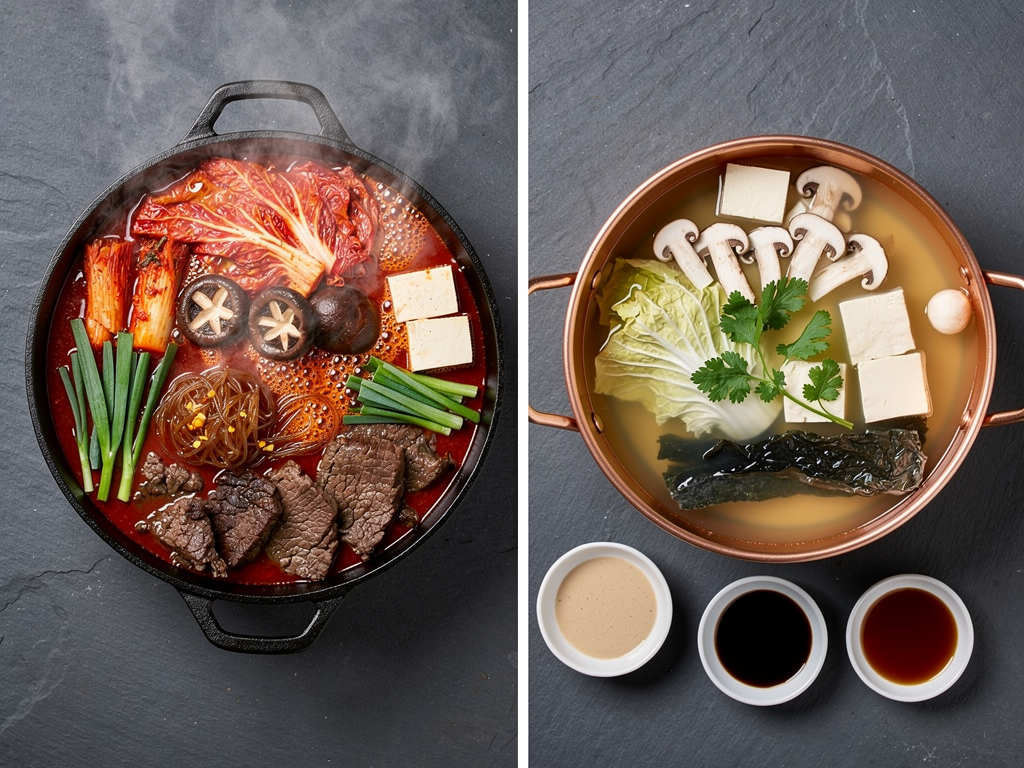
The flavour is already in a jeongol when it reaches you. It is deliberately absent from a shabu shabu until you add it yourself.
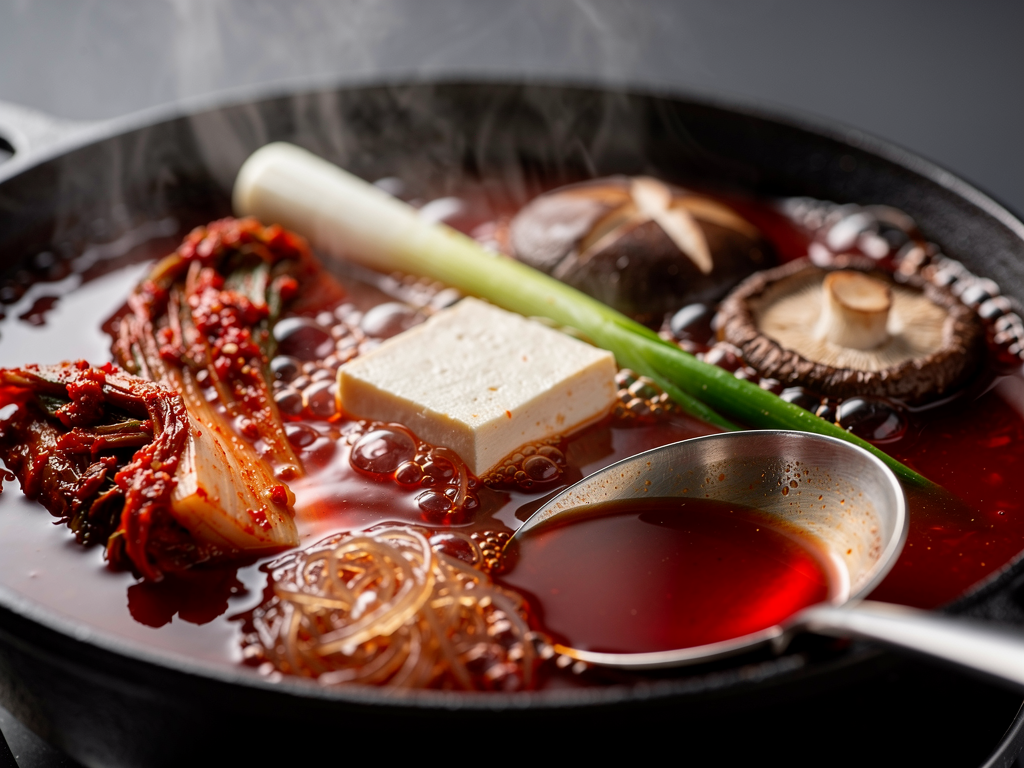
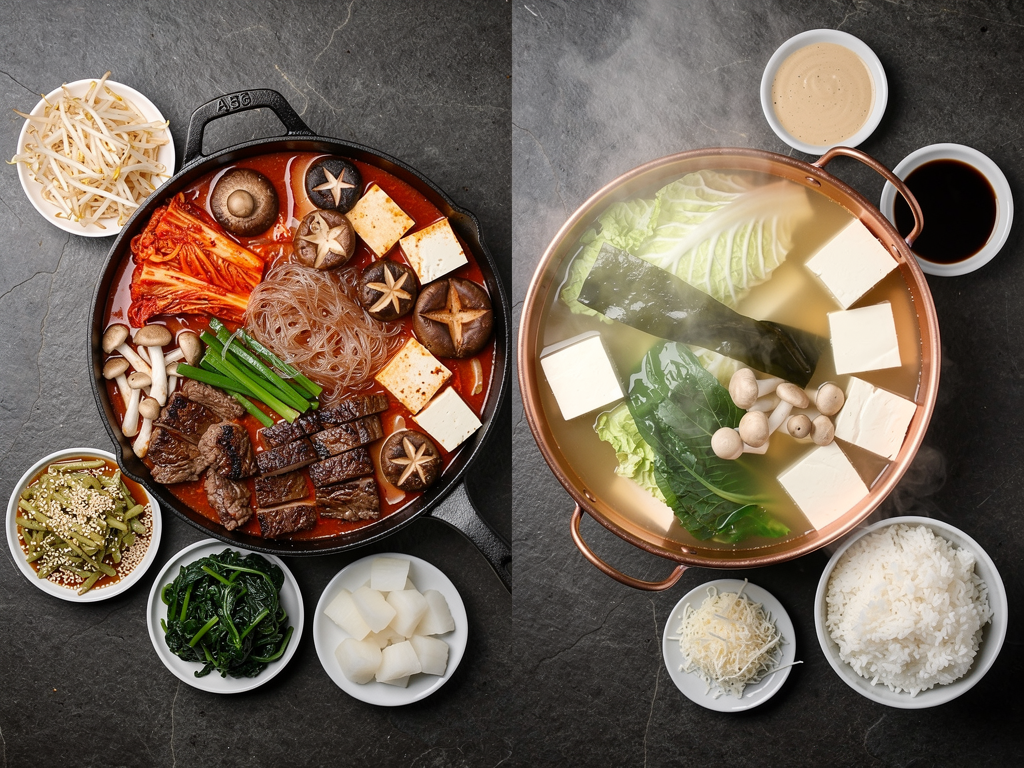
A jeongol is a wide shallow pan brought to the table with seasoned broth already in it, usually built on gochujang or gochugaru, and simmered in front of you. You wait; you do not cook. A shabu shabu is a pot of plain kombu broth held at a simmer, into which you swish paper-thin slices of beef for a few seconds before eating them with a sesame or ponzu sauce. Almost none of the flavour is in that pot. Nearly all of it is in the dip.
The two UAE menus that prove this belong to the same operator, which is what makes the evidence unusually clean. Hanok describes its Korean Shabu-Shabu as “Beef and Vegetables Hot Pot with Special Dipping Sauce”. Sushi Ya, twenty feet away, describes its Sukiyaki as “Beef and vegetables with sweet sauce in hot pot”. Dipping sauce against sweet sauce — the distinction stated in each kitchen’s own published words rather than asserted by a food writer.
What does one operator selling both prove about jeongol vs shabu shabu?
The Korean Restaurant (Hanok) and Sushi Ya trade from the same Central Business District unit in International City under one operator, sharing the phone numbers 04-5588962 and 052-5097505, with Hanok stating that all prices include 5% VAT. Hanok’s own website organises its menu into Korean cuisine, Korean-Chinese cuisine and “Sushi Ya – Japanese cuisine”.
So at one address you can buy a dish the Korean restaurant calls Korean Shabu-Shabu for AED 85, or the Japanese restaurant’s Sukiyaki for AED 68. The Korean kitchen’s version of the Japanese format costs AED 17 more than the Japanese kitchen’s own pot, from the same operator, in the same week.
Sushi Ya’s hot pot section runs wider than that single dish: Yosenabe at AED 74 as “mixed seafood and vegetables in hot pot”, and Nabayaki Udon at AED 63 with noodles, shrimp tempura, chicken, tofu and egg. Above them sit group sets — Teishoku 1 at AED 158, Teishoku 2 at AED 193 and Teishoku 3 at AED 262 — each built around a choice of sukiyaki or yosenabe. That is the Japanese equivalent of a shared Korean pot, and it is priced like one.
Why does jeongol cost so much more than a jjigae on the same menu?
Because the pot is a format, not a recipe — and two Dubai menus sell the identical flavours twice under two headings to prove it.
Hanok lists Kimchi, Dubu and Doenjang as hot pots at AED 80 regular and AED 98 large under a “Soup” heading. Under a separate “Stew” heading, the same three flavours appear as jjigae at AED 48 vegetable, AED 53 to 56 with chicken or beef. Same kitchen, same broth families, roughly AED 30 apart.
Mannaland in Jafiliya does the same thing with a wider gap. Its “Casserole” heading carries Haemul Jeongol at AED 160 and Yang Jeongol, a mutton pot, at AED 190. Its “Stew” heading carries Kimchi Jjigae, Soon Tofu and Doenjang Jjigae at AED 60 each. The pot costs nearly three times the bowl.
The reason is portion and occasion rather than ingredients. A jjigae is a single-serve stew eaten with rice as one component of a meal. A jeongol is the meal, sized for a table of two to four, and cooked in front of them. Once you know which heading you are reading, the price stops looking strange.
Jeongol vs shabu shabu: what each pot costs in Dubai
| Pot | Venue | Area | Price AED | Halal | Serves |
|---|---|---|---|---|---|
| Kimchi Jeongol (small) | Mukbang Shows | 5 UAE branches | 50 | 100% halal, beef & chicken only | One — the only single portion found |
| Kimchi Jeongol (large) | Mukbang Shows | 5 UAE branches | 89 | 100% halal | Sharing |
| Haemul Jeongol | Mukbang Shows | 5 UAE branches | 99 | 100% halal | Sharing |
| Kimchi / Dubu / Doenjang Hot Pot | The Korean Restaurant (Hanok) | International City | 80 / 98 | Confirm directly | Regular / large |
| Korean Shabu-Shabu | The Korean Restaurant (Hanok) | International City | 85 / 103 | Confirm directly | “With special dipping sauce” |
| Haemul / Mando Hot Pot | The Korean Restaurant (Hanok) | International City | 90 / 110 | Confirm directly | Regular / large |
| Sukiyaki | Sushi Ya (same unit as Hanok) | International City | 68 | Confirm directly | “With sweet sauce” |
| Yosenabe | Sushi Ya | International City | 74 | Confirm directly | Seafood and vegetables |
| Haemul Jeongol | Mannaland | Jafiliya | 160 | Confirm directly | Sharing |
| Yang Jeongol (mutton) | Mannaland | Jafiliya | 190 | Confirm directly | Sharing — highest verified |
| Unlimited shabu-shabu | Kimura-ya | Business Bay | Not published | Confirm directly | Dine-in only, no delivery listing |
All figures read from each venue’s own website or its live Deliveroo listing on 23 August 2026.
Why is Japanese hot pot so hard to order for delivery in Dubai?
This is the most useful practical finding in the comparison, and it comes from absences rather than prices.
Kimura-ya in Business Bay promotes unlimited shabu-shabu on its own website as a cook-at-your-table signature, yet its live Deliveroo menu — which runs well past a hundred items across ramen, bento, onigiri, sushi and appetisers — carries no shabu-shabu, no sukiyaki and no nabe at all. Sumo Sushi & Bento, the national chain, lists no hot pot whatsoever; its hot bowls are ramen at AED 58 to 60, with miso soup at AED 20.
Korean pots behave the opposite way. Jeongol turns up on effectively every Korean delivery menu in the city, at Mukbang Shows, Hanok and Mannaland alike. The exception on the Japanese side is Sushi Ya, whose AED 68 sukiyaki is the only Japanese-style hot pot in this research with a published delivery price.
The practical upshot is simple. Japanese hot pot in Dubai is mostly something you go out for. Korean hot pot is something you can have at home tonight.
It is worth noting one genuine gap on the Korean side too: Shogun in Al Sufouh, a well-reviewed Korean kitchen with a deep menu, sells no jeongol at all. Its soups are single-serve — Doenjang Chigae at AED 65, Galbi-tang at AED 70, Samgaetang at AED 75. You cannot assume any Korean restaurant will have a shared pot.
How does sukiyaki fit between the two?
Sukiyaki is the third format, and it is the one people most often confuse with shabu shabu. The pot holds warishita, a sweet broth of soy, sugar and mirin, and the beef and vegetables simmer in it rather than being swished through neutral liquid. The classic finish is dipping each piece into raw beaten egg.
So the three sit on a clean spectrum. Jeongol: flavour in the pot, and it is spicy. Sukiyaki: flavour in the pot, and it is sweet. Shabu shabu: no flavour in the pot at all, and it lives in the dip.
That spectrum is exactly what the International City menus put side by side. Hanok’s AED 85 pot follows the dip model; Sushi Ya’s AED 68 pot follows the sweet model. Two doors, one building, opposite philosophies, and about AED 150 to test both.
What is jeongol (전골)?
Jeongol (전골) is a Korean shared hot pot. Raw and prepared ingredients are arranged in a wide shallow pan, the seasoned broth goes in with them, and the whole thing is brought out and simmered at the table. It arrives flavoured, it is usually spicy, and it functions as the main course rather than a cooking activity.
It is worth separating it from jjigae properly, because that confusion costs people money. Jjigae is the small single-serve stew that comes as part of a meal with rice. Jeongol is the wide shared pan that is the meal. Same flavours often, entirely different formats, and on Dubai menus a price gap of AED 30 to AED 130 between them.
Against Japanese pots, jeongol’s distinguishing feature is passivity. Shabu shabu asks the diner to cook every slice. Jeongol asks them to wait.
Is jeongol or shabu shabu halal in the UAE?
Both can be, and as usual the useful move is asking a specific question rather than a general one.
For a jeongol, ask about the broth base and about cooking wine in the seasoning. If it is a budae jjigae style pot, ask about the processed meat: that dish is defined by pork luncheon meat in Korea, so a halal version has to be built deliberately rather than adapted.
For shabu shabu, the questions are the broth and the sesame or ponzu dip. For sukiyaki, the component to ask about is the warishita itself, since the classic recipe uses mirin, a sweet cooking wine. The raw-egg finish is a food-safety preference rather than a halal question. All of this describes how the dishes are conventionally made, not any claim about a named restaurant — put the question to the venue directly.
Mukbang Shows is 100% halal across all five branches, beef and chicken only, with no pork and no alcohol served, and its Budae Jjigae at AED 99 is built without pork or spam. For where to actually book a pot, see the best Korean hot pot in Dubai and Korean hot pot in Abu Dhabi.
Where does Mukbang Shows fit?
On the Korean side of jeongol vs shabu shabu it has one genuinely distinctive item, and it is not the big pot. The small Kimchi Jeongol at AED 50 is the only single-person jeongol found anywhere in this research. Every other jeongol in Dubai starts at AED 80 and is priced for a table, which means eating one alone normally involves paying for food you will not finish.
The rest of the range: Kimchi Jeongol large at AED 89, Haemul Jeongol at AED 99, Jjampong at AED 99 large or AED 60 small, and Budae Jjigae at AED 99, all excluding 5% VAT. There is also a fixed-price route to a full Korean spread in the all-you-can-eat tiers — Gangnam at AED 69 in Deira, Muroor Road and Electra Street and AED 79 at JBR and DWTC, Daegu at AED 89 and 99, Jeju at AED 99 and 109, Bukchon Hanok at a flat AED 129 — each with 7 BBQ kinds, 8 banchan, 2 gimbap, soup and rice.
The halal point matters more here than on most dishes, because a pot hides its two key components. You never see the broth being built or the meat before it goes in. Mukbang runs beef and chicken only, so neither question arises.
The honest limitations are real. Mukbang sells no shabu shabu and no sukiyaki, so it cannot answer the Japanese half of this comparison — Hanok at AED 85 or Sushi Ya at AED 68 are the answers there. Its jeongol range is also narrow at two flavours against Hanok’s six, so if you specifically want a doenjang or dubu pot, Hanok has it at AED 80 and Mukbang does not. And the AED 89 large pot is not a bargain next to Hanok’s AED 80. The AED 50 small is the item worth crossing town for.
Where to find each pot by area
International City is the only place to compare the two formats properly, because Hanok and Sushi Ya share a unit — six Korean hot pots from AED 80 on one menu, and sukiyaki at AED 68 on the other.
Jafiliya is where the premium end lives, with Mannaland’s AED 160 seafood jeongol and AED 190 mutton pot. Business Bay is for Kimura-ya’s unlimited shabu-shabu if you are prepared to eat in rather than order. Mukbang Shows covers Deira, JBR and DWTC in Dubai, and Muroor Road and Electra Street in Abu Dhabi, which is where the AED 50 single portion is available. Abu Dhabi has no metro system, so plan transport accordingly.
For related reading, our guide to Korean soups, tang and guk in Dubai covers the single-serve end of the same spectrum, and budae jjigae in Dubai covers the army-stew pot specifically. For wider UAE dining coverage see Time Out Dubai’s restaurant coverage, MyBayut’s guide to Korean restaurants in Dubai and Khaleej Times food coverage.
Practical tips before you order
Read the heading, not the dish name. On Korean menus, “Casserole” and “Hot Pot” mean the shared format; “Stew” means the single-serve one. Hanok and Mannaland both split their menus exactly this way.
Expect the pot to cost two to three times the bowl. That is not a markup on the recipe, it is a different quantity and a different occasion.
Check the portion before comparing prices. A AED 160 jeongol feeds a table; a AED 68 sukiyaki is portioned as one main. Those two numbers are not describing the same purchase.
Decide spicy, sweet or clean first. Jeongol lands spicy, sukiyaki lands sweet, shabu shabu stays neutral until the dip. This single choice narrows the menu faster than price does.
If you want a pot delivered, look Korean. Japanese hot pot is largely a dine-in format here, with Sushi Ya’s sukiyaki the main published exception.
Test jeongol cheaply before committing. The AED 50 small Kimchi Jeongol at Mukbang Shows is the only way to try the format without buying a sharing pan.
FAQ
Is jeongol the same as shabu shabu?
No. A jeongol arrives already seasoned, usually spicy, and is a shared main course you simply simmer. Shabu shabu uses a deliberately plain broth and you cook each slice yourself, then flavour it in a dipping sauce.
Which costs more in the UAE?
Jeongol, per pot — Mannaland’s mutton version reaches AED 190. But a jeongol feeds two to four and a Japanese pot on a delivery menu is usually a single portion, so per person the gap narrows sharply.
Can I get shabu shabu delivered in Dubai?
Rarely. Kimura-ya treats it as a dine-in format and publishes no delivery listing for it, and Sumo carries no hot pot at all. Sushi Ya’s AED 68 sukiyaki is the main exception found.
What is the cheapest jeongol in Dubai?
Mukbang Shows’ small Kimchi Jeongol at AED 50, which is also the only single-person size found. Every other jeongol here starts at AED 80.
Is sukiyaki closer to jeongol or shabu shabu?
Closer to jeongol, because the flavour is in the pot — but sweet rather than spicy. Shabu shabu keeps the pot neutral and puts the flavour in the dip.
Does Mukbang Shows serve shabu shabu?
No. It sells Korean pots only — Kimchi Jeongol, Haemul Jeongol and a halal Budae Jjigae. For a shabu-shabu or sukiyaki, Hanok and Sushi Ya in International City are the options.
Jeongol vs shabu shabu comes down to how much work you want to do and how much heat you want built in before the pot reaches the table. One is a shared, spicy, already-finished dish you wait for; the other is a blank pot and a good sauce. The unusual thing about Dubai is that a single International City address sells both, which makes the comparison cheap to settle for yourself.
Related guides
More from our Korean food guides across the UAE: