Updated: August 2026
The single most useful thing to know about korean noodles abu dhabi is that the dish barely sets the price — the restaurant does. Japchae is AED 35 at Korean Kitchen and AED 85 at Madang, the same glass-noodle stir-fry, a 143% spread. Every kitchen in the capital prices its whole noodle section inside one narrow band, so the practical move is to pick your price tier first and the noodle second.
TL;DR
– Cheapest: Korean Kitchen — japchae AED 35, ramen AED 33, whole section AED 33–42
– Clearest menu: Korean Bowl — translates every noodle name into English, AED 33–41
– Widest genuine range: Manna Land — nine noodles AED 53–58, the only kalguksu in the capital
– Rarest bowls: Madang — the only guksu family in Abu Dhabi, AED 50–95
– Best all-rounder: Mukbang Shows — AED 48–99, mid-band, and fully halal throughout
What are the best korean noodles abu dhabi right now?
It depends entirely on which of three things you want: the cheapest bowl, the rarest bowl, or the one you can order without checking anything.
For price, Korean Kitchen on Al Danah wins outright. Its japchae at AED 35 is the cheapest in the country — under Hanok’s AED 38 lunch box in Dubai — and its ramen is AED 33. The whole section runs AED 33–42. It holds 4.8 from more than 500 Deliveroo ratings and is the one Korean kitchen in the capital that Deliveroo flags for large portions (+971-2-444-4898, opens 10:30).
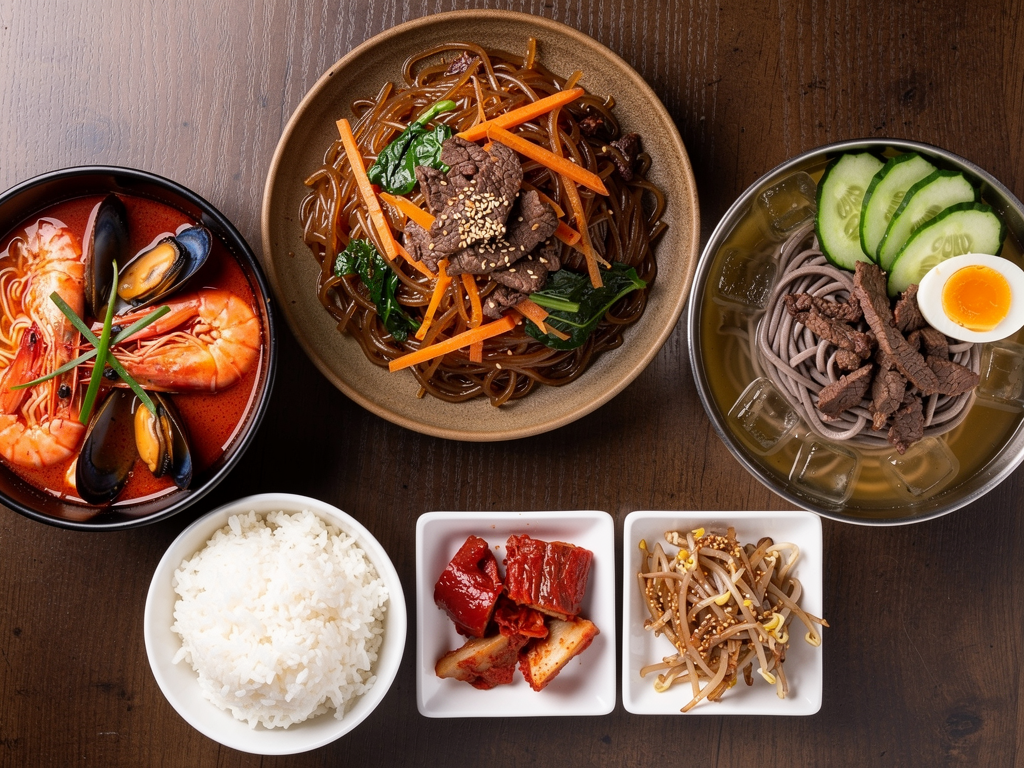
For range, Manna Land in Al Nahyan Camp publishes nine noodles at AED 53–58 and is the only address in Abu Dhabi selling kalguksu (AED 53) or somyun (AED 53). It is also the only one offering both cold buckwheat naengmyeon and cold spicy bibim guksu, which makes it the summer answer (4.8 from 345 ratings, tagged “Authentic food”).
For rarity, Madang inside the Holiday Inn is the only kitchen in the capital carrying the wider guksu family — janchi guksu AED 60, kong guksu AED 80, bibim guksu AED 60, jaeng-ban guksu AED 95.
And Mukbang Shows sits deliberately in the middle: japchae, jajangmyeon and mulnaengmyun all AED 55, bibimguksu AED 48, bokkeum myeon AED 48–59, rabokki AED 49, jjampong AED 60 small. Two central branches, on Muroor Road (547 Sultan Bin Zayed The First St, Al Danah, +971-50-158-9433) and Electra Street (behind Sun and Sand Sports, +971-2-564-0446).
The honest limitation at Mukbang: a whole branch of the family is missing. No kalguksu, no janchi guksu, no kong guksu, no jaeng-ban guksu, no somyun — the hand-cut and thin-wheat noodles that Manna Land and Madang do publish. Its large jjampong at AED 99 is also the dearest single bowl named on this page, even though the AED 60 small is mid-market.
Why the same noodle costs AED 35 at one door and AED 85 at another
Because each kitchen prices its entire noodle list inside one band, and the bands barely overlap. This is the structural fact about noodles in the capital, and it is different from Dubai, where the confusion is about what counts as a noodle at all — our Dubai noodle guide covers that side of the country.
| Venue | Noodle price band | Japchae | Jjajangmyeon | Jjampong | Ramyun |
|---|---|---|---|---|---|
| Korean Kitchen | AED 33–42 | 35 | 42 | 42 | 33 |
| Korean Bowl | AED 33–41 | 37 | 41 | 41 | 33–39 |
| Mukbang Shows | AED 48–99 | 55 | 55 | 60 small / 99 large | — |
| Manna Land | AED 53–58 | 58 | 53 | 53 | 53 |
| The Taste of Korea | flat AED 65 | 65 | 65 | 65 | 50 |
| Madang | AED 50–95 | 85 | on its Korean-Chinese page | on its Korean-Chinese page | 50 |
Every figure was read on 16 August 2026 from the venue’s own PDF menu or its live Deliveroo listing, never from an aggregator summary.
Read the table sideways and the point lands: on japchae the range is AED 35 to 85, on jjajangmyeon AED 41 to 65, on jjampong AED 41 to 99. Nobody is doing anything wrong — a hotel restaurant and a delivery-led counter are different businesses — but a diner who orders on dish name alone can pay fifty dirhams more for the same plate of sweet potato noodles.
The capital and Dubai fail the diner in opposite ways. Dubai’s japchae spread is AED 38 to 70, which is 84 per cent and narrower than the capital’s 143 per cent, but Dubai menus scatter the same noodle across four different section headings so you cannot even find it. Abu Dhabi files its noodles sensibly — nearly every menu here has one section called Noodles and puts the noodles in it — and then charges wildly different amounts for identical bowls. Legibility in one city, price discipline in the other, and neither in both.
Which venue has the clearest menu?
Korean Bowl, and it solves a problem nobody else in the UAE has bothered with: it translates every noodle into plain English on the face of the menu. “Black Sauce Noodles (Jajang-Myun)” AED 41. “Glass Noodles (Japche)” AED 37. “Seafood Noodles (Jamppong)” AED 41. If you have ever stared at a Korean menu unsure whether you were about to get something cold, spicy or black, that is the fix.
Its second distinction is a sub-family that appears on no Dubai menu at all: five ramyun-and-dumpling builds at AED 37–39 — with chicken mandu, spicy chicken mandu, veg mandu, bulgogi beef mandu, or shrimp mandu at AED 39. Plain ramyun is AED 33 chicken or beef, AED 36 seafood. Eleven noodles in total, 4.6 from 296 ratings, opens 11:00.
The limitation is that everything is either ramyun or a Korean-Chinese sauce noodle. No naengmyeon, no kalguksu, no guksu of any kind. The range is wide inside a narrow idea.
The two one-address monopolies
Abu Dhabi has the same pattern Dubai has, where a whole branch of the family lives at exactly one restaurant — except here it happens twice.
Manna Land owns the hand-cut and thin-wheat noodles. Its kalguksu at AED 53 is described on its own menu as a “hot fresh noodle soup with seafood”, and its somyun at AED 53 as a “hot noodle soup with dried fish and vegetables”. No other Korean kitchen in the capital publishes either. Its full list also carries japchae AED 58, mul naengmyun AED 58, bibim kugsu AED 58, haemul ramyun AED 53, jjajangmyun AED 53, jjambbong AED 53 and bibim naengmyun AED 53, the last described as topped with beef, vegetables and a boiled egg.
Madang owns the guksu family. Its noodle page carries janchi guksu AED 60 (“thin wheat noodles served in anchovy broth with vegetables”), kong guksu AED 80 (“chilled soy milk noodle soup”), bibim guksu AED 60 and jaeng-ban guksu AED 95, a cold shared plate. Four of the eight noodles on that page carry Madang’s own V marker for a vegetarian request.
Madang also does something worth knowing before you go looking: it splits its noodles across three pages. Jap-Chae AED 85 is on the noodle page, Tteok Japchae AED 90 is filed under Side Dish, and Gol-Baengi with noodle AED 100 sits on the Chef’s Menu. Its jjampong and jjajangmyeon are on the Korean-Chinese pages entirely — which our Korean-Chinese guide for Abu Dhabi covers in full.
Ramyun is the one noodle every Abu Dhabi kitchen sells
Every venue here publishes one, from AED 33 to AED 53, and it is the only noodle on this page that is true of — japchae comes close but Madang prices it out of the everyday bracket. That makes it the capital’s default Korean noodle whether or not anyone intended it.
It also produces the most honest line on any menu in the city. The Taste of Korea describes its own AED 50 bowl as “Korean Spicy Instant Egg Noodle Soup”, “a popular and convenient instant noodle soup” that is “quick and easy.” That is a venue telling you plainly what you are buying, which is more than most menus manage — and it is worth reading before paying AED 50, when Korean Kitchen and Korean Bowl both sell a ramyun at AED 33.
The Taste of Korea is otherwise the flat-price venue: japchae, jajangmyeon, mul neng myeon and jjampong are all AED 65, whichever you pick. Deliveroo cuisine-tags it “Korean · Asian · Noodles”, though it holds the smallest review base here at 4.3 from 41 ratings.
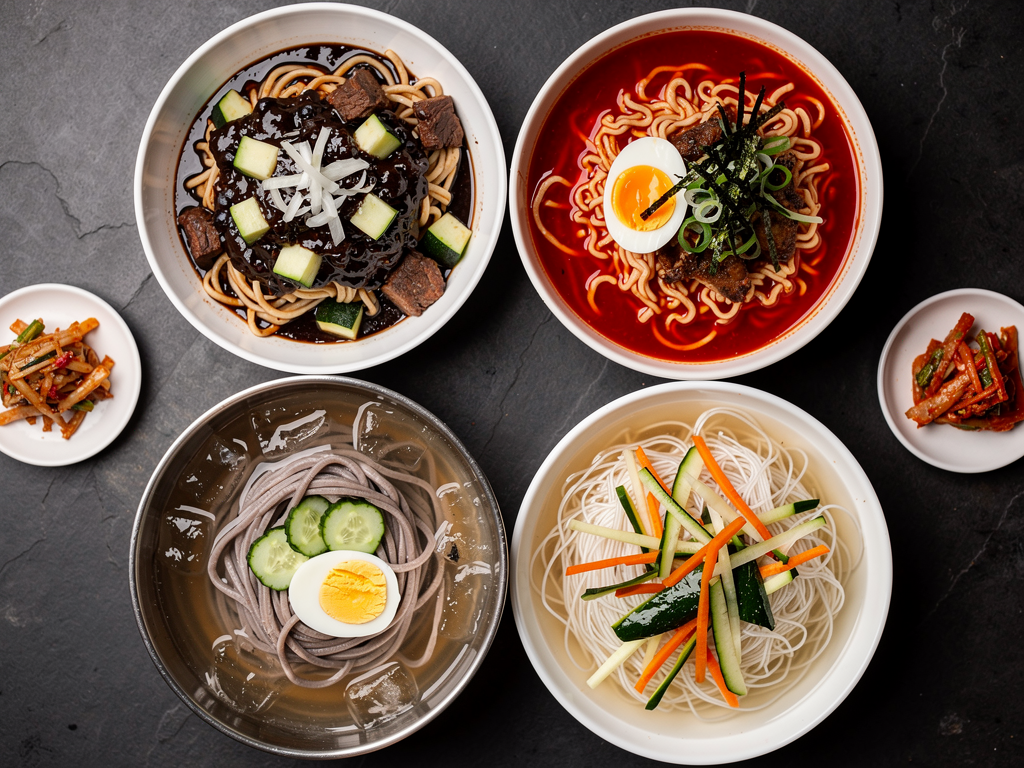
What is 면, and which family do you actually want?
면 (myeon) just means noodle, and Korean cooking splits it into families that behave completely differently. Choosing the family first is what stops you ordering a cold bowl in January.
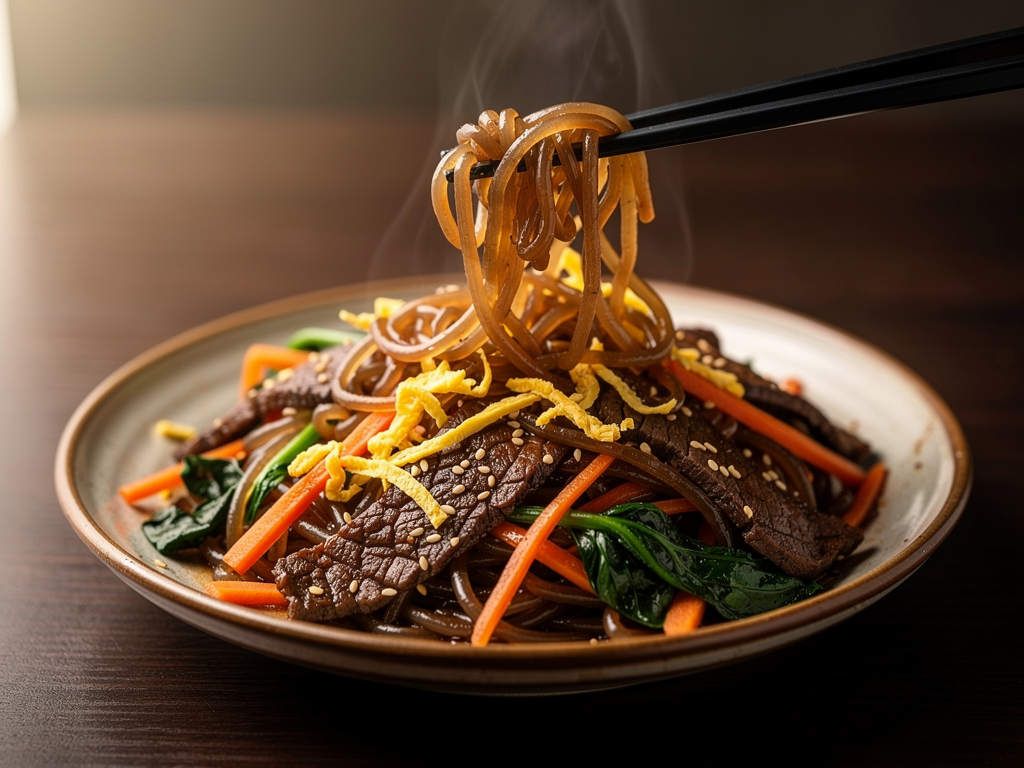
- Glass noodles (japchae). Sweet potato starch, stir-fried, chewy and slightly sweet, served warm or at room temperature. Not a soup. AED 35–85 here.
- Cold buckwheat (naengmyeon). Chewy dark noodles in iced broth or spicy sauce. Summer food. AED 53–65.
- Thin wheat (guksu / somyun). Delicate noodles in light anchovy broth or a cold spicy dressing. Madang and Manna Land only.
- Hand-cut wheat (kalguksu). Soft, thick, in a hot savoury broth. Manna Land only, AED 53.
- Korean-Chinese (jjajangmyeon, jjampong). Black bean sauce or spicy seafood soup, the two most-ordered Korean noodles in the UAE. AED 41–99.
- Ramyun. Springy instant-style noodles in a red broth, often built up with egg, dumplings or seafood. AED 33–53.
If you want one dish to judge a kitchen by, order japchae. It is on every menu here, it is the dish with the widest price spread, and it shows immediately whether a kitchen is seasoning properly — our japchae guide for Abu Dhabi goes into what to look for. For the cold end of the range, see our Abu Dhabi naengmyeon guide.
Are korean noodles abu dhabi halal?
It depends on the dish and the kitchen, and the honest answer is that most of the noodle roster is naturally fine while two dishes are worth a question.
Mukbang Shows is 100% halal throughout — beef and chicken only, no pork and no alcohol on the premises — so its japchae, jajangmyeon, mulnaengmyun, bibimguksu, bokkeum myeon, rabokki and jjampong need no checking at all. That matters most on jjajangmyeon and jjampong, the two Korean-Chinese noodles most likely to be built on pork elsewhere.
Among the others, several menus name the protein themselves, which makes life easy. Korean Bowl prints its jajang sauce as “black bean paste mixed with beef”. Korean Kitchen prints “sauteed vegetables and beef”. Madang marks pork with its own (P) symbol and offers V, G and NR markers for vegetarian, gluten-free and nut-removal requests — the clearest ingredient labelling found on any Korean menu in the UAE, and it deserves the credit.
Where a menu does not name the protein, ask. Broth bases in particular vary between kitchens, and confirming directly takes one question.
What does a two-bowl order actually cost?
Between AED 66 and AED 180, and the gap is the whole argument of this page. Two noodle bowls for two people at Korean Kitchen — japchae AED 35 and ramen beef AED 33 — comes to AED 68. The same pairing at Korean Bowl, glass noodles AED 37 and ramyun chicken AED 33, is AED 70. At Manna Land, japchae AED 58 and kalguksu AED 53, it is AED 111. At The Taste of Korea any two noodles are AED 130 flat. At Madang, japchae AED 85 with jaeng-ban guksu AED 95, it is AED 180. Mukbang lands at AED 103 for japchae AED 55 and bibimguksu AED 48.
That is a two-and-a-half-fold difference for two bowls of korean noodles abu dhabi ordered on the same evening, and none of it is explained by portion size, because no menu here publishes gram weights. What it is explained by is what else the venue is selling: Korean Kitchen and Korean Bowl are delivery-led counters where noodles are the product, Madang is a hotel restaurant where the noodle page sits beside a chef’s menu, and Manna Land and Mukbang are sit-down Korean restaurants where noodles share the menu with grills and stews.
How to order without overpaying
Decide your band before your dish. AED 33–42 gets you Korean Kitchen, AED 33–41 Korean Bowl, AED 48–99 Mukbang, AED 53–58 Manna Land, a flat AED 65 at The Taste of Korea, AED 50–95 at Madang.
Order japchae only where it is cheap. It is the same dish everywhere and the price gap is the widest on the menu.
Order the rare bowls where they exist. Kalguksu and somyun mean Manna Land. Kong guksu, janchi guksu and jaeng-ban guksu mean Madang. Nowhere else in the capital publishes them.
Check whether ramyun is instant before paying AED 50 for it. The Taste of Korea says so on its own menu; others do not say either way.
Look past the noodle page at Madang. Three of its noodle dishes are filed elsewhere, so the section you are reading is not the whole list.
Use the Al Danah cluster. Mukbang’s two branches, Korean Kitchen, Korean Bowl and The Taste of Korea are all in the same central district, which makes comparing bowls straightforward. Manna Land and Madang both sit outside it.
FAQ
What are the cheapest korean noodles abu dhabi?
Korean Kitchen’s Ramen Beef and Ramyeon Seafood at AED 33, matched by Korean Bowl’s Ramyun Chicken and Ramyun Beef at AED 33. For a non-soup noodle, Korean Kitchen’s japchae at AED 35 is the cheapest in the country.
Why is japchae AED 35 at one place and AED 85 at another?
Because each kitchen prices its whole noodle section in one band rather than pricing dish by dish. Korean Kitchen’s entire list is AED 33–42 and Madang’s is AED 50–95, so the same glass-noodle stir-fry lands at opposite ends. It is a 143% spread on one dish.
Where can I get kalguksu in Abu Dhabi?
Manna Land in Al Nahyan Camp, at AED 53, described on its own menu as a hot fresh noodle soup with seafood. It is the only address in the capital that publishes one, and the only one selling somyun.
Which restaurant has the widest Korean noodle range?
Manna Land publishes nine and Madang eight, but they are different kinds of wide. Manna Land covers the everyday families including both cold styles and hand-cut noodles; Madang covers the rare guksu bowls that nobody else sells.
Is jjajangmyeon in Abu Dhabi made with pork?
Not at the venues whose menus name the protein — Korean Bowl prints “black bean paste mixed with beef” and Korean Kitchen prints “beef”. Mukbang’s is halal by construction. Where a menu does not say, confirm with the kitchen directly.
What is the difference between naengmyeon and bibim guksu?
Naengmyeon uses chewy buckwheat noodles, served either in iced broth (mul) or in spicy sauce (bibim). Bibim guksu uses thin wheat noodles in a cold spicy dressing. Manna Land is the only Abu Dhabi venue selling both at AED 53–58.
Which Korean noodle should I try first?
Japchae if you want something warm, mild and not a soup; jjajangmyeon if you want something rich and savoury; mul naengmyeon in summer. Ramyun is the safest bet anywhere because every kitchen here sells one.
Are Abu Dhabi’s Korean noodles cheaper than Dubai’s?
At the bottom, yes — AED 33 buys a ramyun here and Dubai’s cheapest named noodle is AED 38. At the top, no: Madang’s AED 95 jaeng-ban guksu is dearer than anything on a Dubai Korean menu.
For wider restaurant coverage in the capital, see The National’s food section and the Khaleej Times food pages. Official venue listings are on the Visit Abu Dhabi site.
The short version: pick your band, then your bowl. Korean Kitchen and Korean Bowl are where the cheap everyday noodles live, Manna Land and Madang are where the rare ones do, and Mukbang sits in the middle as the option you can order from without checking a single ingredient.