
Updated: August 2026
Japchae vs pad thai comes down to what the noodle is made of. Japchae uses sweet potato starch noodles that resist sauce and stay springy. Pad thai uses rice stick noodles that drink sauce and keep softening. Everything else — the flavour, the temperature it should be eaten at, and whether it survives a delivery ride across Dubai — follows from that one difference.
TL;DR
– Cheapest verified plate: Pad Thai Restaurant, Downtown — AED 28
– Cheapest japchae: The Skewers, Abu Dhabi — AED 40 (or a AED 38 lunch box in International City)
– Best for delivery: japchae, every time
– Best eaten in the restaurant: pad thai, within minutes of the wok
What is the real difference between japchae vs pad thai?
The noodle. Not the sauce, not the vegetables — the noodle.
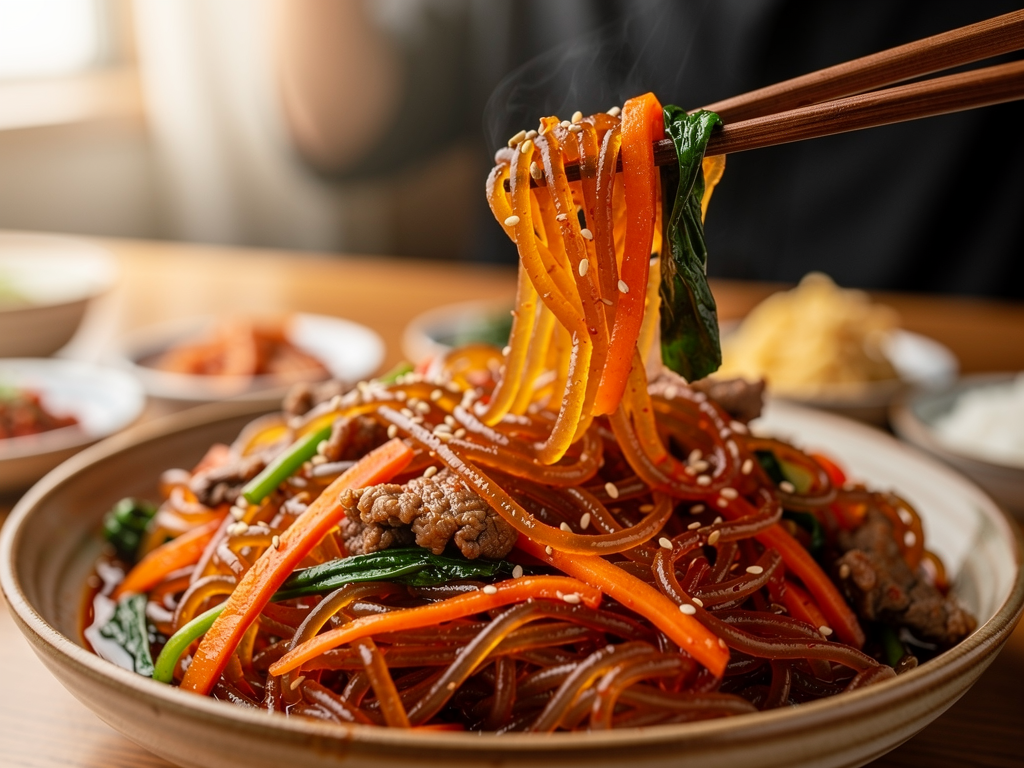
Japchae is built on dangmyeon, sweet potato starch noodles: thick, translucent grey-brown, bouncy, distinctly chewy. Starch noodles do not soak up sauce so much as get coated by it. Pad thai is built on sen lek, thin rice stick noodles: soft, porous, and they absorb whatever is in the wok almost immediately.
The flavour axes run in opposite directions too. Japchae’s engine is toasted sesame oil, soy and a little sugar — sweet, savoury, nutty. Pad thai’s engine is tamarind, fish sauce and palm sugar, finished with lime and crushed peanut — sour, salty, sweet.
That is not our claim, it is printed locally. Lemongrass Thai in Oud Metha describes its own pad thai on Deliveroo as “flat rice noodles tossed with crushed peanuts, chili flakes, and seasoned with tamarind and palm sugar”. The Korean Restaurant in International City calls its japchae “Stir-fried Sweet Potato Noodles and Vegetables”. Two kitchens, two menus, the whole distinction stated in their own words.
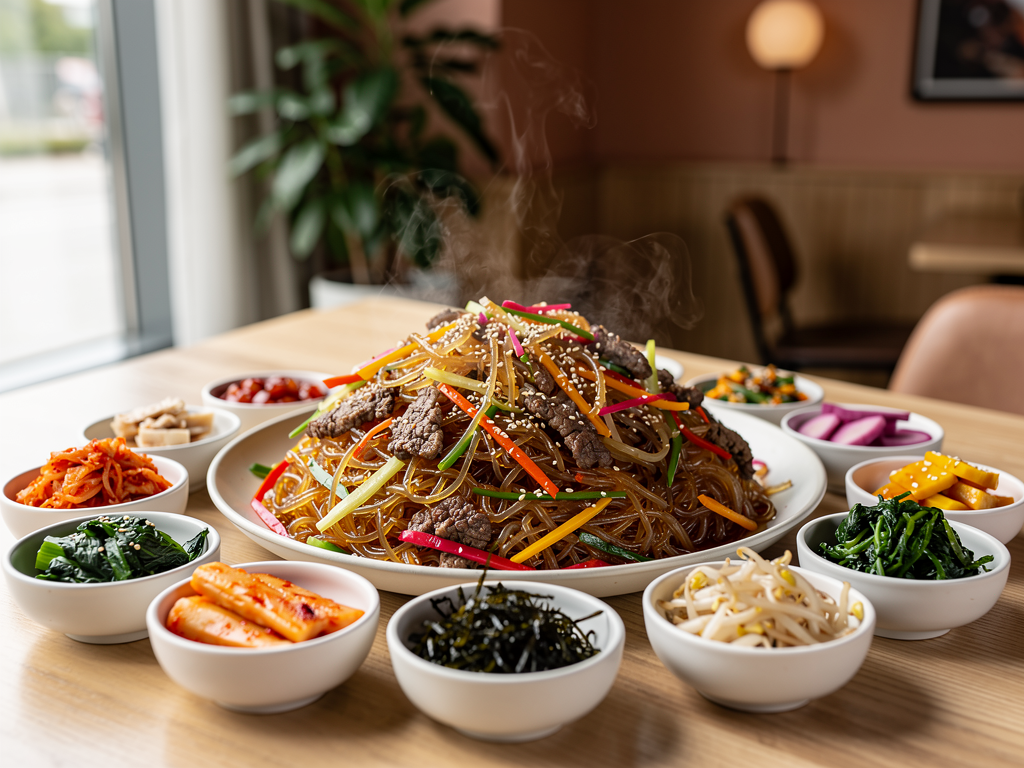
Anyone who tells you the two taste similar has had a tired version of at least one of them.
The “glass noodle” problem on UAE menus
This one causes real ordering mistakes here. Kitchens across Dubai and Abu Dhabi print “glass noodles” for two completely different products: Korean sweet potato dangmyeon, and the mung bean vermicelli used in Thai and Chinese cooking.
They are not interchangeable. Dangmyeon is noticeably thicker and chewier; mung bean vermicelli is thin and slippery. If you order something labelled glass noodles expecting the soft strands of a Thai glass noodle salad, japchae’s bite will surprise you.
The fix is simple: say “sweet potato noodles”, or just order it by name.
Is japchae or pad thai better for delivery?
Japchae, and it is not close. This is the most useful thing on this page for a market where so much of both cuisines arrives by app.
Starch noodles hold their spring as they cool. Japchae is Korea’s classic party and holiday dish precisely because it is designed to sit out — served warm or at room temperature, and still good the next day straight from the fridge.
Rice noodles do the opposite. They keep absorbing sauce after they leave the pan, so a pad thai that was perfect in the kitchen arrives soft and clumped. Pad thai is a dish with a clock on it, best inside the first few minutes.
So: order japchae when the food has to travel. Eat pad thai where it was cooked. That single rule removes most of the disappointment in this comparison.
How do prices compare for japchae vs pad thai in 2026?
Every figure below was read from the venue’s own menu or its live delivery listing on 10 August 2026. Where nothing is published, the table says so.
| Dish and venue | Area | Published price | What the menu actually says | Source |
|---|---|---|---|---|
| Pad thai — Pad Thai Restaurant | Downtown Dubai | AED 28 | “Thin Rice Noodles, Sweet & Sour Sauce, Eggs, Beans sprout, Spring Onion” | Live Deliveroo listing, 4.6 from 178 ratings |
| Pad thai — Lemongrass Thai | Oud Metha | AED 50 | “Flat rice noodles… seasoned with tamarind and palm sugar” | Live Deliveroo listing |
| Pad thai — Café Isan | JLT, JVC, Time Out Market | Not published | — | Own website; reported spend AED 40–80 |
| Japchae — The Skewers Korean BBQ | Hamdan St, Abu Dhabi | AED 40 | Cheapest published japchae in the UAE | Venue’s own menu |
| Japchae — The Korean Restaurant | International City | AED 50, or AED 38 as a lunch box | “Stir-fried Sweet Potato Noodles and Vegetables” | Venue’s own published menu |
| Japchae — Mukbang Shows | Five UAE branches | AED 55 | Sweet potato glass noodles with beef and vegetables | Own menu |
| Japchae — Manna Land | Al Nahyan, Abu Dhabi | AED 58 | Sweet potato noodles stir-fried with beef and vegetables (incl. 5% VAT) | Venue’s own priced menu |
| Japchae — Nuri Grill & Bar | Yas Island | AED 100 | Most expensive published japchae in the UAE | Venue’s own menu |
Verified pad thai runs AED 28–50. Verified japchae runs AED 40–100. The ranges overlap heavily between AED 40 and AED 55.
The honest headline is buried in that spread: the gap inside japchae is far wider than the gap between the two dishes. Nuri Grill’s AED 100 japchae is three and a half times Pad Thai Restaurant’s AED 28 pad thai — and both are noodle plates in the same country. Where you order matters more than which you order.
Where to eat each one
On the pad thai side, Pad Thai Restaurant in Downtown is the cheapest verified plate at AED 28, though its entire main course menu is a flat AED 28 — curries, fried rice and Tom Yum all included — so the kitchen is not pricing a quick noodle plate any differently from a slow-built curry. Lemongrass Thai in Oud Metha sits at AED 50 with the most informative menu description of the lot, but its published rating count is very small, so treat that rating as thin evidence.
Café Isan carries the strongest critical consensus — its JLT branch won Best Thai at the Time Out Dubai Restaurant Awards 2025. It runs three sites: Level 1 of the Armada Avenue Hotel in Cluster P, JLT (058-5291003); Unit GO15 in Circle Mall, JVC (04-5789832), open 11am–10pm Monday to Thursday and to midnight Friday to Sunday; and a counter at Time Out Market in Souk Al Bahar. It publishes no dish prices, so confirm before you go.
On the japchae side, The Korean Restaurant in International City publishes AED 50 for veg, chicken or beef, and an AED 38 lunch box with Korean sides that is the cheapest route into the dish in Dubai — the catch being that International City is a real drive from most of the city. In Abu Dhabi, The Skewers on Hamdan Street sets the national floor at AED 40, Manna Land in Al Nahyan charges AED 58 for a beef-and-vegetable build, and Nuri Grill on Yas Island is the AED 100 ceiling.
Both of our own venue rundowns go deeper: the best japchae in Dubai and the same for Abu Dhabi. For the wider Thai picture, Time Out Dubai’s guide to the best Thai restaurants is the reference worth reading.
Is japchae vs pad thai halal in the UAE?
Both are easier than most cross-cuisine comparisons, but for different reasons — and the useful information here is about the dishes, not about any particular restaurant.
Japchae is canonically beef, vegetables, soy and sesame. No pork is involved in the standard build, which makes it one of the very few Korean staples that needs no substitution at all to be served halal. Two UAE menus confirm the beef-and-vegetable build in print: The Korean Restaurant and Manna Land both describe it that way.
Pad thai has no pork in its canonical build either. But it depends on fish sauce, and very often dried shrimp, in the base seasoning. That is the genuinely useful ordering fact: a pad thai that looks vegetarian usually is not, even when the menu calls it a vegetable pad thai. Ask about the base sauce specifically rather than the toppings.
For any venue named here, confirm directly. Mukbang Shows is 100% halal across all five branches — beef and chicken only, no pork, and no alcohol served anywhere on the premises.
What japchae actually is (잡채)
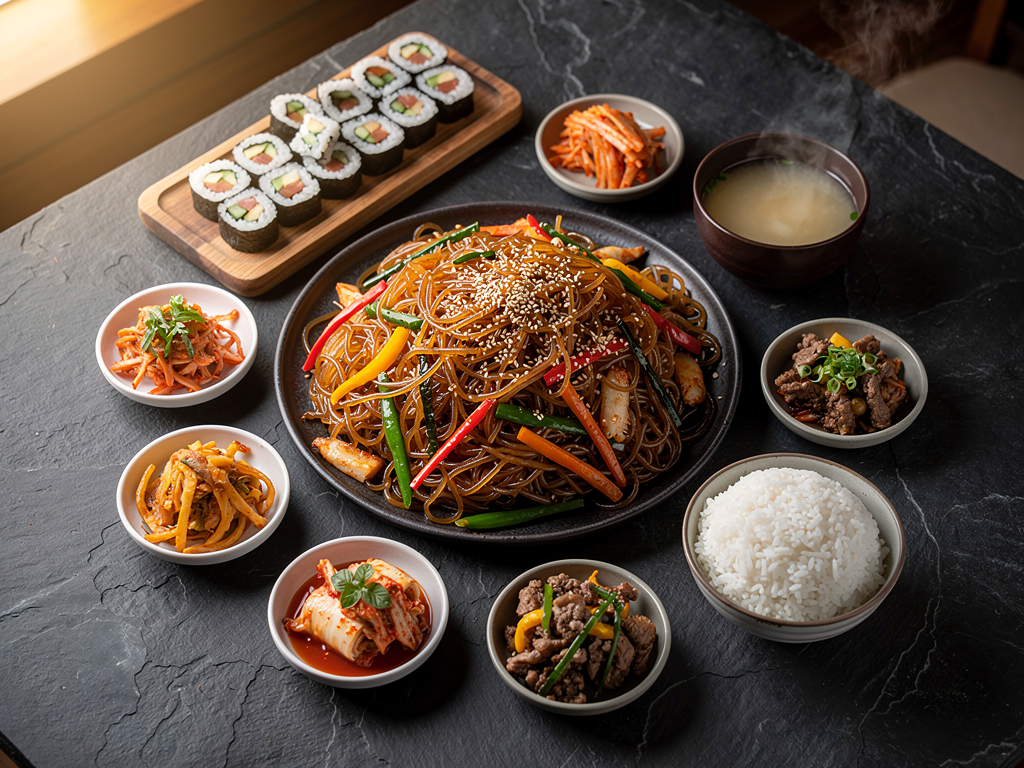
Dangmyeon noodles boiled until translucent, then tossed with thinly sliced beef, carrot, spinach, onion and mushroom, seasoned with soy, garlic, a little sugar and a generous pour of toasted sesame oil.
The starch noodle is the whole point. Because it does not soak up liquid, the sesame oil coats each strand instead of soaking in, and the chew stays distinct even after the dish cools completely. That property is why japchae is a holiday and party dish in Korea — it can sit on a table for hours — and it is the same property that makes it survive a delivery run better than almost any other noodle dish sold here.
It comes in vegetarian, chicken and beef versions, and beef is the default across UAE Korean menus. Cold leftovers the next day are genuinely good, which is rare for a noodle dish. There is solid background on japchae and its sweet potato starch noodles if you want the history.
What pad thai actually is
Thin rice sticks soaked rather than boiled, then thrown into a very hot wok with egg, beansprouts, spring onion, crushed peanut, usually dried shrimp, and a protein. The sauce balances tamarind for sourness, fish sauce for salt and depth, and palm sugar for sweetness, with lime squeezed over at the end.
The rice noodle is porous, so it takes on that sauce fast — which is exactly why the dish peaks in its first few minutes and declines steadily after. Everything good about pad thai is a function of heat and immediacy.
Regional versions vary considerably; the Isan approach of north-eastern Thailand leans bolder and sharper than the Bangkok default. If you have only ever had a sweet, ketchup-ish pad thai, you have had a version tuned down for export palates rather than the real balance.
Why both dishes exist, and why neither is ancient
A small surprise: both are modern, and both were shaped by cheap imported starch rather than by centuries of tradition.
Sweet potato starch noodles reached Korean home cooking in the twentieth century. The dish that preceded them was a vegetable-and-meat toss with no noodles at all — the noodles were the addition, not the base. That is why japchae still tastes like a seasoned vegetable dish with noodles running through it, rather than a noodle dish with vegetables on top. Order it and you will notice the vegetables are doing real work.
Pad thai is younger still, and it was deliberate. It rose to national-dish status in Thailand in the mid-twentieth century as part of a state campaign that promoted rice noodles at a moment when rice itself was in short supply and wheat noodles carried foreign associations. A dish designed to be cheap, fast, portable and unmistakably Thai.
Which explains a lot about how they behave now. Japchae was built around the properties of a starch noodle somebody had to learn to use, and it inherited the room-temperature habits of banquet food. Pad thai was built for a street cart with a hot wok and a customer standing in front of it. Neither is trying to be the other, and the reason each fails at the other’s job is that it was never designed to do it.
Practical rules for ordering either dish
1. Name the noodle. Say “sweet potato noodles” or order japchae by name. “Glass noodles” is ambiguous on UAE menus and gets you mung bean vermicelli about as often as not.
2. Let distance decide. If the food is travelling, order japchae. If you are sitting down, pad thai is the better use of the occasion.
3. Ask about the base sauce, not the toppings. For pad thai, fish sauce and dried shrimp live in the seasoning, not on top. Removing the shrimp garnish changes nothing.
4. Take the lunch box when it exists. The Korean Restaurant’s AED 38 japchae lunch box comes with Korean sides and is the cheapest legitimate way into the dish in Dubai.
5. Ask for lime on the side with pad thai. Acidity fades faster than sweetness, so a fresh wedge lets you rebuild the balance at the table.
6. Ignore the AED 100 outlier and the AED 28 floor. The AED 45–55 band gets you a representative version of either dish without destination markup or flat-menu compromise.
Where Mukbang Shows fits, and where it does not
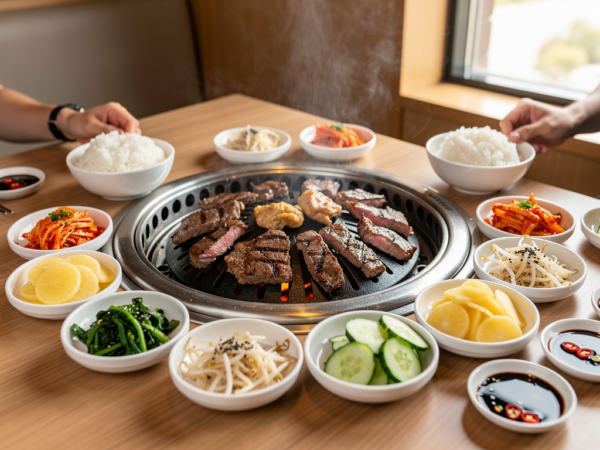
Straight version: Mukbang is on one side of this comparison only. It is a Korean BBQ house — there is no pad thai on the menu and there never will be. Japchae is AED 55, sweet potato noodles with beef and vegetables, sitting in a noodle section alongside jajangmyeon at AED 55, cold mulnaengmyun at AED 55, bibimguksu at AED 48 and three bokkeum myeon variants from AED 48 to AED 59.
Two honest limitations. First, AED 55 is not the cheapest japchae in the country — The Skewers publishes AED 40 and The Korean Restaurant AED 50. Second, japchae here is a supporting dish, not the reason to book; the grill is, with all-you-can-eat from AED 69 at Deira, Muroor and Electra and AED 79 at JBR and DWTC.
What it does have going for it: the beef-and-vegetable build is the default, so nothing needs substituting, and it arrives as part of a table rather than as a solo plate. Deira is on Al Ittihad Road in Port Saeed (+971-4-886-4494), with the other branches at The Walk in JBR, Sheikh Zayed Road opposite the metro station, and two sites in Al Danah, Abu Dhabi.
FAQ
Can japchae be eaten cold?
Yes, and it is meant to be. Sweet potato starch noodles keep their spring at room temperature, which is why japchae is a Korean party dish and why cold leftovers hold up the next day.
Does pad thai always contain fish sauce?
The canonical version does, and dried shrimp is common in the base seasoning too. If that matters to you, ask about the sauce specifically — a plate labelled vegetable pad thai often still contains both.
Which is cheaper in the UAE?
Pad thai, at the floor. AED 28 at Pad Thai Restaurant undercuts the cheapest published japchae, AED 40 at The Skewers. In the middle the two overlap almost exactly, between AED 45 and AED 55.
Are japchae noodles the same as Thai glass noodles?
No. Japchae uses sweet potato starch noodles, which are thicker and much chewier. Thai and Chinese glass noodles are mung bean starch, thin and slippery. UAE menus use the same English label for both, which is where the confusion in japchae vs pad thai usually starts.
Which is better for a group?
Japchae. It can sit on the table through a whole meal without going downhill, so it works as a shared dish. Pad thai wants to be eaten immediately, which makes it awkward to share across a long table.
Is japchae spicy?
No. It is one of the least spicy dishes on a Korean menu — sweet, savoury and nutty rather than hot. Pad thai is not inherently spicy either; the heat comes from chili flakes added at the table.
Pick on behaviour, not on cuisine. One of these dishes was built to sit still and one was built to be eaten immediately, and once you know which is which the rest of the decision makes itself.
Related guides
More from our Korean food guides across the UAE:
Comments are closed.