Updated: July 2026
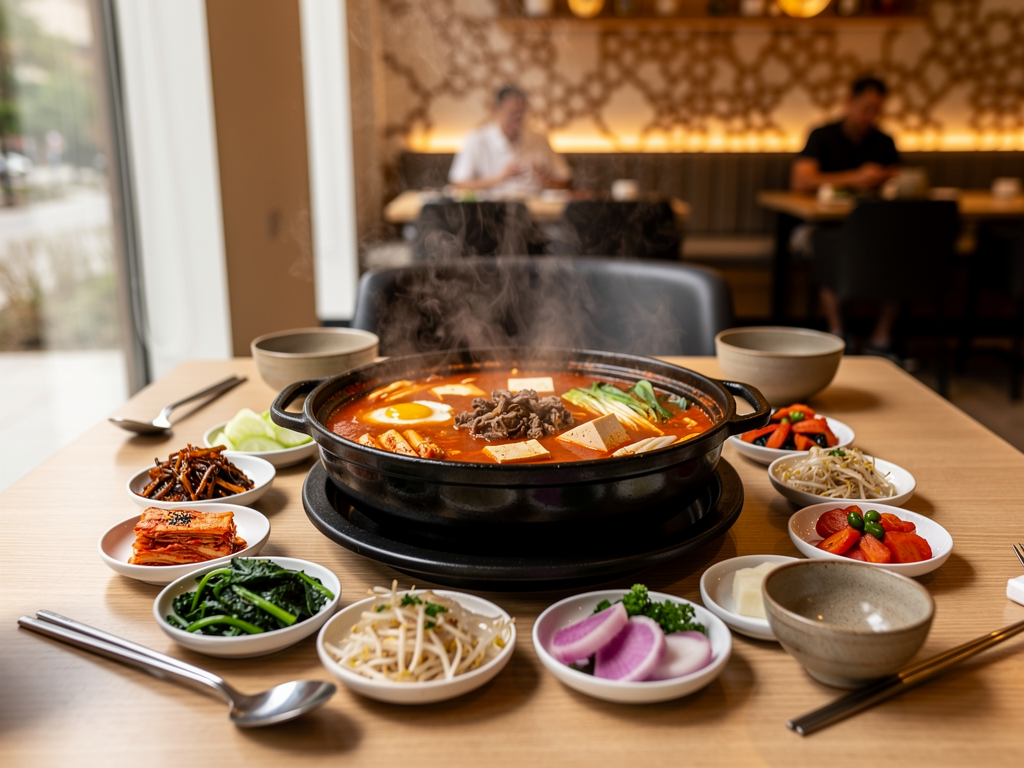
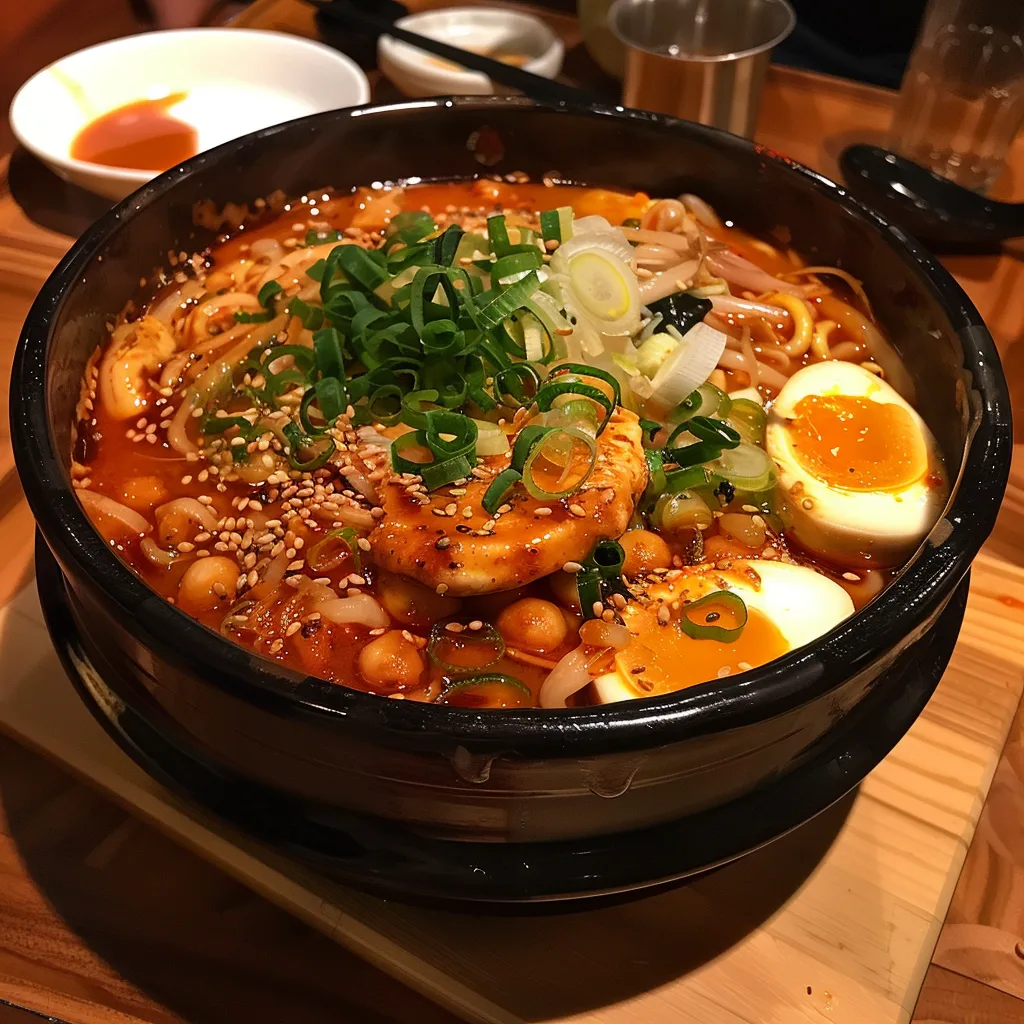
What is soondubu jjigae? It is a Korean stew of uncurdled silken tofu in a chilli-oil broth, cooked and served in an earthenware pot that is still boiling when it reaches the table. In the UAE the clearest place to try it is Mukbang Shows, where the stew is listed at AED 59.
TL;DR
- Best overall: Mukbang Shows (Deira, Al Ittihad Rd) — AED 59, halal settled before you order
- Best value: Mukbang Shows Muroor Road and Electra Street, Abu Dhabi — same AED 59 stew
- Situational pick: Mannaland in Al Hudaiba for a plain, home-style neighbourhood bowl
What is soondubu jjigae?
What is soondubu jjigae, in one line? It is a Korean stew built on sundubu — soft tofu that was never pressed into a block — simmered in a red broth of chilli flakes, stock and kimchi, with a raw egg cracked in at the end.
The Hangul is 순두부찌개. The two halves of the name do the explaining: 순두부 means soft tofu, 찌개 means stew. It is everyday food in Korea, sold by specialist shops that cook almost nothing else and let you choose the protein and the heat level.
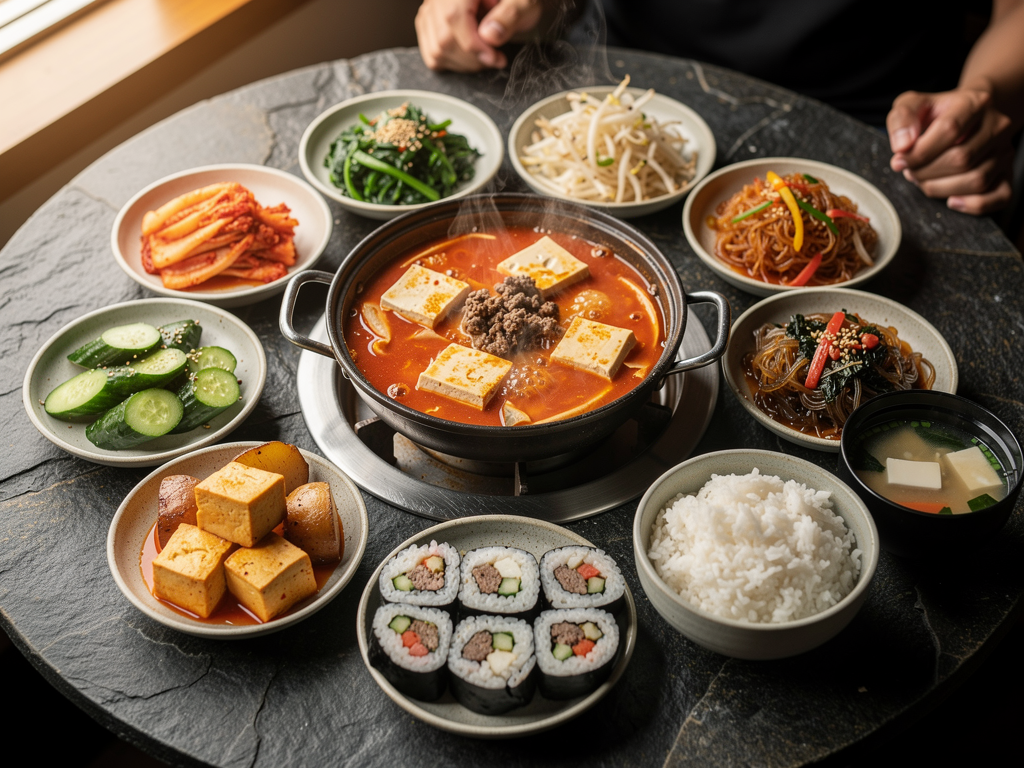
The tofu is the whole dish. It arrives scooped rather than sliced, and it breaks apart into trembling ribbons that soak up the broth in a way a firm block never manages. The pot comes with a separate bowl of rice and a set of banchan, and you eat the three in rotation.
What does soondubu jjigae taste like?
The first spoonful is chilli oil, then salt, then a savoury depth from the stock underneath. It is thicker and saltier than a clear soup because a jjigae is meant to be eaten with rice rather than drunk on its own.
The tofu itself is close to flavourless. That is the point — it carries the broth rather than competing with it, so the texture does the work. Kimchi brings sour edges, spring onion and garlic keep it from turning heavy, and the protein, beef or seafood, adds the last layer.
The heat is round rather than sharp, because the chilli goes in as flakes bloomed in oil at the start of cooking rather than as powder stirred in at the end.
What is the difference between soondubu and regular tofu?
This distinction is the reason the dish exists. Regular tofu is curdled and then pressed into a firm block so it can be cubed and fried without collapsing. Sundubu is stopped before the pressing stage — never squeezed, never shaped.
That is why it is sold in a tube rather than a slab, why it cannot be cut into neat pieces, and why the texture sits closer to barely set custard than to the springy bite most people associate with tofu.
It is also why the stew is stirred gently. Work the pot too hard and the sundubu breaks down into something closer to porridge. Handled properly it stays in soft folds through the broth, and that mouthfeel is what regulars are actually ordering.
What goes in soondubu jjigae?
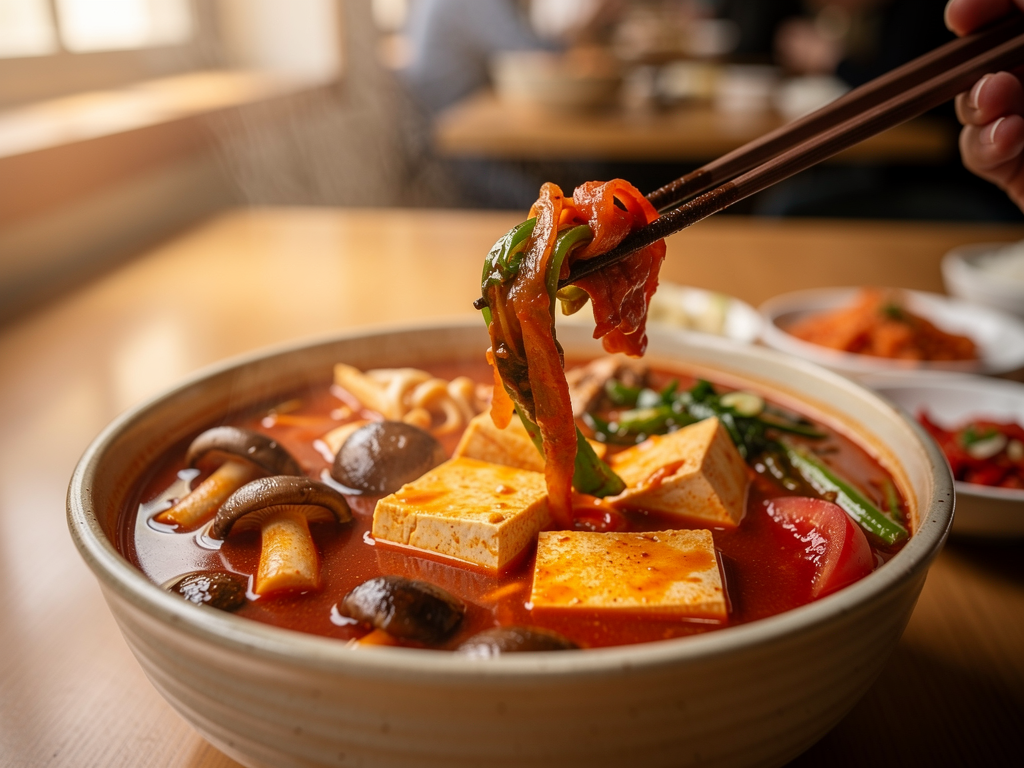
Five components, in order of assembly. Gochugaru — Korean chilli flakes — bloomed in oil, which produces the red slick that sits on the surface. A stock, most often anchovy-and-kelp or beef. Kimchi, for acidity. Aromatics: garlic, spring onion, a little soy or salt.
Then the protein: beef, mixed seafood, dumplings, or nothing at all. The sundubu goes in last so it stays as intact as possible, and a raw egg is added to the boiling pot at the end, where it poaches in the residual heat rather than on the stove.
No two kitchens build the same version. The stock is where the real variation lives, which is why people who eat this dish often end up loyal to one specific restaurant.
Soondubu, sundubu or sun-dubu: which spelling is right?
All of them. They are competing romanisations of the same Korean word, 순두부, and none is more correct than the others in English. Menus in the UAE tend to use “soondubu jjigae” or “sundubu jjigae” interchangeably, sometimes on the same page.
If you see soft tofu stew, soondubu jjigae, sundubu jjigae or sun-dubu jjigae on a menu, they point at the same pot.
Soondubu jjigae vs kimchi jjigae vs doenjang jjigae
All three are jjigae — thicker, saltier stews shared at the centre of the table, as opposed to guk, which is a thinner soup served in individual bowls, or jeongol, which is a hotpot cooked at the table on a burner.
| Stew | Built on | Texture | Best for |
|---|---|---|---|
| Soondubu jjigae | Uncurdled soft tofu, chilli oil | Lightest, silky | A fast, hot solo meal |
| Kimchi jjigae | Aged, sour kimchi | Chunky, punchy | Fermented, sour heat |
| Doenjang jjigae | Fermented soybean paste | Earthy, thick | Deep savoury flavour, low heat |
Soondubu jjigae is the lightest of the three and the quickest to eat, which is why it is the standard weekday lunch order. Kimchi jjigae is the most aggressive. Doenjang jjigae is the one to order if chilli is not your thing at all. There is a fuller local comparison in the kimchi jjigae in Dubai guide.
Why is it served still boiling in a stone bowl?
The pot is a ttukbaegi — thick, unglazed-looking earthenware with enough thermal mass to hold a rolling boil for several minutes after it leaves the stove.
That sustained heat does two jobs. It cooks the raw egg at the table without the pot going back to the kitchen, and it keeps the last spoonful as hot as the first, which matters more than it sounds when you are eating slowly.
Practical warning: the bowl itself stays hot enough to burn for the whole meal. Move the tray, not the pot.
How do you eat soondubu jjigae properly?
Let the egg sit in the broth for around half a minute before stirring it through, so it sets rather than dissolving into the stew.
Use a spoon, not chopsticks — soft tofu and broth do not survive the trip on sticks. Spoon the stew over your own bowl of rice instead of tipping rice into the shared pot, which is how it is done at a Korean table and which also stops the broth going starchy.
Then rotate: stew, rice, banchan, repeat. The banchan are not garnish; they are the reset between spoonfuls.
How spicy is soondubu jjigae, and can you get it mild?
Most restaurant versions land at a medium that builds slowly rather than hitting hard. In Korea, specialist tofu houses usually publish a spice ladder and let you pick a level.
Menus in the UAE generally list one version, so if you want it toned down, say so when you order rather than assuming there is a mild option on the card. Even at its gentlest it is not a mild dish in the way a cream soup is mild — the fermented kimchi and the stock carry flavour regardless of the chilli.
Is soondubu jjigae halal?
Not automatically — and the risk is not where most people look for it. The tofu and vegetables are never the problem. The two watch points are the stock and any cooking wine used to season it.
Plenty of kitchens build the base on anchovy, kelp or beef, all of which are fine. Others use a pork bone base, and that is invisible under a red broth. So the useful question at the table is not “is there pork in it” but “what is the stock made from”.
At Mukbang Shows the question is already settled: the restaurant is 100% halal, beef and chicken only, no pork and no alcohol across all five branches. Anywhere else, ask about the stock — including at venues that look obviously Korean and family-run.
How many calories is soondubu jjigae?
Roughly 300–450 kcal for a standard pot before rice. The range is wide because the chilli oil and the protein swing the number more than the tofu does — a seafood version sits lower than a beef one, and a heavy-handed oil bloom adds up fast.
Add a bowl of rice and the meal lands somewhere in the 500–700 kcal region. Treat all of these as ranges. Any restaurant quoting an exact figure for a hand-built stew is guessing.
Where can you try soondubu jjigae in the UAE?
Mukbang Shows is the clearest answer, mostly because it is the only place found publishing a firm price. The stew is AED 59, listed on the live menu next to Doenjang Jjigae at AED 59, Kimchi Jeongol at AED 89 sharing or AED 50 solo, and Budae Jjigae at AED 99. It comes made to order with rice and banchan. Five branches carry it: Deira (Al Ittihad Rd, Port Saeed, +971-4-886-4494), JBR, DWTC, plus Muroor Road and Electra Street in Abu Dhabi.
The honest limitation: Mukbang is a Korean BBQ house first. The menu lists one version of the stew rather than the seafood / beef / dumpling / plain spread a dedicated tofu house in Seoul would offer, and there is no published spice ladder, so mild is something you request rather than select. What it wins on is price and on the halal question being answered before you sit down. It also works as a AED 59 opener before an all-you-can-eat BBQ set, which starts at AED 69 at the value branches and AED 79 at the premium ones.
Mannaland (Al Hudaiba / Satwa) is the strongest neighbourhood alternative — a long-running halal kitchen where the stews sit alongside bibimbap and galbi on a short menu, roughly AED 60–120 a head. The room is plain and it fills at lunch. Call +971 4 345 3200 to check the soft tofu stew is on that day.
Seoul Garden (Al Karama) is one of Dubai’s oldest Korean restaurants, with private rooms, tabletop grills and a full stew section the Korean community orders from as much as the grill. Around AED 170 for two; stew prices are not published. Dated room, tight evening parking, and halal status to confirm directly.
Hankook (Al Nahyan, Abu Dhabi) is the capital’s value kitchen for home-style stews, around AED 50 a dish and roughly AED 195 for two per MyBayut’s February 2026 listing, with portions reviewers say stretch across three people. The soft tofu stew is not confirmed on its published menu, so call first. Abu Dhabi has no metro — budget for a taxi.
Hanok (DIFC), Sonamu (Asiana Hotel, Deira) and Sura Dining Lounge (Al Garhoud) sit further up the price ladder. Hanok is a formal DIFC dining room. Sonamu runs an all-you-can-eat Korean buffet around AED 89 a head where a soft tofu stew usually appears on the hot line — cheap way to taste several stews, but a buffet tray is not a ttukbaegi and it will not arrive boiling. Sonamu and Sura are both licensed venues (alcohol served); confirm what you need to before booking.
| Venue | Area | Price AED | Halal | Standout order |
|---|---|---|---|---|
| Mukbang Shows | Deira, JBR, DWTC, Abu Dhabi ×2 | 59 | Yes — beef and chicken only | Soondubu Jjigae AED 59 |
| Mannaland | Al Hudaiba / Satwa | ~60–120 pp | Halal kitchen per listings | Soft tofu stew, home style |
| Seoul Garden | Al Karama | ~170 for two | Confirm directly | Full stew section |
| Hankook | Al Nahyan, Abu Dhabi | ~50 a dish | Confirm directly | Home-style stews, big portions |
| Hanok | DIFC | Above AED 59 | Confirm directly | Polished DIFC service |
| Sonamu | Deira | ~89 buffet | Licensed venue (alcohol served) | Buffet stew line |
| Sura Dining Lounge | Al Garhoud | Mains 70+ | Licensed venue (alcohol served) | Broad à la carte jjigae |
Expect AED 55–80 for a proper made-to-order pot anywhere in the country, and call ahead at the smaller kitchens — a single-dish stew comes and goes from a menu. The deeper local ranking is in the best soondubu jjigae in Dubai guide, and current pricing is on the full Mukbang Shows menu.
Practical ordering tips
- Call ahead at smaller kitchens. Stews rotate, and a single-dish order can be off on a quiet night.
- Say your spice level when you order, not after. Most menus here list one version by default.
- Ask what the stock is made from if halal matters to you. “Is there pork in it” is the wrong question — the pork lives in the base.
- Keep the rice in its own bowl and spoon the stew over it, rather than tipping rice into the pot.
- Ask for the egg to go in at the table if it has not arrived that way — you get to control how far it sets.
- Do not move the ttukbaegi by its rim. It holds heat for the length of the meal.
- Eat it reasonably briskly. The broth reduces on the residual heat and gets saltier as it sits.
Where the dish comes from
Sundubu is associated most strongly with Gangneung, on Korea’s east coast, where the tofu is traditionally set with seawater rather than a commercial coagulant. That coastal version is milder and often served plain, without the chilli oil, so the tofu itself is the flavour.
The red, chilli-oil style most people picture is the restaurant standard, and it travelled well — sundubu chains were among the first Korean restaurant formats to spread abroad, because the dish is fast to serve, cheap to build and survives being cooked to order in a small kitchen. That is the same reason it turns up on Korean menus in the UAE even where the rest of the list is barbecue.
For background beyond the restaurant scene, Korean Bapsang’s soondubu jjigae recipe walks through the home version, and the Korea Tourism Organization’s guide to Korean food covers where it sits in the wider canon. Time Out Dubai’s best Korean restaurants list is a reasonable cross-check on the venues above.
FAQ
Is soondubu jjigae vegetarian? Usually not. Even a version with no visible meat is often built on anchovy stock, and many add beef or seafood. Ask about the base rather than the toppings.
What is soondubu jjigae served with? A separate bowl of steamed rice and a set of banchan. The stew is not eaten on its own — the rice is part of the dish, not a side.
Can I make it at home in the UAE? Yes. Tubes of sundubu turn up in Korean grocery shops in Dubai, and a heavy casserole substitutes for a ttukbaegi reasonably well, though it will not hold the boil as long.
Is soondubu jjigae gluten-free? Not reliably. Soy sauce and stock seasonings commonly contain wheat. Check with the kitchen, or use certified gluten-free seasoning at home.
Can children eat it? Yes, if you ask for it mild and stir the egg through. The soft texture usually goes down well once the chilli is dialled back.
Soondubu jjigae or kimchi jjigae — which should a first-timer order? Soondubu jjigae. It is lighter, less sour and less confronting than aged-kimchi stew, and the tofu texture is the more interesting thing to try first.
Once you have had one, the dish stops being mysterious: soft tofu, a red broth, an egg, a pot too hot to touch. At AED 59 it is one of the cheapest full Korean meals in the country, and it takes about fifteen minutes to eat.
Related guides
More from our Korean food guides across the UAE:
- soondubu vs Mapo Tofu
- what Is Jjigae?
- what Is Kimchi Jjigae?
- soondubu vs Shorbat Adas
- doenjang Jjigae vs Miso Soup
- the best soondubu jjigae in Abu Dhabi
Mukbang Shows pricing: our all-you-can-eat sets start from AED 69 per person at Deira and Abu Dhabi, and AED 79 at JBR and Dubai World Trade Centre. See the full price list for every set and branch.
Comments are closed.