Updated: July 2026
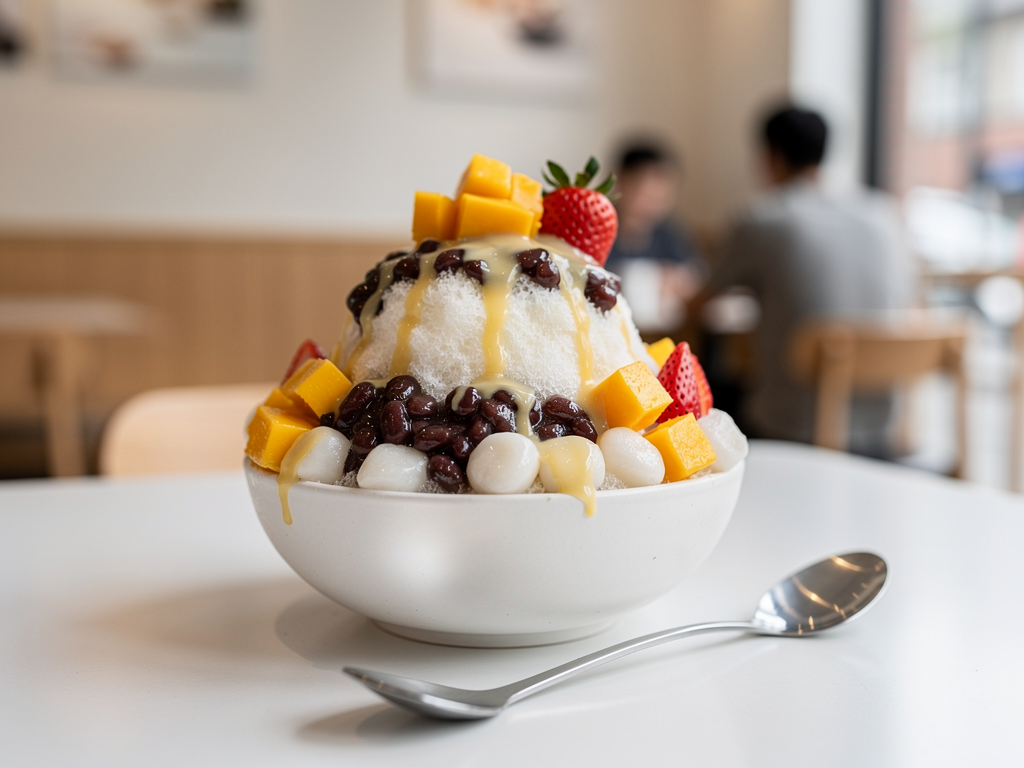
What is bingsu? It is a Korean shaved-ice dessert built on frozen milk shaved into snow-fine ribbons, piled with red bean, rice cake or fruit, and shared between two or three people. The cheapest published bowl in the UAE is at Mukbang Shows, at AED 37.
TL;DR
- Best overall: Mukbang Shows — AED 37, the cheapest published bowl in the country, across five branches
- Best for dessert as the main event: Mealtop, La Mer — a dedicated Korean dessert cafe, roughly AED 40–70
- Best documented in Abu Dhabi: Madang, Al Ghazal Golf Club — AED 55, price published at source
What is bingsu?
What is bingsu, precisely? A Korean shaved-ice dessert, written 빙수, whose name means “ice water”. The original and still-traditional version is patbingsu (팥빙수) — red bean shaved ice.
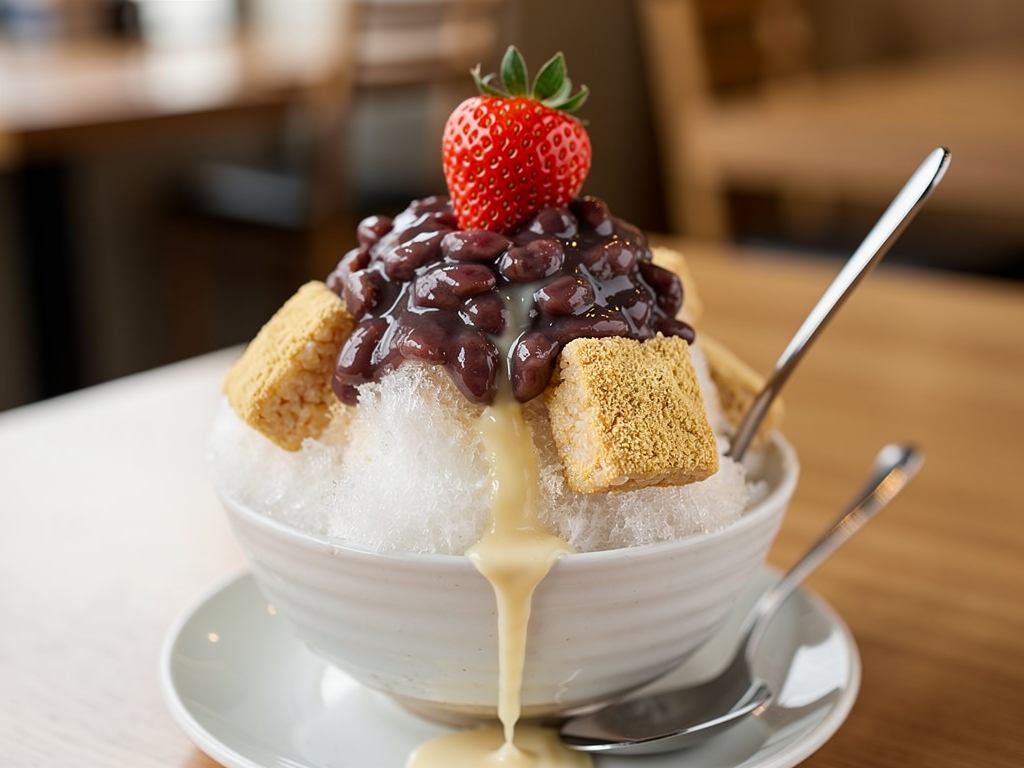
The ice is the dish. At a proper bingsu counter the block going into the machine is frozen milk, not water, and it is shaved into ribbons fine enough that Koreans call the result nunkkot: snow flower. Because the dairy is inside the ice rather than poured over it, the dessert is already creamy and lightly sweet before a single topping lands.
It is a sharing dessert by design, built for two or three, meant to be mixed the moment it arrives and eaten quickly.
What does bingsu taste like?
Milky and lightly sweet first, then whatever the toppings are doing. That order matters — in most shaved-ice desserts the syrup is the flavour and the ice is the vehicle. Here the base carries flavour on its own.
The texture is the real event. Properly shaved milk ice collapses on the tongue into something closer to cold cream than to crushed ice, with no crunch at all. That is why a bowl left sitting turns into sweet milk within minutes rather than melting slowly.
The contrast is what keeps it interesting: soft snow against chewy tteok rice cake, firm sweetened red beans, and cold fruit. It is a good closer after grilled meat for exactly that reason.
What is bingsu made of?
Milk, frozen into a solid block, then shaved. Everything else is a topping.
The traditional build is sweetened red bean paste, tteok rice cake — often injeolmi, dusted in roasted soybean powder — condensed milk, and sometimes a scoop of ice cream. Modern cafe versions swap in mango, strawberry, matcha, chocolate, Oreo crumb, cheesecake pieces or tiramisu.
The milk-ice base is the non-negotiable part. Water ice with syrup poured over the top is a different dessert, however Korean the toppings look.
Why is bingsu different from other shaved ice?
This is the useful question in the UAE, where four different shaved-ice traditions are sold within a few kilometres of each other. The differences are real, and they come down to what the ice is made of, how finely it is shaved, and whether you mix it.
| Dessert | Origin | The ice | Dairy | How it is eaten |
|---|---|---|---|---|
| Bingsu | Korea | Frozen milk, shaved snow-fine | Inside the ice | Mixed through, shared, eaten fast |
| Halo-halo | Philippines | Crushed water ice | Evaporated milk poured on top | Mixed hard at the table — the name means mix-mix |
| Kakigori | Japan | Water ice, very finely shaved | Usually none in the ice | Eaten as served, syrup on top |
| Baraf ka gola | South Asia | Crushed ice packed on a stick | None | Held and eaten, syrup-soaked |
Bingsu’s snow collapses immediately. Halo-halo stays chunky and layered much longer. Kakigori melts cleanly but has no creamy body. Gola is the simplest and sweetest of the four. Khaleej Times covered how Asia beats the summer heat across exactly this spread of desserts.
What is patbingsu, and how is it different?
Patbingsu is the original. Pat means red bean, and the classic bowl is red bean paste, tteok, roasted soybean powder and condensed milk over the ice — sweet, nutty, not fruity.
Korea’s ice-dessert history runs a long way back: the Joseon court maintained ice stores called seobinggo, and shaved ice with red bean became a commercial summer staple in the twentieth century. The milk-snow style that dominates cafe menus now is comparatively recent, popularised by Korean dessert chains from the 2010s.
That shift turned bingsu from a red-bean dessert into a blank canvas. Most UAE menus default to the newer milky base, usually with a spoonful of red bean still on top even for a mango bowl. The Korea Tourism Organization’s guide to Korean food covers where it sits in the wider canon.
What are the most common bingsu flavours?
Mango, strawberry, chocolate and original are the standard four on UAE restaurant menus. Matcha and Oreo turn up at dedicated cafes, along with injeolmi, cheesecake and seasonal specials.
Mango and strawberry dominate here, which is unsurprising — fresh fruit reads well against milk snow and photographs well. Matcha is the one to order if the sweetness of the others is too much; the bitterness cuts it.
Restaurant dessert menus keep the list short deliberately. A specialist cafe is where the range lives.
How do you eat bingsu properly?
Mix it immediately. Fold the toppings down through the snow the moment it lands so every spoonful has some of everything — eating only off the top leaves you with plain ice at the bottom.
Then eat fast. This is not a dessert to linger over, especially not in this climate: a bowl left for ten minutes is sweet milk with sunken toppings.
Share it. A standard bowl is sized for two or three after a meal, which is also how the price works out sensibly. Use the long spoon it comes with, not chopsticks.
Is bingsu halal?
Bingsu is one of the lower-risk Korean desserts. The base — milk ice, red bean, fruit, rice cake, condensed milk — raises nothing.
Two things are worth checking. Gelatin in jelly toppings, which may be pork-derived unless the venue states otherwise. And alcohol in dessert-restaurant versions: liqueur-soaked sponge, rum-raisin ice cream, that class of ingredient. Neither is common in a standard bowl, but neither is visible either.
Mukbang Shows is 100% halal — beef and chicken only, no pork, no alcohol on site — so the question does not arise. HARU in Abu Dhabi states it is explicitly halal on its own channels. For Mealtop, Madang, Seoul Street Coffee and the Al Wahda Mall dessert outlet, confirm directly.
How many calories is bingsu?
Roughly 400–800 kcal for a full shared bowl. The spread comes from the condensed milk, any ice cream scoop, and whether cookie or cheesecake pieces are involved — a plain original sits near the bottom of that range, a loaded chocolate bowl near the top.
Split between two or three people, which is how it is meant to be eaten, that is a modest dessert per head. Exact counts are rarely published, so treat all of these as ranges.
Where can you try bingsu in the UAE?
Mukbang Shows has the cheapest published bingsu found anywhere in the country: AED 37, in mango, strawberry, chocolate and original, identical across all five branches — Deira (Al Ittihad Rd, Port Saeed, +971-4-886-4494), JBR, DWTC, plus Muroor Road and Electra Street in Abu Dhabi.
The honest limitation, stated plainly: the entire dessert menu is three lines. One bingsu, a Melona ice cream bar at AED 17, and bubble tea. No injeolmi bowl, no cheesecake shell, no matcha tower, no wall of twenty flavours. It is a restaurant dessert built to close a barbecue meal — the all-you-can-eat sets start at AED 69, two-person minimum, AED 60 leftover charge — and if bingsu is the whole reason you are going out, a dedicated dessert cafe will serve you better. What it wins on is price and on being 100% halal without asking.
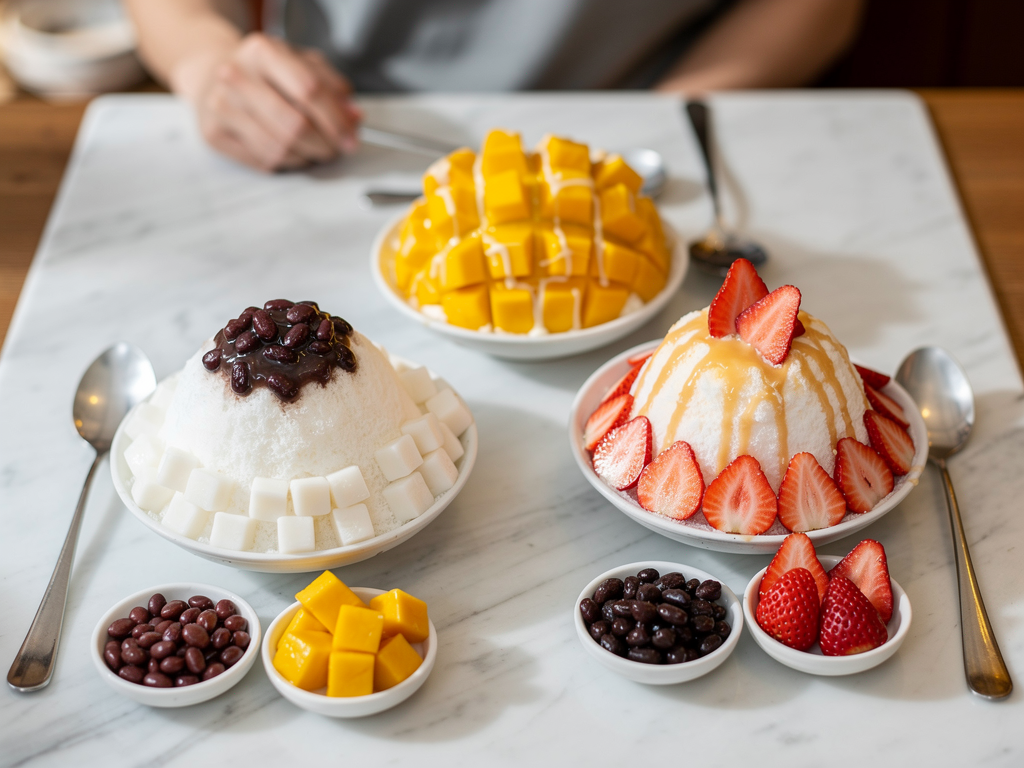
Mealtop (La Mer North, Jumeirah 1, Dubai) is where bingsu is the main event — a South Korean dessert chain by origin and the best-known specialist in the city, roughly AED 40–70 a bowl depending on flavour. It is a dessert cafe, not a restaurant, and La Mer parking is a genuine hassle at weekends. Confirm halal status directly.
Madang Korean Restaurant (Al Ghazal Golf Club, Al Sa’adah, Abu Dhabi) publishes AED 55 a bowl on its own site, described there as sized to share between two or three — the only competitor bingsu price published at source anywhere in the capital. It sits on a golf club’s ground floor, so it is a destination trip rather than a walk-in. Confirm halal status directly.
Seoul Street Coffee (1004 Gourmet, The Greens, Dubai) runs cafe pricing around AED 30–55, attached to a Korean grocery — useful if you want dessert and a bag of ingredients in one stop. Limited seating, snack-focused. Confirm availability and halal status directly.
Bingsu Wa Bungeopang (Al Wahda Mall Extension, Abu Dhabi) is the one genuinely dedicated Korean dessert outlet found in the capital, pairing bingsu with bungeoppang, the fish-shaped red bean pastry. No prices are published anywhere reachable, and listings conflict on whether it is currently trading — confirm before you travel.
HARU Restaurant (Al Najda St and Al Zeina, Abu Dhabi) is the capital’s most prominent explicitly-halal Korean cafe-restaurant. Bingsu is not verified on its published menu, which lists coffee and bakery items, so call before going for it specifically.
1004 Gourmet (Shams Boutik Mall, Al Reem Island, Abu Dhabi) is the do-it-yourself answer, and a real one given how thin the capital’s dessert scene is — red bean paste, injeolmi powder, tteok and Korean milk are all on the shelves. It is a supermarket; there is no served bowl.
| Venue | Area | Price AED | Halal | Standout order |
|---|---|---|---|---|
| Mukbang Shows | Deira, JBR, DWTC, Abu Dhabi ×2 | 37 | Yes — 100% halal, no alcohol | Mango bingsu, after AYCE BBQ |
| Mealtop | La Mer, Jumeirah 1 | ~40–70 | Confirm directly | Specialist flavour range |
| Madang | Al Sa’adah, Abu Dhabi | 55 (published at source) | Confirm directly | Shareable bowl for 2–3 |
| Seoul Street Coffee | The Greens, Dubai | ~30–55 | Confirm directly | Dessert plus a grocery run |
| Bingsu Wa Bungeopang | Al Wahda Mall, Abu Dhabi | Not published — ask | Confirm directly | Bingsu with bungeoppang |
| HARU | Al Najda / Al Zeina, Abu Dhabi | Not published — ask | Explicitly halal per its own channels | Call to confirm bingsu is on |
| 1004 Gourmet | Al Reem Island, Abu Dhabi | Grocery pricing | — | Ingredients for a home bowl |
Budget AED 35–70 for a shareable bowl. Note how little of this is published: only Mukbang and Madang list a price at source, and several Abu Dhabi venues publish nothing at all, so phone ahead in the capital. Local rankings are in the best bingsu in Dubai guide and the best bingsu in Abu Dhabi guide, and current pricing is on the full Mukbang Shows menu. Time Out Dubai’s best Korean restaurants list puts several of these venues in wider context.
Practical ordering tips
- Call ahead in Abu Dhabi. Dedicated dessert outlets there are few, trading status is not always clear, and a Korean-named venue does not necessarily serve bingsu.
- Order it as a shared bowl. One person rarely finishes one before the snow gives out.
- Ask for less condensed milk if you want it lighter — that is the sweetest element by some distance.
- Ask about gelatin if there are jelly toppings, and about alcohol in anything sponge- or ice-cream based.
- Mix once, thoroughly, then leave it alone. Repeated stirring melts the snow faster than eating it does.
- Time it as the last order rather than an afterthought, so it does not sit while you finish savoury dishes.
- If you want range rather than a closer, go to a dessert cafe. Restaurant menus here carry one or two flavours by design.
Why bingsu works better in the Gulf than in Korea
In Korea, bingsu is a seasonal dessert. Shops build the machines out in May and the category quietly recedes in October. In the UAE the conditions that make it appealing are present most of the year, which is why it has become a permanent menu item here — including on barbecue-led Korean menus that carry almost no other dessert.
That has a second effect worth knowing. Because bingsu here is usually a restaurant closer rather than a cafe’s main product, the flavour range at most venues is narrow, and the specialists are few and concentrated. Dubai has a handful; Abu Dhabi has fewer, and the capital’s dedicated outlets are the ones most likely to have changed hours or moved since a listing was written.
The upside for anyone curious about shaved ice is that this country puts four traditions side by side. You can eat bingsu, halo-halo, kakigori and gola in the same week without leaving one emirate, which is a genuinely unusual thing.
FAQ
Is bingsu the same as shaved ice? Not quite. Bingsu is shaved ice, but the block is frozen milk rather than water, which changes both the flavour and the texture. Most other shaved-ice desserts start with water ice and add flavour afterwards.
Can one person finish a bowl? Usually not well. A standard bowl is built for two or three, and the snow loses its texture faster than one person can work through it.
Does bingsu contain alcohol or gelatin? Standard versions contain neither. Some dessert-restaurant builds use liqueur-soaked elements or jelly toppings set with gelatin, so ask if either matters to you.
Is there bingsu in Abu Dhabi? Yes, though the scene is thin. Mukbang Shows lists it at two branches, Madang publishes AED 55, and there is a dedicated dessert outlet at Al Wahda Mall Extension — confirm it is trading before travelling.
How long does a bowl last on the table? Minutes, not tens of minutes. Mix it as it arrives and eat it straight away, or it becomes sweet milk with sunken toppings.
Can I make bingsu at home? Yes, roughly. Freeze milk in a shallow block, shave or blitz it, and add red bean paste and tteok from a Korean grocery. Home texture will not match a proper shaving machine, but it is close enough.
Once you know the ice is made of milk, the rest of the dessert explains itself: mix it, share it, eat it quickly. At AED 37 it is also one of the cheapest Korean things you can order in this country.
Related guides
More from our Korean food guides across the UAE:
Mukbang Shows pricing: our all-you-can-eat sets start from AED 69 per person at Deira and Abu Dhabi, and AED 79 at JBR and Dubai World Trade Centre. See the full price list for every set and branch.