Updated: September 2026
What is jajangmyeon? It is a Korean bowl of thick wheat noodles under a thick, glossy, near-black sauce made from chunjang — a Korean black soybean paste fried in oil — with diced onion, potato, courgette and meat. It is sweet-savoury rather than spicy, it costs roughly AED 38 to AED 70 in the UAE, and our #1 pick is the halal bowl at Mukbang Shows in Deira, Dubai, at AED 55.
TL;DR
– Best overall: Mukbang Shows — glossy sauce, halal beef or chicken, five branches — AED 55
– Best value: The Skewers Korean BBQ, Hamdan Street, Abu Dhabi — AED 38
– Most flexible: The Korean Restaurant (Hanok), International City — three builds from AED 45
What Is Jajangmyeon?
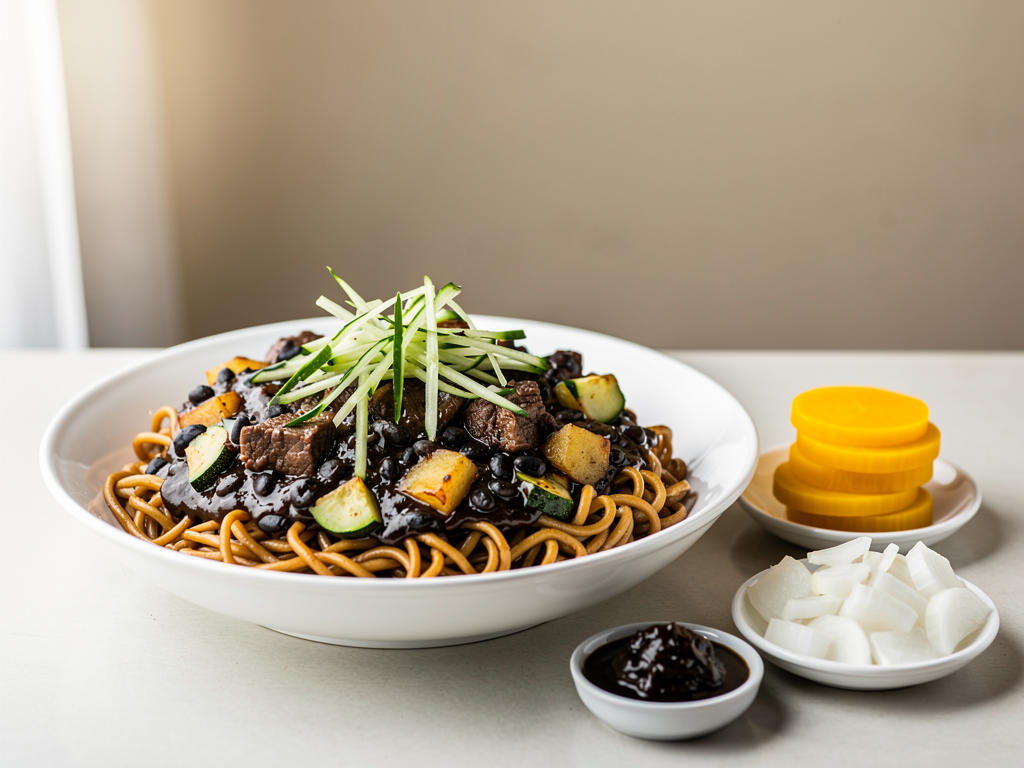
A bowl of thick wheat noodles topped with a thick, glossy, near-black sauce built from chunjang that has been fried hard in oil with diced onion, potato, courgette and meat, then thickened with a starch slurry so it clings to every strand instead of pooling at the bottom.
The dish sits at the centre of junghwa yori — Korean-Chinese food — the category that also contains its spicy sibling jjampong and the sweet-and-sour fried meat dish tangsuyuk. It was created around 1905 in Incheon by Chinese immigrants from Shandong, who took their home dish zhajiangmian and rebuilt it for Korean palates.
That rebuild is the entire point. Chinese zhajiangmian is salty, loose and brown. Korean chunjang has caramel in it and is fried until the bitterness burns off, which produces a sweeter, thicker, almost black result. The two dishes share an ancestor and taste nothing like each other.
The cultural weight is real too. Jajangmyeon is the most-ordered delivery food in Korea. Families eat it on moving day because the delivery arrives before the furniture does. And on 14 April, Black Day, people who received nothing on Valentine’s Day or White Day dress in black and order a bowl.
For the full background see the history of jajangmyeon and the junghwa yori tradition it belongs to.
Is Jajangmyeon Spicy?
No. It is one of the mildest dishes on any Korean menu — sweet-savoury, built around roasted soybean paste and vegetable sweetness, with no chilli in the sauce at all. This is exactly why it is the default order for children and for anyone who has been burned by Korean spice levels once already.
The heat lives in its sibling. Jjampong, the chilli-red seafood noodle soup, is the spicy half of the same menu, and Korean-Chinese restaurants largely exist so a table can order one of each and pass bowls across. Our full breakdown of how the two differ covers which one to order when.
Diners who arrive expecting Korean fire are sometimes disappointed by how gentle it is. That reaction is normal and it is not the kitchen’s fault — the mildness is the recipe.
Why Do UAE Menus Spell Jajangmyeon So Many Different Ways?
Because there is no single agreed romanisation, and UAE kitchens all picked a different one. You will see jajangmyeon, jjajangmyeon, jjajangmyun, chajangmyeon and the plain English “noodles in black bean sauce” — five labels, one bowl.
The Korean Restaurant in International City prints JJAJANGMYEON. Manna Land in Abu Dhabi prints JJAJANGMYUN and describes the sauce as brown beans sauce rather than black. The Skewers in Abu Dhabi prints Jajangmyeon. Several venues drop the Korean word entirely and just describe the sauce.
The practical consequence is that searching one spelling misses half the restaurants that serve it. Scan menus for “black bean” or for chunjang in the description rather than fixating on a spelling, and you will find it every time.
What Is Jajangmyeon Supposed to Look and Taste Like?
Glossy, dark, and clinging. Four checks work in any UAE restaurant, and none of them requires you to know Korean.
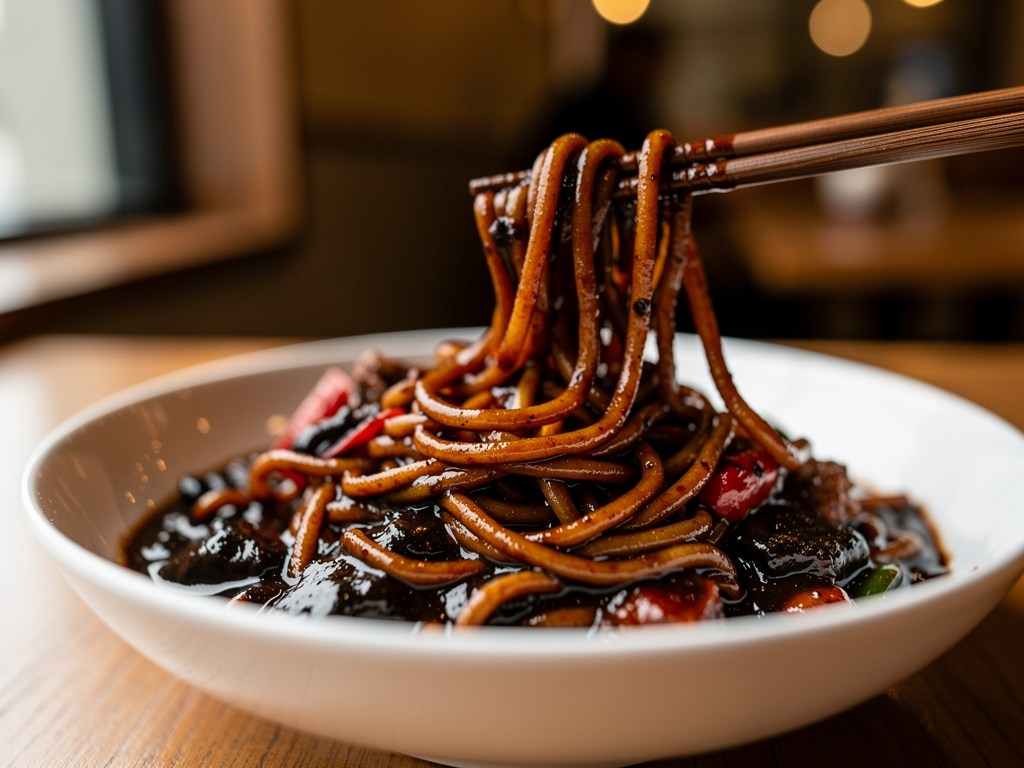
The gloss. The sauce should coat every noodle and leave the bowl looking lacquered. A watery layer separating out at the bottom means the chunjang was not fried long enough.
The colour. Dark brown-black. Grey means under-fried paste; a reddish tint means something else is in the pan.
The noodle. Thick, chewy and substantial, with real resistance. Thin, spaghetti-like strands are the wrong noodle for this dish.
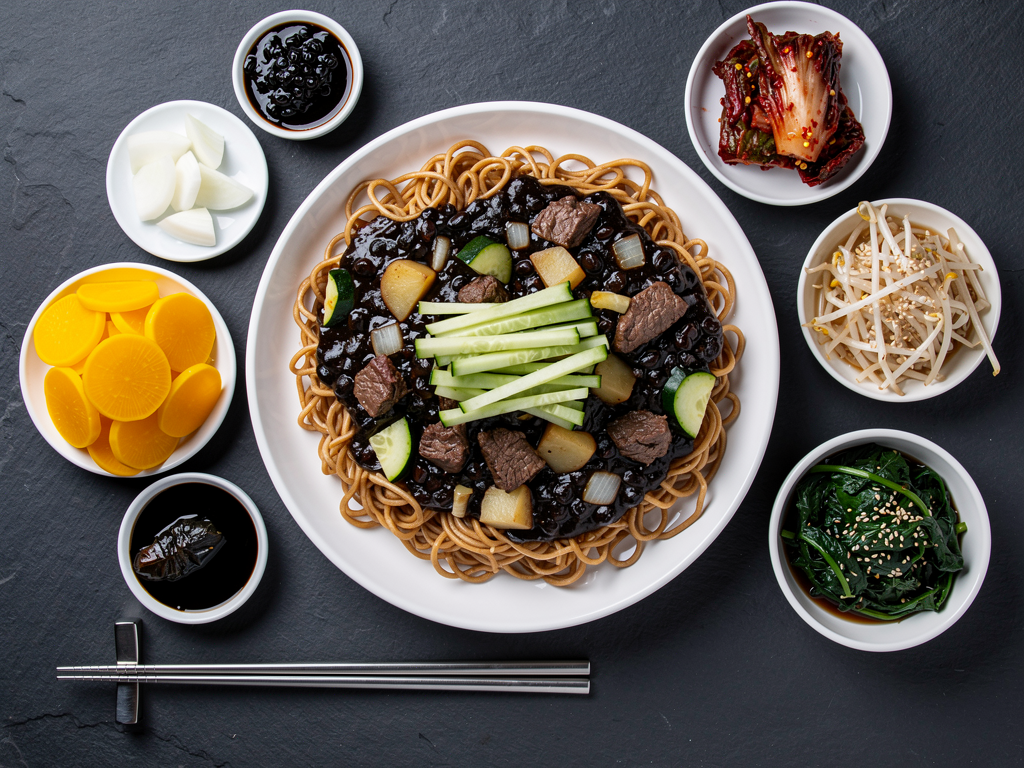
The sides. You should get a bowl of danmuji — the yellow pickled radish — and a small plate of raw onion chunks with extra black bean sauce for dipping. Both are standard in junghwa yori. If neither arrives, the kitchen is treating this as a generic noodle plate.
Is Jajangmyeon Halal in the UAE?
The canonical Korean recipe is built on diced pork belly, so this is a fair question rather than a paranoid one — and the honest answer is that halal kitchens in the UAE, including Mukbang Shows, build it with beef or chicken instead.
The swap costs the dish remarkably little. The flavour in jajangmyeon comes from the fried chunjang, the caramelised onion and the softened potato, not from the meat, which is there for texture. A beef build tastes like jajangmyeon; it does not taste like a compromise. That is genuinely unusual — most dishes lose something in translation, and this one mostly does not.
Mukbang Shows is 100% halal across all five branches: beef and chicken only, no pork, no samgyeopsal, no alcohol. At every other venue below, confirm halal status directly with the restaurant before ordering. For wider background on the cuisine, see the Korea Tourism Organization’s guide to Korean food.
Where to Eat Jajangmyeon in the UAE
Mukbang Shows Restaurant is our first pick for anyone asking what is jajangmyeon and wanting a halal answer in one trip. The Deira branch on Al Ittihad Rd, Port Saeed serves it à la carte at AED 55, in a noodle section that also carries japchae AED 55, mulnaengmyun AED 55, bibimguksu AED 48 and bokkeum myeon from AED 48. The spicy sibling, jjampong, is AED 60 small and AED 99 large, so ordering one of each is easy.
Five branches: Deira (+971-4-886-4494), JBR at Plaza Level, Bahar 7, Unit P33, The Walk, Marsa Dubai (+971-54-523-1898), Love Mukbang DWTC on Sheikh Zayed Rd opposite the metro station (+971-54-524-5904), Muroor Road at 547 Sultan Bin Zayed The First St, Al Danah, Abu Dhabi (+971-50-158-9433), and Electra Street behind Sun and Sand Sports, Al Danah (+971-2-564-0446).
The honest limitation: Mukbang serves one jajangmyeon. Hanok publishes three builds and starts AED 10 lower. Mukbang is a Korean BBQ house first, and the junghwa yori side of the menu is a supporting act — a dedicated Korean-Chinese kitchen will out-specialise it on this one dish. Our city guides go deeper: where to eat jajangmyeon in Dubai and the best jajangmyeon in Abu Dhabi.
The Korean Restaurant (Hanok), International City, Dubai publishes the widest range in the country: vegetable AED 45, chicken or beef AED 50, seafood AED 53. It is the only UAE venue that splits the dish three ways, which makes it the best place to work out which build you actually like. Its menu also carries haemul ramyun AED 42 and omurice AED 48. International City is a drive from central Dubai and cluster parking is tight; confirm halal status directly.
The Skewers Korean BBQ, Hamdan Street, Abu Dhabi (behind Emax and Brands for Less) sells the cheapest published bowl in the country at AED 38, described on its own menu as thick noodles and black bean sauce with vegetables and meat. Japchae is AED 40, kimchi fried rice AED 34, gimbap AED 38 and beef bulgogi AED 43 on the same list. Its site states it opens 11:00 to 03:00 every day and publishes the number 02 883 6144. Casual counter-style room; confirm halal status directly.
Manna Land Korean Restaurant, Al Nahyan, Abu Dhabi prices JJAJANGMYUN at AED 53 and is the only UAE venue calling the sauce brown rather than black — a fair description of a lighter fry, and a useful clue about what will arrive. Japchae AED 58, mul naengmyun AED 58 and jjambong AED 53 sit on the same page. À la carte only, small room that fills at dinner; confirm halal status directly.
Koreana, Al Barsha 1, Dubai lists jajangmyeon at AED 55, with deopbap at AED 50 and kimchi bokkeum bap at AED 35 in a section headed “Korean-style Rice Bowl
HYU Korean Restaurant, JLT, Dubai charges AED 69, near the top of the market, with rice bowls at AED 69 to 73. Every table has its own grill and the venue is alcohol-free. JLT access and parking can be difficult at peak times; price last verified August 2026; confirm halal status directly.
Mannaland Korean Restaurant, Al Hudaiba / Satwa, Dubai publishes AED 70, the highest bowl in the country. Its stews are filed under separate “Casserole” and “Stew” headings — haemul jeongol AED 160, yang jeongol AED 190, basic stews AED 60. Busy neighbourhood room with limited seating and parking; price last verified August 2026; confirm halal status directly.
How Much Does Jajangmyeon Cost in the UAE?
From AED 38 to AED 70 — one of the tightest price bands of any Korean dish in the country, with less than a doubling from floor to ceiling.
| Venue | Area | Price (AED) | Halal | Standout order |
|---|---|---|---|---|
| The Skewers Korean BBQ | Hamdan Street, Abu Dhabi | 38 | Confirm directly | Cheapest published bowl |
| The Korean Restaurant (Hanok) | International City, Dubai | 45–53 | Confirm directly | Vegetable 45 / beef 50 / seafood 53 |
| Manna Land Korean Restaurant | Al Nahyan, Abu Dhabi | 53 | Confirm directly | The “brown beans sauce” build |
| Mukbang Shows Restaurant | Deira, JBR, DWTC, Muroor, Electra | 55 | 100% halal, beef and chicken only | Halal bowl plus AED 60 small jjampong |
| Koreana | Al Barsha 1, Dubai | 55 | Confirm directly | Jajangmyeon with a rice-bowl menu beside it |
| HYU Korean Restaurant | JLT, Dubai | 69 | Confirm directly | Grill table with the noodles |
| Mannaland Korean Restaurant | Satwa, Dubai | 70 | Confirm directly | The country’s dearest bowl |
Six of the nine published figures land between AED 45 and AED 55, which makes AED 50 the realistic going rate. Anything near AED 70 is buying the room rather than the noodles. Abu Dhabi is genuinely cheaper on this dish — both published Abu Dhabi bowls sit at or below the Dubai median.
Prices marked August 2026 were read then and not re-checked this week. Everything else was read from the venue’s own live menu on 6 September 2026. Menus change; check before you go.
What to Order Alongside It
Two things arrive with the bowl and two more are worth adding, and knowing which is which is most of the difference between a good order and a flat one.
The two that should already be there are danmuji and raw onion. The pickled radish resets the palate between mouthfuls of a sauce that is heavier and sweeter than it looks; the raw onion, dipped in the leftover black bean sauce at the bottom of the bowl, is what regulars do with the last third of the dish rather than leaving it.
The two worth adding are jjampong and tangsuyuk, and this is why junghwa yori menus are built the way they are. Jjampong gives the table the heat that jajangmyeon deliberately lacks — AED 60 for the small bowl at Mukbang, AED 53 at Manna Land. Tangsuyuk gives it the crunch: Mukbang’s chicken tangsuyuk is AED 59. A table of three ordering one of each covers sweet, spicy and crisp for roughly AED 175 and eats better than three people ordering three noodle bowls.
Why Jajangmyeon Is Built for Delivery
Because it is the most-ordered delivery food in Korea, and the recipe reflects that rather than the other way round.
A sauce thickened with starch until it clings is a sauce that survives a journey. A thin sauce separates, soaks into the noodles and turns the bowl claggy; a properly fried, properly thickened chunjang sauce sits on top of the noodles and can be stirred through on arrival exactly as it would be at the table. That is why the dish became the thing Korean families order on moving day, and why it is one of the few noodle dishes that arrives in a UAE delivery bag more or less as the kitchen sent it.
The one thing to watch is whether the sauce comes separately. Some kitchens plate it over the noodles and some send it in its own tub. Separate is better for a long journey, because the noodles keep their bite until you pour. If the bowl arrives pre-mixed and has travelled thirty minutes, stir it hard before the first mouthful — the sauce will have settled to the bottom and the top layer will taste of very little.
How to Order Jajangmyeon Well
Scan for the sauce, not the spelling. Any of the five spellings, or plain “noodles in black bean sauce”, is the dish you are looking for.
Ask which protein the kitchen uses if halal matters. Mukbang Shows answers that across all five branches; everywhere else needs a direct question.
Insist on the sides. If the danmuji and the raw onion do not arrive, ask for them — most Korean kitchens have both behind the pass, and their absence is the clearest sign the dish is being treated as an afterthought.
Decide in advance whether you want mild or spicy, and remember that the mild one is the one you are ordering. If half the table wants heat, add a jjampong rather than asking the kitchen to spice the jajangmyeon.
If you are going to Mukbang for the all-you-can-eat rather than the noodles, note that the tiers start at AED 69 at the value branches (Deira, Muroor Road, Electra Street) and AED 79 at JBR and DWTC, need a minimum of two people, and carry an AED 60 leftover charge. The à la carte jajangmyeon sits outside the tiers.
Judge the finished bowl on the four tells — gloss, colour, noodle thickness and sides. They work identically at AED 38 on Hamdan Street and at AED 70 in Satwa.
FAQ
Is jajangmyeon Korean or Chinese?
Korean. It was created by Chinese immigrants in Incheon around 1905, but the recipe was adapted so completely — caramel in the paste, hard frying in oil, a much thicker sauce — that it now defines its own Korean restaurant category, junghwa yori.
Does jajangmyeon contain pork?
The classic version uses diced pork belly. Halal kitchens in the UAE replace it with beef or chicken, and because the flavour comes from the chunjang and the vegetables rather than the meat, the swap changes very little. Mukbang Shows uses beef and chicken only.
Is jajangmyeon spicy?
No. It is sweet-savoury and mild by design. Its spicy counterpart is jjampong, which appears on the same menus.
What sides should come with jajangmyeon?
Yellow pickled radish (danmuji) and a small plate of raw onion chunks with extra black bean sauce. Both are standard, and both are a reliable sign the kitchen knows the dish.
Is AED 55 a fair price for jajangmyeon in the UAE?
Yes. Published prices run AED 38 to AED 70, and six of the nine sit between AED 45 and AED 55, so AED 50 is the median. Above about AED 60 you are paying for the venue.
Can I get vegetarian jajangmyeon?
Yes — The Korean Restaurant in International City publishes a vegetable build at AED 45, the cheapest jajangmyeon in Dubai. Elsewhere, ask; the sauce is the same and only the protein changes.
What is jajangmyeon called in Korean?
짜장면. You will also see 자장면, an older official spelling, which is why the romanisations differ so much on UAE menus.
Jajangmyeon is one of the easiest Korean dishes to order well in this country, precisely because it is so standardised. Check the gloss, the colour, the noodle and the sides, and the bowl will taste much the same whether you paid AED 38 on Hamdan Street or AED 55 in Deira.
Related guides
More from our Korean food guides across the UAE: