
Updated: August 2026
Bingsu vs halo halo comes down to one fact: bingsu shaves frozen milk into soft opaque ribbons that get creamier as you eat, while halo-halo shaves frozen water that stays neutral until you pour over evaporated milk and stir. Everything else — how you eat it, how fast it collapses, what you should pay — follows from that. Both are sold within a few kilometres of each other in Dubai, and once you divide the shared bowls by the people actually eating them, they cost about the same per head.
TL;DR
– Cheapest real patbingsu: The Korean Restaurant, International City — AED 20
– Cheapest halo-halo: Chowking — AED 17 regular
– Best minimalist halo-halo: Razon’s of Guagua, Al Karama — AED 26
– Best as a meal-closer: Mukbang Shows — AED 37, four flavours, five branches
What is the real difference between bingsu vs halo halo?
The ice. That is the whole argument, and every other difference is downstream of it.
Modern Korean bingsu shaves a frozen block of milk. The ice already carries fat and sugar before a single topping lands on it, so it falls in soft, opaque ribbons and melts into cream. That is why bingsu is eaten from the top down and why the last spoonfuls often taste better than the first.
Halo-halo shaves frozen water. The ice is deliberately a blank carrier — the flavour lives in the beans, the jackfruit, the leche flan, the ube ice cream and the evaporated milk poured over at the table. The name means “mix-mix”, and it is an instruction, not a description. Stir it the moment it arrives or it turns into sweet soup.
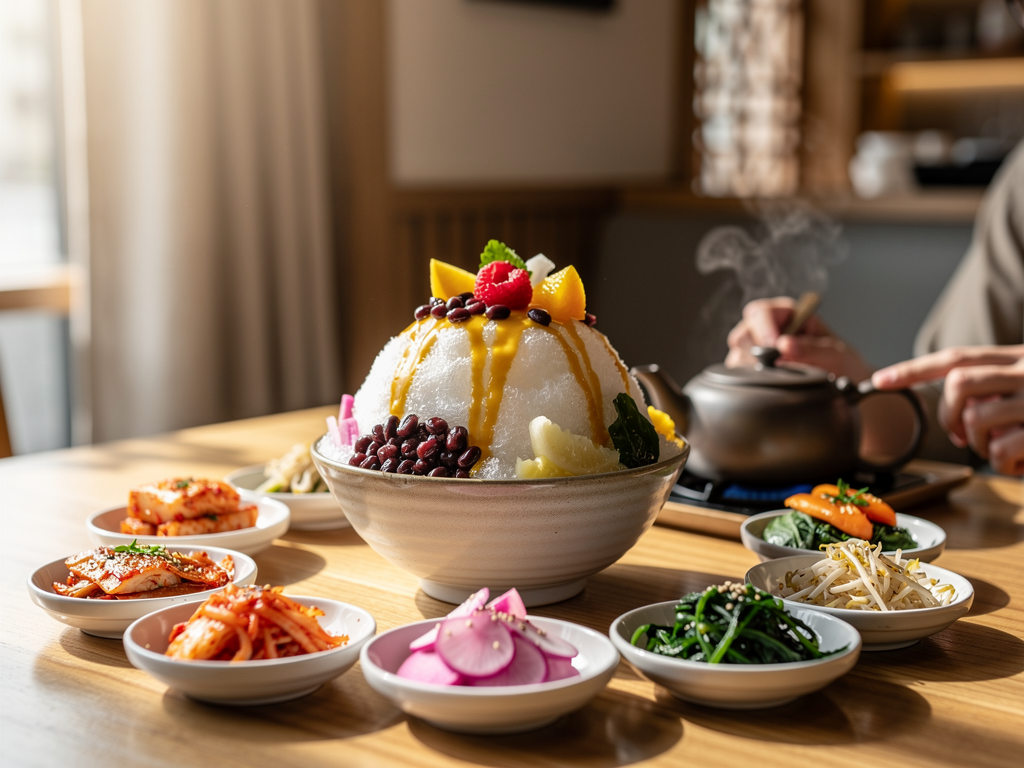
There is a second, less obvious split. Each dessert has a minimalist and a maximalist school, and the UAE sells both of them — which means the choice most diners think they are making (Korean or Filipino) is often not the choice that actually decides whether they enjoy the bowl.
Bingsu vs halo halo at a glance
Every price below was read from the venue’s own menu or its live delivery listing on 10 August 2026. Where a venue publishes nothing, this table says so rather than guessing.
| Dessert and venue | Style | Published price | Portion | Where the price came from |
|---|---|---|---|---|
| Mukbang Shows bingsu | Modern milk-snow, four flavours | AED 37 | One bowl, dessert course | Own menu, five UAE branches |
| The Korean Restaurant (Hanok), International City | Traditional patbingsu — its own menu says “crunchy shaved ice” | AED 20 traditional, AED 25 flavoured | One bowl | Venue’s own published menu |
| Madang, Al Sa’adah, Abu Dhabi | Modern loaded bingsu | AED 55 | Stated by the venue as built for 2–3 (≈AED 18–27 a head) | Venue’s own website |
| Mealtop Bingsoo Cafe, La Mer | Dedicated milk-snow dessert cafe | Not published | — | No price at source — confirm directly |
| Chowking, three emirates | Loaded halo-halo | AED 17 regular, AED 25 large, AED 52 family | Solo, family size shares | Chain’s own UAE menu |
| Razon’s of Guagua, Al Karama | Pampanga-style minimalist halo-halo | AED 26 | Solo | Live Deliveroo listing |
| Halo Halo Restaurant, Dubai Marina | Filipino and Asian kitchen | Not published | — | No price at source — confirm branch status directly |
Which one is actually better in the UAE heat?
Neither, and anyone who tells you otherwise is selling something. They fail in opposite directions, which is the useful part.
Bingsu holds. Because the base is already milk, a bowl that sits for ten minutes becomes richer rather than thinner. That makes it the safer order if you are talking, sharing, or eating slowly after a long meal.
Halo-halo rewards speed. Stirred immediately, it gives you contrast in every spoonful — cold neutral ice against warm-sweet flan, chewy nata de coco, the ube hitting last. Left alone, it dilutes fast. It is a dessert with a clock on it.
So the honest rule: order bingsu when you want something to linger over, and halo-halo when you are going to eat it properly and finish it.
How much does bingsu vs halo halo cost in the UAE in 2026?
On paper the Korean side looks expensive. Halo-halo runs roughly AED 17–26 for one person; bingsu runs roughly AED 20–55. That gap survives exactly one piece of arithmetic.
The loaded bingsu bowls are built to share and say so. Madang publishes AED 55 and states on its own site that the bowl is designed for two to three people — that is about AED 18–27 a head, which lands inside the halo-halo range. The cheap end is even closer: Hanok’s traditional bingsu at AED 20 and Chowking’s regular halo-halo at AED 17 are three dirhams apart.
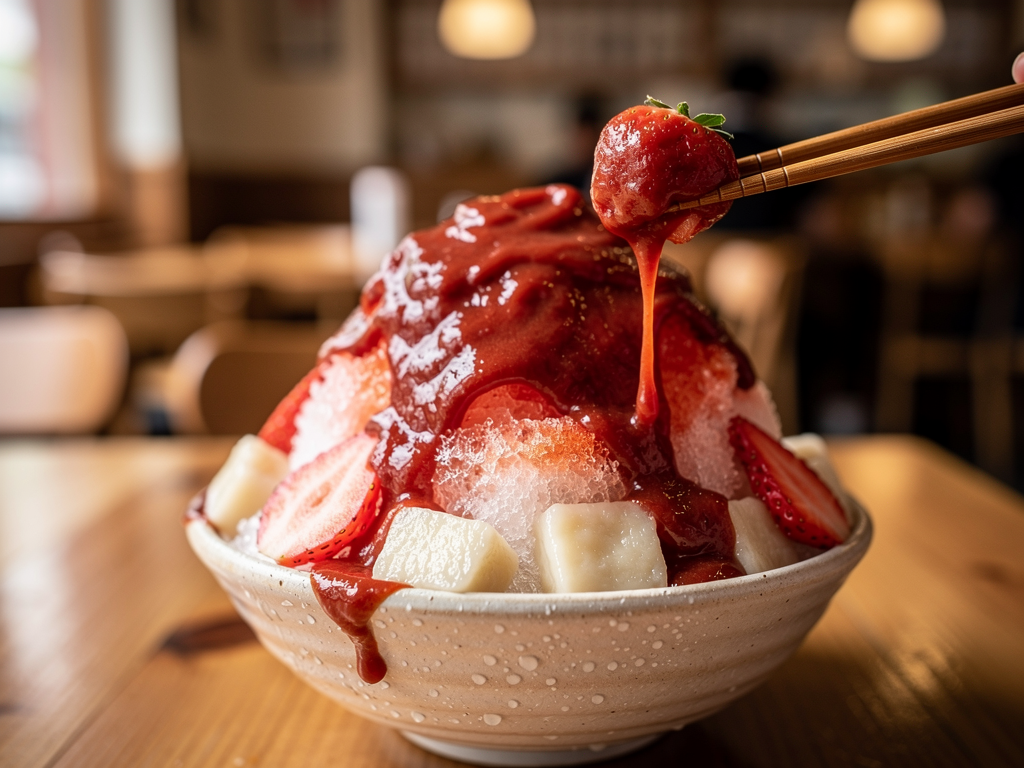
One caveat worth knowing before you order at Chowking: the chain’s own site lists Halo-Halo Regular at AED 17 and Large at AED 25, while a promotional banner on the same site advertises AED 15 and AED 20. Check which one is live when you order.
The real difference is not cost. It is whether you want a dessert you split or a dessert you own — and that is a question about the evening, not the cuisine.
Where can you actually eat each one?
The two desserts cluster in different parts of Dubai, which is why most people have only ever had one of them.
The bingsu side sits with the Korean restaurants. The Korean Restaurant in International City publishes the cheapest bingsu in the country at AED 20 and is worth the drive for that alone. Mukbang Shows runs five branches — Deira on Al Ittihad Road in Port Saeed near Deira City Centre, JBR on The Walk, Love Mukbang on Sheikh Zayed Road opposite the metro station, plus Muroor Road and Electra Street in Abu Dhabi. Mealtop at La Mer is the only dedicated bingsu cafe in the city rather than a restaurant with a dessert page.
The halo-halo side follows the Filipino community, which is one of the largest in the world here — this is a mainstream mall dessert in the UAE, not a novelty import. Chowking operates across Dubai, Abu Dhabi and Sharjah and is the default for the loaded version. Razon’s of Guagua in Al Karama is the destination for the minimalist Pampanga style, rated 4.6 from 198 ratings on its Deliveroo listing.
Halo Halo Restaurant, which named itself after the dessert, operates from Jannah Marina Hotel Apartments in Dubai Marina (04 275 9460) with a second listing at Jannah Dubai Creek (04 597 6699). The Creek listing was showing as temporarily closed when checked in August 2026 while the Marina branch was taking delivery orders, so ring ahead rather than turning up.
Abu Dhabi is thinner on both counts. Madang in Al Sa’adah is the only competitor in the capital publishing a bingsu price at source, and Mukbang’s two Al Danah branches carry the same AED 37 bowl as Dubai.
The convergence nobody mentions
Here is the fact that makes this comparison more than a curiosity. The Korean Restaurant in International City publishes a jackfruit bingsu at AED 25 and a coconut bingsu at AED 20.
Jackfruit is langka. Coconut is macapuno. Those are two of the defining halo-halo ingredients, printed on a Korean shaved-ice menu in Dubai. And it runs both ways: Razon’s sells a KLM — keso, langka, mais, meaning cheese, jackfruit and corn — at AED 26, which is a Filipino dessert built on the same logic as a topped Korean ice bowl.
The two desserts are already meeting in the middle here, in public, on menus you can read today. You can taste the whole convergence in one afternoon: International City and Al Karama are a short drive apart.
Where each dessert came from
Both are old, and both were luxuries before they were street food — which is why the ice matters so much in each.
Korean shaved ice goes back centuries to ice stored through winter in royal ice houses and shaved over fruit in summer. The version most Koreans grew up with is patbingsu: ice, sweet red bean, a little condensed milk, maybe rice cake. The milk-snow bowl piled with fruit and syrup is a modern cafe invention, and it is the one that travelled. That is why you will find both on UAE menus and why they can taste like different desserts entirely.
Halo-halo’s ancestry runs through Japanese kakigori into the Philippines in the early twentieth century, where it picked up local ingredients — sweet beans, jackfruit, macapuno, ube, leche flan — and became something else. The stacked-glass presentation and the stirring ritual are Filipino, not Japanese.
Which makes the comparison less arbitrary than it looks. Two hot countries, two shaved-ice traditions, both built to be eaten fast in heat that punishes anything slower. They diverged on one engineering decision — freeze the milk, or freeze the water — and the UAE happens to be one of the few places in the world where you can put both on the same table in the same week and see what that decision actually bought.
Seven rules for ordering either one
1. Look at the ice before you commit. Milk-snow arrives as soft opaque ribbons that hold their shape. Water ice is granular, slightly translucent, and rattles against the spoon. If a venue calls it bingsu and hands you crunchy white ice with condensed milk drizzled on top, you have a halo-halo base with Korean toppings.
2. That is not necessarily a con. The Korean Restaurant describes its own bingsu as “crunchy shaved ice” in print. That is honest labelling of the traditional style — it just changes what the bowl is worth to you.
3. Decide the format before the flavour. Madang’s AED 55 bowl is published as a two-to-three-person dessert. Chowking and Razon’s are portioned for one. Ordering the wrong format is the fastest way to feel a price gap that does not exist per head.
4. Match the school, not the country. Traditional patbingsu and Pampanga-style halo-halo are both minimalist and feel closer to each other than either does to the loaded version of its own cuisine.
5. Chase the crossover items. Hanok’s jackfruit and coconut bingsu and Razon’s KLM are the most interesting things on either menu, precisely because they should not exist.
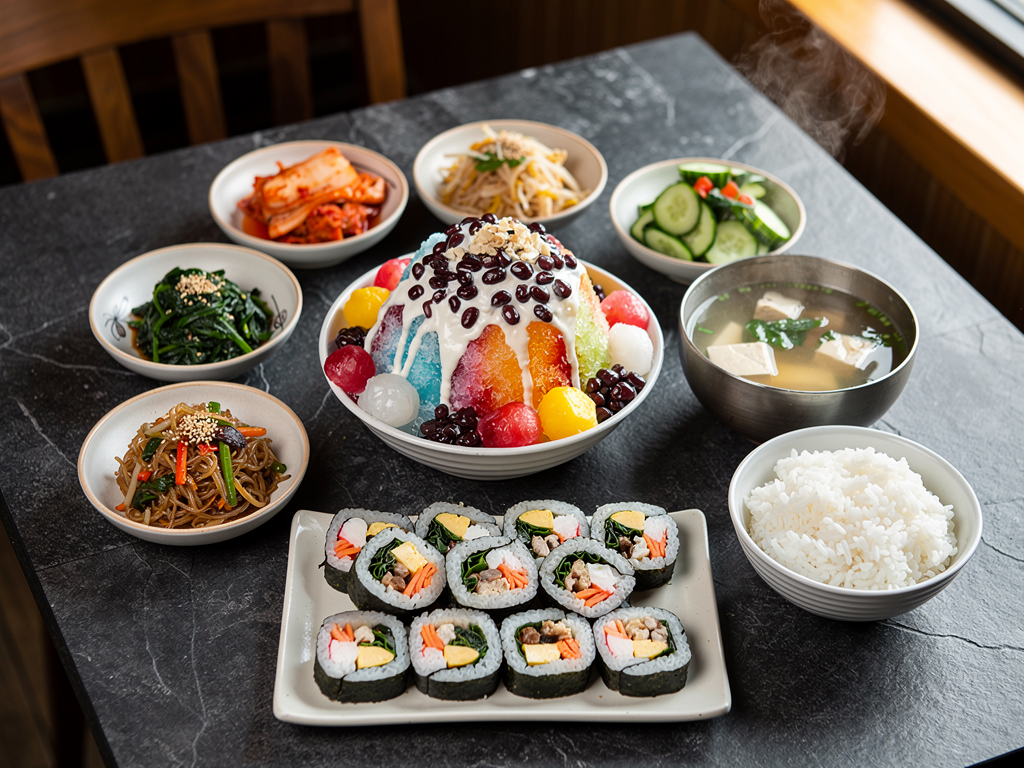
6. Check prices and branch status before you travel. Chowking’s promotional and list prices differ. Mealtop and Halo Halo Restaurant publish no dessert prices at all. Two of the venues here are a genuine drive from central Dubai.
7. Ask about the topping, not the base. More on that below.
Is bingsu vs halo halo halal in the UAE?
Both are straightforward. Neither bingsu nor halo-halo has a canonical pork or alcohol component — this is one of the very few Korean-versus-anything comparisons where the halal question is genuinely easy on both sides. The shaved-ice base raises no issue in either cuisine.
The one thing actually worth checking, at any venue of either cuisine, is the ice cream or jelly scooped on top, because gelatin-set products vary by supplier. Ask about that specific item rather than the dessert as a whole.
For the venues named here, confirm directly. Mukbang Shows is 100% halal across all five branches — beef and chicken only, no pork, and no alcohol served anywhere on the premises, so every drink on the list is non-alcoholic.
Where Mukbang Shows fits, and where it does not
Straight version: Mukbang only plays on one side of this comparison. It is a Korean BBQ house with a bingsu on the dessert page — not a dessert cafe, and not a Filipino kitchen. One bingsu, AED 37, four flavours (mango, strawberry, chocolate, taro), across Deira, JBR, DWTC, Muroor and Electra.
That is the right order when it is closing a Korean BBQ, which is exactly how it is priced and portioned — all-you-can-eat starts at AED 69 at the Abu Dhabi and Deira branches and AED 79 at JBR and DWTC, and the bingsu is the full stop at the end of it.
The honest limitation: AED 37 is not the cheapest bingsu in Dubai. International City is, by seventeen dirhams. If what you want is a dessert destination in its own right, a dedicated cafe will give you more variety, and if you want halo-halo you need a Filipino kitchen. If you want a bingsu to end a grill meal, this is the one that fits the meal.
For more on the dish itself, see our full explainer on what bingsu actually is, or the venue-by-venue rundown of the best bingsu in Dubai. The Korea Times has a good background piece on bingsu as Korea’s summer shaved-ice dessert, and Time Out Dubai’s tested restaurant list for 2026 is the reference worth checking when you are planning where to eat around either dessert.
FAQ
Does bingsu melt slower than halo-halo?
Effectively yes. Milk-snow bingsu melts into cream rather than water, so it holds texture longer. Halo-halo turns watery quickly if you do not stir it immediately — mix it the moment it lands.
What does halo-halo mean?
It is Filipino for “mix-mix”. The name is an instruction: the ice is a neutral carrier and the dessert only works once everything is stirred together.
Which is cheaper in the UAE?
Per menu line, halo-halo — Chowking’s regular is AED 17 against AED 20 for the cheapest published bingsu. Per person actually eating, they are close to identical once shared bowls are divided.
Can I try both in one afternoon?
Yes. The Korean Restaurant in International City (traditional bingsu, AED 20) and Razon’s of Guagua in Al Karama (Pampanga halo-halo, AED 26) are a short drive apart, and the contrast between the two minimalist styles is the clearest way to understand bingsu vs halo halo.
Is there a vegan version of either?
Halo-halo is the easier one to adapt because its base is water ice, but the standard build includes evaporated milk, leche flan and ice cream. Modern milk-snow bingsu is milk at the base, so a true vegan version is rare. Ask each kitchen directly rather than assuming.
Does any UAE venue serve both?
Not among the venues listed here. The closest thing is The Korean Restaurant’s jackfruit and coconut bingsu, which borrow halo-halo ingredients onto a Korean menu.
Why does Mukbang’s bingsu cost more than Hanok’s?
Different jobs. Hanok sells a simple AED 20 patbingsu inside a full Korean restaurant; Mukbang’s AED 37 bowl is a flavoured milk-snow dessert positioned to close an all-you-can-eat BBQ. Neither is overpriced for what it is.
Once you know whether you are being handed milk ribbons or water granules, the rest of this is easy — and the UAE is one of the few places on earth where you can settle the question of bingsu vs halo halo properly, in the same week, a short drive apart.
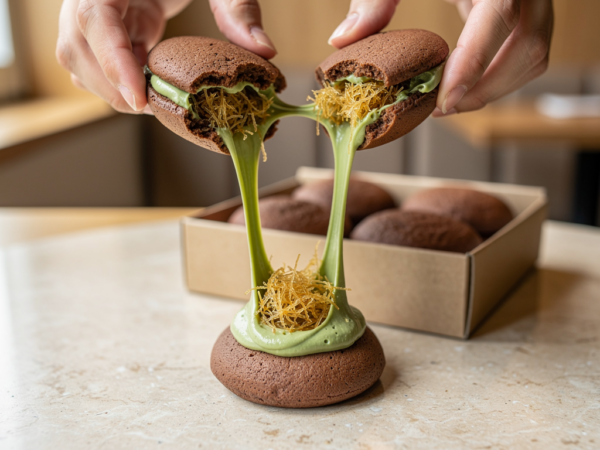
New at Mukbang Shows: Mukbang Shows also sells Dubai Chewy Cookies by Chef Nouel Catis, co-creator of Dubai chocolate, at AED 40 a box.
Related guides
More from our Korean food guides across the UAE:

Comments are closed.