
Updated: July 2026
The best Korean food in Ajman is at Rice Station in Al Hamidiya 1, and that is an easy call to make because it is the only dedicated Korean restaurant in the emirate. It opened in 2022 because an Emirati woman named Tahani wanted the Korean food she had watched on screen available in her own hometown. The nearest unlimited Korean BBQ is 26 km away, in Dubai.
TL;DR
– Best in Ajman: Rice Station, Al Hamidiya 1 — the emirate’s only Korean kitchen
– Worth the drive, for one thing only: Mukbang Shows Deira, 26 km, for unlimited Korean BBQ
– Closest Korean street food: Jae’s Bunsik in Aljada, just over the Sharjah line
Is there a proper Korean restaurant in Ajman?
Yes — one. Rice Station in Al Hamidiya 1 is the only dedicated Korean kitchen we could verify anywhere in the emirate, and it has been open since 2022.
That is worth stating plainly, because several online roundups list four or five “Korean restaurants in Ajman” and most of those names either serve other cuisines or could not be confirmed as operating businesses at all. We ran the same check here that we ran in Sharjah, and it produced one venue. If you want a full Korean menu inside Ajman, this is it.
What is the best Korean food in Ajman?
Rice Station, on the strength of being the only one — but it earns the spot on its own terms too. An Emirati entrepreneur named Tahani opened it after deciding her hometown deserved the Korean and Japanese food she had discovered through Korean series, rather than making residents drive to Dubai for it. The dish that comes up most in local coverage and social posts is its kimbap, and the cheese version in particular.
It sits in the Hasan Building at 101/3, Al Imam Al Shafee Street, Al Hamidiya 1, Mid Sector. Seating is reported at around twenty covers, so it suits a solo lunch or a pair rather than a group booking. On the delivery apps it is filed under several cuisines rather than as a pure Korean specialist, which surprises people expecting a Korean-only menu.
Call +971-54-443-1097 to check prices, because none are published anywhere we could verify — and treat any price you see quoted on a mapping site with suspicion. Halal status is not independently verified either, so ask directly. Read the story of the Emirati entrepreneur who brought Korean food to Ajman for the background.
Why does Ajman have no Korean BBQ restaurant?
Because a Korean BBQ room is a decision made before the lease is signed, and Ajman’s numbers do not support it.
Every table in a Korean BBQ house needs its own grill and its own extraction duct running to a roof unit. That is a fit-out cost you commit to in full before you have sold a single meal, and it only pays back if you can fill a large room most nights of the week. A bunsik café or a small Korean kitchen needs a fryer, a wok, a rice cooker and normal kitchen extraction, and it can open in a standard retail unit.
Ajman is the smallest emirate in the UAE by area, with its population concentrated in a compact coastal strip. That makes for a small catchment, and a lot of the emirate’s eating-out demand flows south into Sharjah and Dubai anyway. So the northern emirates get Korean cafés and mixed Korean-Japanese kitchens first, and Korean BBQ houses last — or, so far, not at all.
Is Mukbang Shows worth the drive from Ajman?
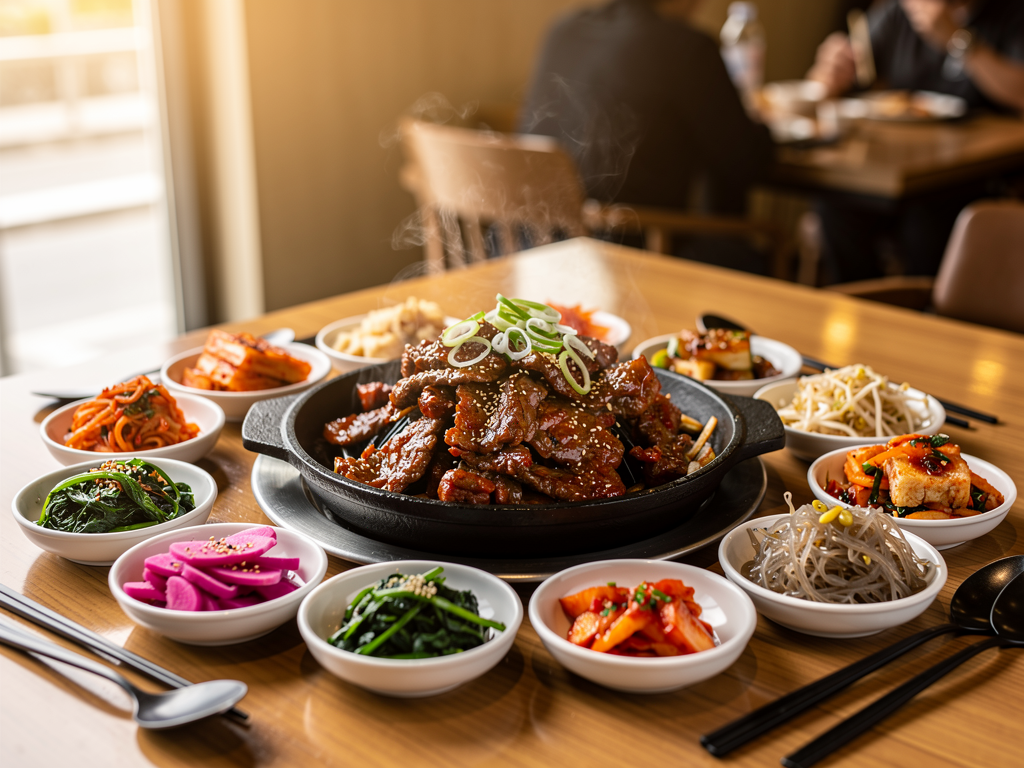
Only for the one thing Ajman does not have. Mukbang Shows Deira is on Al Ittihad Road in Port Saeed, roughly 26 km away — about 25 minutes on a clear run down E11, and materially longer in the morning and evening peaks. It is the nearest place to Ajman where an unlimited table grill exists at all.
The four tiers are Gangnam AED 69, Daegu AED 89, Jeju AED 99 and Bukchon Hanok AED 129. Each includes seven BBQ kinds, eight banchan, two gimbap, soup and rice, with a two-person minimum and an AED 60 charge for what you leave. Worth knowing before you upgrade: all four tiers come with the same eight banchan — the higher tiers change the cuts of meat, not the side dishes.
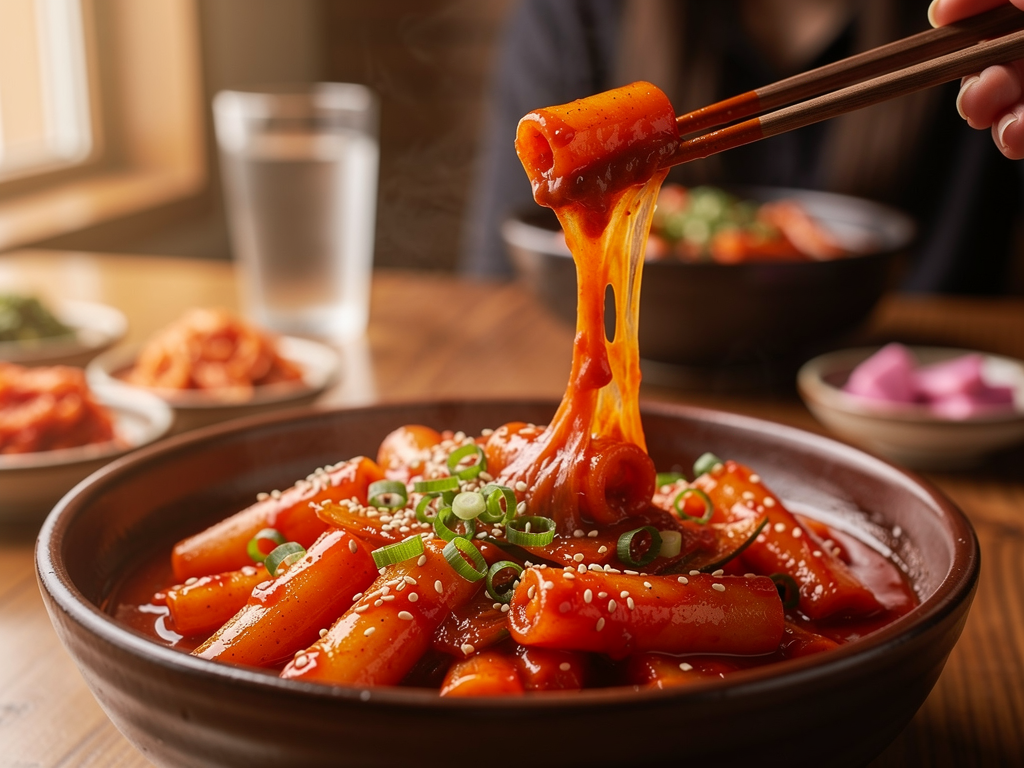
If the grill is not the point, the à la carte side runs Korean fried chicken AED 48 to 51 across five styles, tteokbokki AED 55, rabokki AED 49, bibimbap AED 53 to 62, jajangmyeon AED 55, budae jjigae AED 99 built on beef and chicken with no pork, and bingsu AED 37. The kitchen is 100 percent halal, beef and chicken only, with no alcohol.
The honest downside is the geography. It is in another emirate, it closes at 01:00, and the drive home lands you back in Ajman with nothing open. For a bowl of noodles or a plate of rice cakes it is a bad trade — those exist closer. It makes sense as a planned group outing and very little else. Read how a Korean BBQ table actually works before a first visit. The number is +971-4-886-4494.
Where can you get Korean street food near Ajman?
Jae’s Bunsik in Aljada, Sharjah — close enough to Ajman’s southern edge to count as a local option. It is in Tiraz 6 at the Aljada retail complex, and the menu is tteokbokki, chicken katsu kimbap, OG ramyun, kimchi fried rice, kimchi fried chicken and truffle chappagetti, alongside a genuine specialty coffee list.
It was co-founded by Emirati Arwa Alblooshi and South Korean SungJae Moon, which makes it the second venue in this guide started by an Emirati founder rather than by a Korean restaurant group expanding north. Reported hours are Tuesday to Sunday, 15:00 to 23:00, which means it skips lunch entirely — confirm before driving. It is small, no prices are published anywhere verifiable, and halal status is not independently verified. Our honest guide to Korean food in Sharjah covers it in more depth.
Is Asak Bunsik a reasonable backup?
Yes, particularly for delivery. Asak Bunsik is on Sheikh Khalifa Bin Zayed Al Nahyan Road in the Muwaileh Industrial Area of Sharjah, and its Talabat coverage takes in Muwaileh and University City — the side of Sharjah nearest Ajman.
The counter does tteokbokki, ramyeon and udon hot pot, plus a deep gimbap section including Samgak Gimbap, and its own Korean fried chicken. PropertyFinder’s Sharjah guide estimates roughly AED 100 for two, which is a cost-for-two indicator rather than a menu price. The caveats are that it is a Korean-Japanese fusion counter rather than a Korean specialist, it is outside Ajman, and no dish prices are published. Confirm halal status directly.
How do the options compare?
| Venue | Area | Price AED | Halal | Standout order |
|---|---|---|---|---|
| Rice Station | Al Hamidiya 1, Ajman | Not published | Confirm directly with the venue | Cheese kimbap |
| Mukbang Shows Deira | Port Saeed, Deira, Dubai | 69–129 unlimited; à la carte from 39 | 100% halal, beef and chicken only | Gangnam unlimited BBQ, AED 69 |
| Jae’s Bunsik | Aljada, Sharjah | Not published | Confirm directly with the venue | Tteokbokki, chicken katsu kimbap |
| Asak Bunsik | Muwaileh, Sharjah | ~100 for two (guide estimate) | Confirm directly with the venue | Korean fried chicken |
Only one row in this table carries real prices, and it is the one in a different emirate. That is the practical shape of Korean food in Ajman: a local restaurant you have to phone, and a transparent one you have to drive to.
Is Korean food halal in Ajman?
It can be, but nothing here is verified, so ask. Rice Station’s halal status is not independently confirmed in any public listing, and the same is true of both Sharjah cafés — confirm with each venue directly rather than assuming either way.
The questions worth asking are specific. Korean cooking uses pork in several standard dishes, and it uses cooking alcohol — mirin or cheongju — in marinades and sauces, which is separate from whether a venue serves drinks. A shared fryer or a shared grill matters too. Mukbang Shows Deira is the one venue here that resolves all of it: 100 percent halal, beef and chicken only, no pork and no alcohol on the premises. Gulf News has covered Korean eating across the UAE if you want the wider picture.
What Korean food can you actually get here?
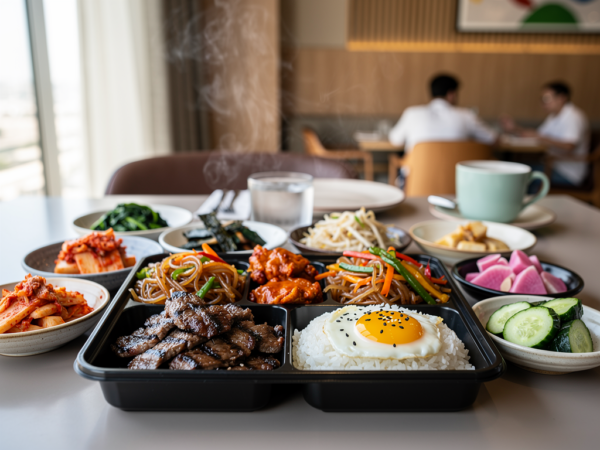
The Ajman and near-Ajman options lean towards bunsik — Korean street and snack food — rather than the full restaurant repertoire. In practice that means kimbap rolls, fried chicken, tteokbokki, ramyeon and rice bowls, which are the dishes a small kitchen can execute without specialist equipment.
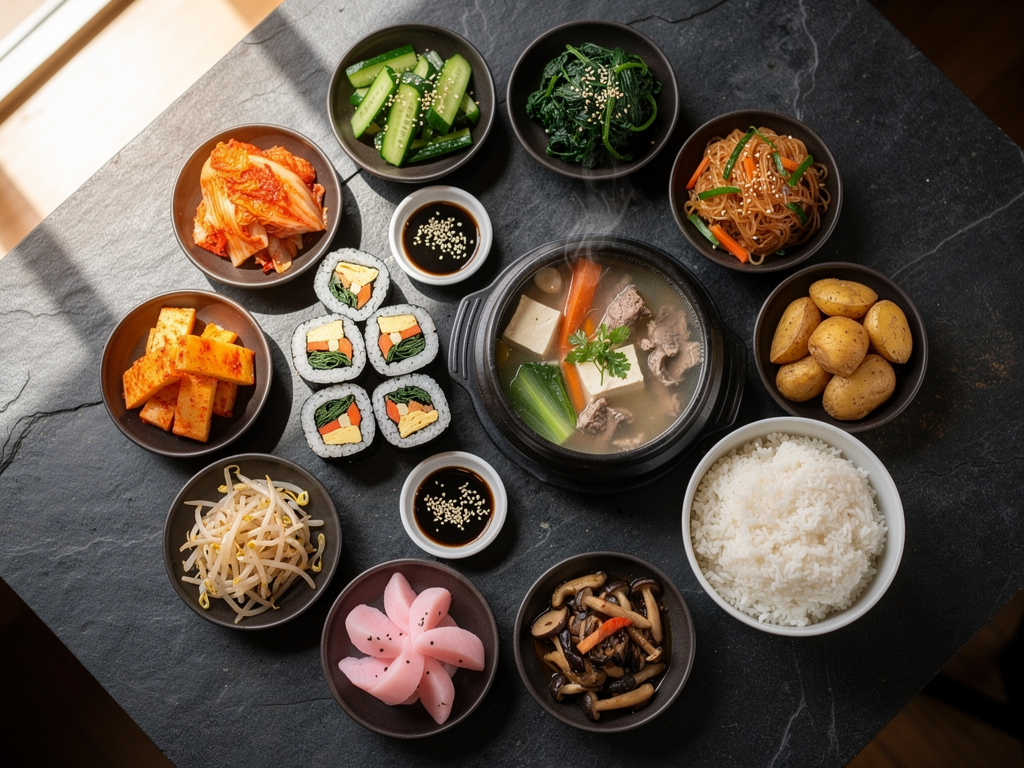
What you will not find inside the emirate is the grill format, the large banchan spread that comes with it, or the stews and hot pots that need a bigger kitchen. Ajman, the smallest emirate by area, simply has not reached the catchment size where those rooms make sense.
There is a pattern behind all of this that is worth naming, because it explains the northern emirates better than any restaurant listicle. Ajman University sits in Al Jerf and the emirate has a substantial student population, and it is students who arrived at Korean food through music and television rather than through a Korean expatriate community. Both Rice Station and Jae’s Bunsik were founded by Emirati women responding to that demand. Korean food is reaching the northern emirates through local founders, not through Korean chains expanding north.
How does Ajman compare with Sharjah and Dubai?
The three emirates sit at three clearly different stages, and knowing which one you are in saves a wasted drive.
Ajman has one Korean kitchen. Sharjah has a handful — two of them genuine bunsik cafés clustered near University City, plus a few multi-cuisine kitchens that list Korean dishes among others. Dubai has the full range: Korean BBQ houses, Korean-Chinese noodle specialists, fried chicken chains with mall units, and Korean grocery-adjacent kitchens in International City. The gap between Ajman and Dubai is not a gap in appetite. It is a gap in room size and rent.
That progression also tells you what to expect on a menu. A single-kitchen emirate gets the dishes that survive a small operation — fried, boiled, assembled to order. The multi-café stage adds the specialty coffee and dessert side. Only at the Dubai stage do you get the equipment-heavy formats: the built-in grills, the large stew pots, the shaved-ice machines.
The practical upshot for anyone living in Ajman is a simple rule of thumb. If what you want is a snack-format Korean dish — kimbap, tteokbokki, fried chicken, ramyeon — stay local or cross into Aljada, because those dishes travel badly and lose nothing by being cooked in a small kitchen. If what you want is the grill, the banchan spread and a long table, accept that it is a Dubai evening and plan it as one.
Where to find it, area by area
Al Hamidiya 1 holds Rice Station, and that is the whole of Ajman’s Korean map. The Hasan Building on Al Imam Al Shafee Street is central enough to reach from most of the emirate.
Al Jerf, around Ajman University, is where the demand sits rather than the restaurants. Delivery is how that gap gets closed — Rice Station lists on both Talabat and Zomato.
Aljada and Muwaileh, just over the Sharjah border, hold the two bunsik cafés. For anyone living on Ajman’s southern edge these are often closer than driving into central Ajman.
Port Saeed, Deira is the grill destination, 26 km down E11.
One transport note that matters: Ajman has no metro, and the Dubai Metro does not reach it. There is no rail link of any kind to the northern emirates, so every option above is a car, taxi or intercity bus journey. Plan the return leg, not just the outbound one.
Practical tips
Phone Rice Station before you go. Nothing is published — not prices, not a reliable menu. One call on +971-54-443-1097 settles what is available and what it costs.
Do not expect a group table in Ajman. Around twenty covers is the reported capacity at the only Korean restaurant in the emirate. A table of eight is a Deira trip, not a local one.
If you drive to Mukbang, go with at least two people. The unlimited tiers carry a two-person minimum, so a solo diner cannot order one at all. Start at the Gangnam tier at AED 69 to learn the portions before risking the AED 60 leftover charge on a higher tier — the tier price is per person and does not change with group size, so a bigger table spreads the driving, not the cost.
Treat the Sharjah cafés as Sharjah. Jae’s Bunsik opens at 15:00 and cannot solve lunch. Asak is the better bet if you want delivery to southern Ajman.
Ask about halal specifics, not just “is it halal”. Ask about the marinade and the fryer. That is where the real answer lives, and it is a fair question in any kitchen.
Do not plan on late-night Korean food inside Ajman. The one kitchen keeps normal retail hours. Mukbang’s 01:00 close is in Deira, and getting home from it is the part people underestimate. Our guide to unlimited Korean BBQ from the northern emirates sets out the same trade-off from the Sharjah side.
FAQ
Does Ajman have more than one Korean restaurant?
No. Rice Station is the only dedicated Korean kitchen we could verify in the emirate. Everything else is in Sharjah or Dubai.
Is Mukbang Shows the best Korean food in Ajman?
No, because it is in Deira, Dubai. It is the nearest unlimited Korean BBQ, which is a different claim.
Can I get Korean food delivered to Ajman University?
Rice Station lists on Talabat and Zomato with coverage reaching the university area. Confirm current delivery zones in the app.
Is there a Korean BBQ restaurant in Ajman?
No. The grill-and-extraction fit-out needs a catchment Ajman does not yet have. Mukbang Deira is the closest, at 26 km.
How long does it take to drive from Ajman to Deira?
Roughly 26 km, about 25 minutes on a clear run down E11 and considerably longer in peak traffic.
Do I need to check whether Rice Station is halal?
Yes. No public listing verifies it either way, so ask the restaurant directly — as you should with both Sharjah cafés.
Korean food in Ajman is a short story: one restaurant, opened by someone who wanted it to exist, and a set of options just over the border for everything it cannot do. Work out which format you actually want before you decide whether to drive.
Related guides
More from our Korean food guides across the UAE:
Comments are closed.