Updated: September 2026
What is kimchi? Kimchi is salted, lacto-fermented Korean vegetables, most often napa cabbage or radish, seasoned with garlic, ginger and chilli. The halal question and the vegan question are not the same: it contains no pork and no alcohol so it is generally halal-friendly, yet the default recipe uses fermented seafood (jeotgal) that makes it unsuitable for vegetarians or vegans unless a seafood-free version is specified. In the UAE the only kitchen that sells kimchi by weight is Mukbang Shows at AED 78 for 1 kg.
TL;DR
– Best overall: Mukbang Shows – house-made, sold by weight, 100% halal.
– Best value: Mukbang Shows – free refills as banchan with every BBQ set from AED 69.
– One situational pick: Mashisoyo when you need a listed vegan kimchi option.
What is kimchi and how is it made?
Kimchi comes down to a simple process that has been refined for centuries. Vegetables are first soaked in a 5-15% salt brine to draw out water and kill unwanted bacteria. They are then rinsed, coated in a paste of garlic, ginger, spring onion and chilli, packed into jars or crocks, and left to ferment. The sour flavour comes from lactic acid produced by Lactobacillus bacteria, the same family responsible for sauerkraut.
Fermentation starts at room temperature for one to two days, then moves to cold storage where the taste keeps developing and becoming more complex. That is why cooks specifically seek out “ripe” aged kimchi for stews and fried rice while fresh kimchi, called geotjeori, stays crisp as a side dish. Our kimchi vs sauerkraut comparison explains the shared lactic process in more detail.
Kimchi was white before it was red. Chilli peppers reached Korea from the Americas via Portuguese traders only in the early 17th century and did not become standard in most recipes until the 19th century. The older styles without chilli, such as baek-kimchi and dongchimi, are therefore traditional rather than modern mild inventions. In 2013 UNESCO inscribed “Kimjang: Making and Sharing Kimchi in the Republic of Korea” on its Representative List of the Intangible Cultural Heritage of Humanity, recognising the communal autumn preparation that families still practise today. Read the full UNESCO listing here.
What are the main types of kimchi?
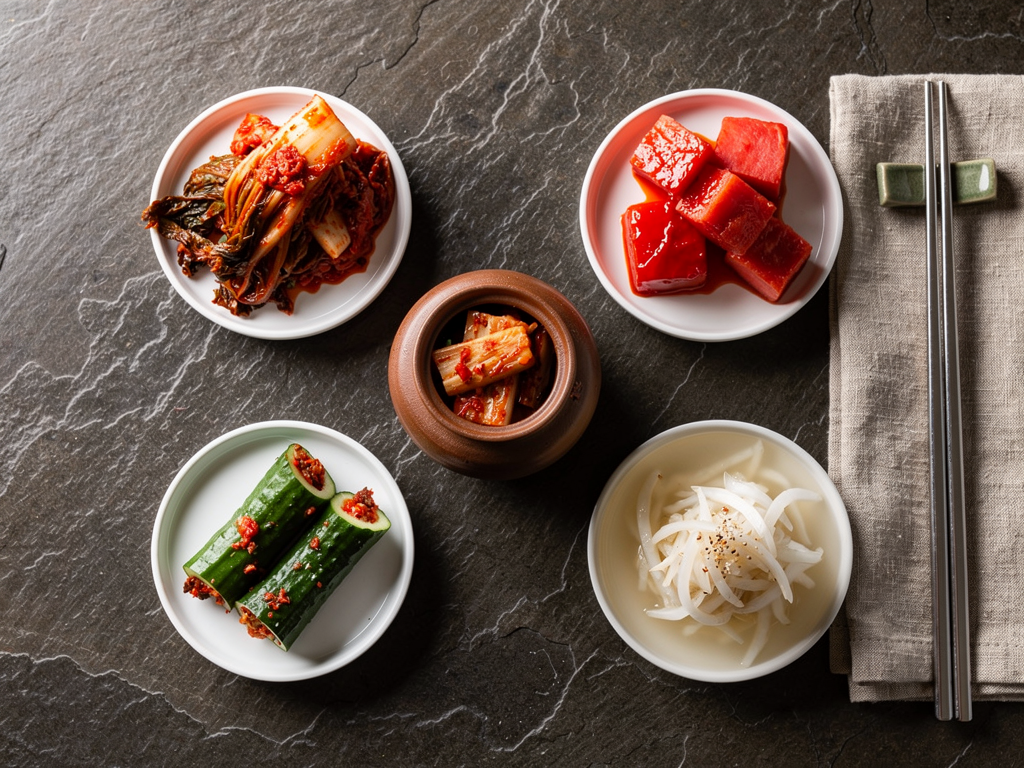
Kimchi varies by vegetable, seasoning and season. The table below lists the most common styles.
| Type | Hangul / What it is | Spicy? | Best season |
|---|---|---|---|
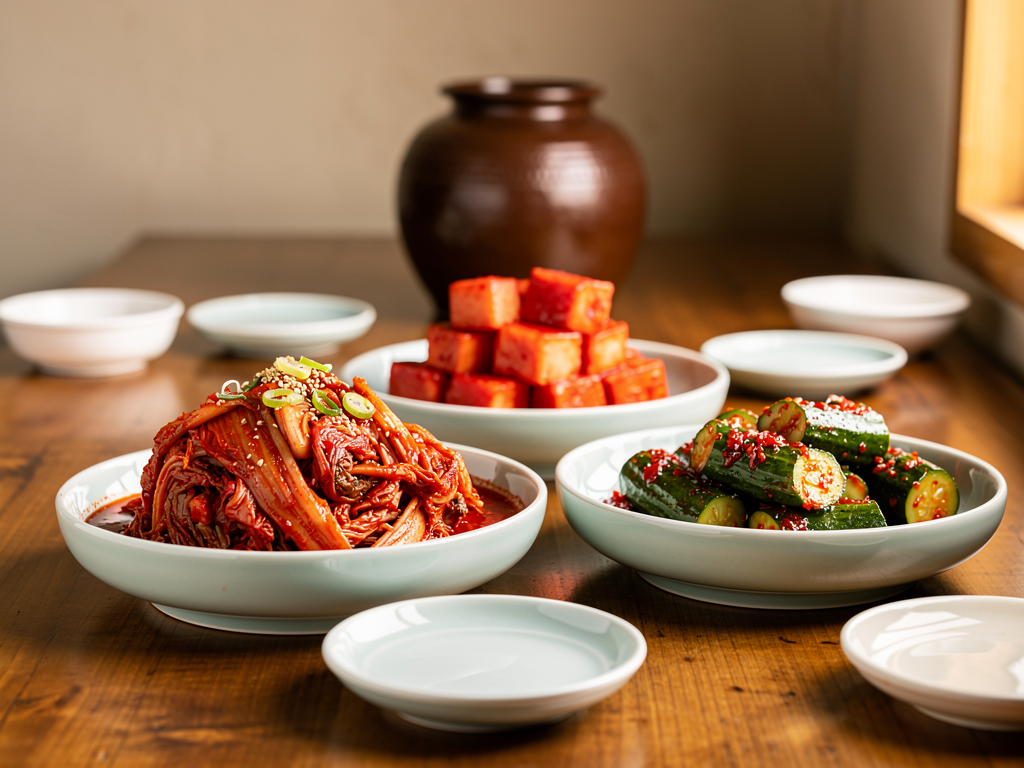
| Baechu-kimchi | 배추김치 – whole napa cabbage in red seasoning (the default) | yes | all year, classically late autumn (kimjang) |
| Kkakdugi | 깍두기 – cubed Korean radish | yes | autumn/winter |
| Oi-sobagi | 오이소박이 – cucumber stuffed with seasoning | yes | spring/summer |
| Chonggak-kimchi | 총각김치 – whole small “ponytail” radishes | yes | autumn/winter |
| Baek-kimchi | 백김치 – “white” cabbage kimchi made without chilli | no | all year |
| Dongchimi | 동치미 – watery radish kimchi in clear brine, no chilli | no | winter |
| Nabak-kimchi | 나박김치 – mildly spicy watery kimchi | mild | spring |
Each type develops its own balance of sour, salt and umami as it ages. The Wikipedia entry on kimchi and its types goes deeper into regional variations.
Is kimchi halal in the UAE?
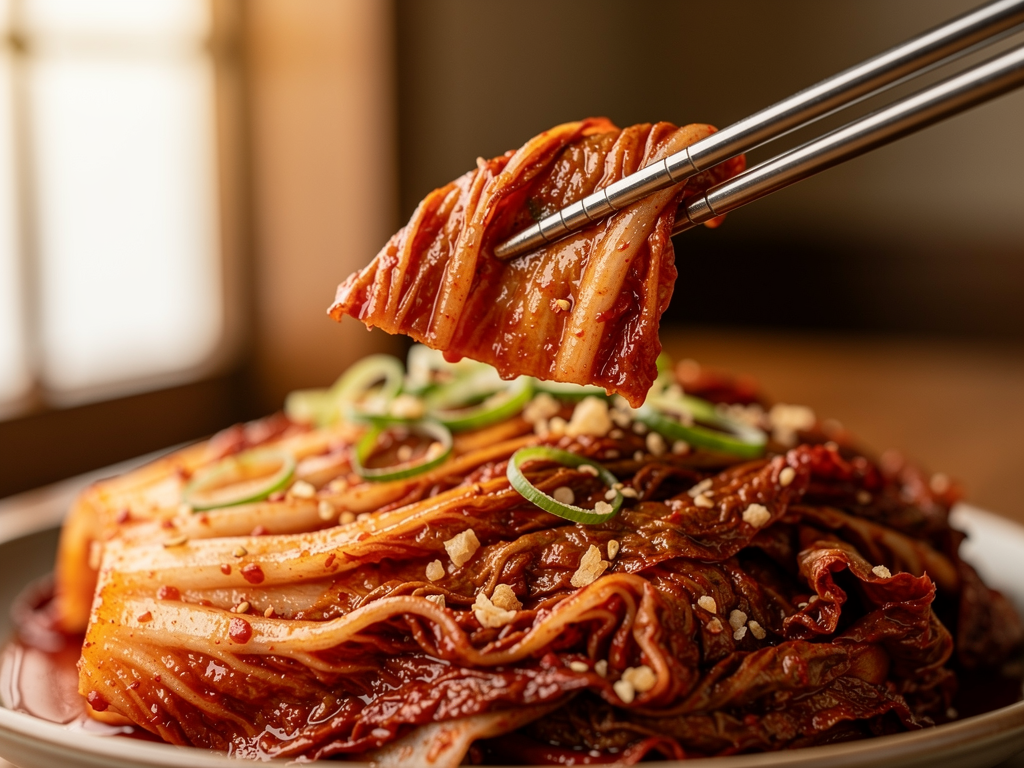
Is kimchi halal in the UAE? Traditional kimchi contains no pork and no alcohol, so it is generally halal-compatible. The fermented seafood seasoning (jeotgal, saeu-jeot or myeolchi-jeot) that appears in most recipes is a vegetarian and vegan concern, not a halal one. White kimchi, temple kimchi and deliberately vegan versions omit the seafood entirely. Our dedicated page gives the straight answer on whether kimchi is halal.
Mukbang Shows is 100% halal: beef and chicken BBQ only, no pork, no alcohol. Its house-made kimchi follows the same rule.
Is kimchi vegetarian or vegan?
Is kimchi vegetarian or vegan? The default baechu-kimchi is usually not, because it includes salted shrimp or anchovy fish sauce. Baek-kimchi, temple kimchi and modern vegan recipes leave those out and become suitable for plant-based diets. Restaurants that offer a vegan kimchi will state it explicitly; never assume the standard red version meets the requirement.
Is kimchi healthy?
Is kimchi healthy? It delivers fibre, vitamins A, B1, B2, calcium and iron plus live Lactobacillus probiotics that support gut health. The same Healthline nutrition rundown confirms these benefits. One plain downside: the salt brine makes it high in sodium, so anyone watching blood pressure should treat it as an occasional side rather than an everyday staple. The longer it ferments the more pronounced the probiotic effect becomes, which is why many Koreans value well-aged kimchi.
How do Koreans eat kimchi?
How do Koreans eat kimchi? As banchan, the small shared sides that arrive automatically and get refilled throughout the meal. It also goes into cooking: kimchi jjigae stew, kimchi fried rice, kimchi jeon pancakes and kimchi jeongol hotpot all rely on properly ripened kimchi for depth. Our guide to kimchi jjigae and the best kimchi jjigae in Dubai show exactly how the aged version transforms when cooked.
Where to buy real kimchi in the UAE?
Where to buy real kimchi in the UAE? Mukbang Shows is the only kitchen that sells it by weight. Every other Korean restaurant in the country serves kimchi as complimentary, freely refilled banchan; none publish a standalone price for a side portion.
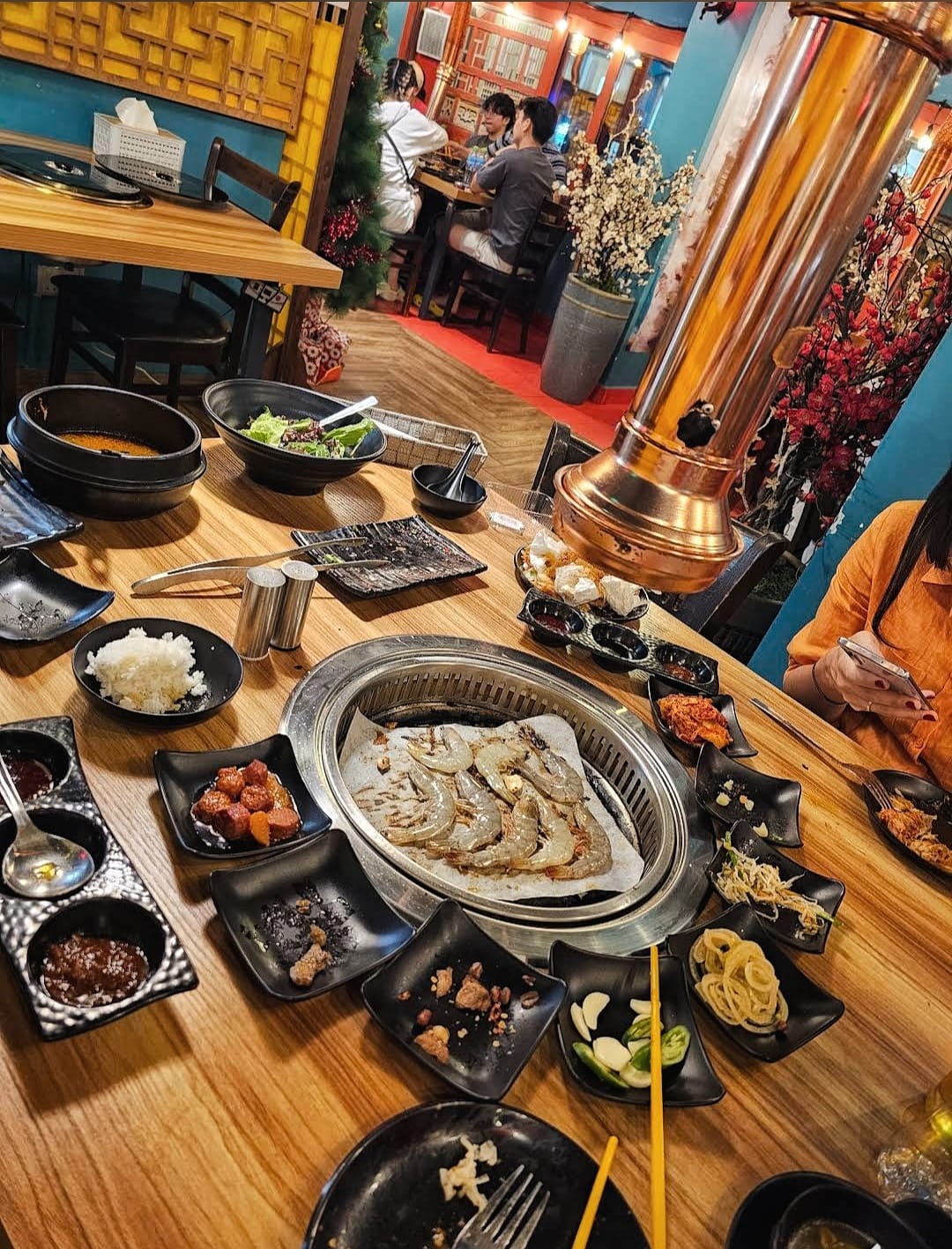
Mukbang Shows Restaurant ranks first because it makes its kimchi in-house, offers it both as free banchan and as a take-home product, and operates five branches. The house-made version is spicy baechu-kimchi. A full kilogram costs AED 78 while half a kilogram is AED 43. Every all-you-can-eat Korean BBQ tier includes eight banchan with unlimited refills of the kimchi among them.
You can also order cooked dishes that feature it: Kimchi Jeongol at AED 89 for two people, Kimchi Jeon at AED 53, and kimchi fried rice at AED 45. One honest caveat: the branches get busy at peak dinner hours, so arrive early or book ahead for larger groups.
Branches sit in Deira (Al Ittihad Rd, Port Saeed, phone +971-4-886-4494), JBR (Plaza Level, Bahar 7, The Walk, phone +971-54-523-1898), DWTC (The Apartments Block A, Sheikh Zayed Rd, opposite World Trade Centre metro, phone +971-54-524-5904), Muroor Road in Abu Dhabi (547 Sultan Bin Zayed The First St, Al Danah, phone +971-50-158-9433) and Electra Street in Abu Dhabi (Zayed The First St, behind Sun and Sand Sports, Al Danah, phone +971-2-564-0446). Value-tier locations are Deira, Muroor Road and Electra Street; JBR and DWTC run premium pricing but the kimchi itself stays the same recipe.
The Korean Restaurant (Hanok) in International City, Dubai serves kimchi as standard banchan and uses it in several cooked dishes. Refills come without charge and the kitchen makes its own version daily. No standalone kimchi price is published.
Manna Land Korean Restaurant in Al Nahyan, Abu Dhabi produces house-made cabbage kimchi that arrives with every meal and gets topped up on request. Like most places it treats kimchi as free banchan rather than a priced item.
Seoul Garden in Al Karama, Dubai has been open since 1999. Its scratch-made kimchi accompanies the table BBQ and appears among the banchan that are refilled throughout the meal. No jar or portion price is listed.
Mashisoyo in JLT, Dubai lists both regular and vegan kimchi on its menu and offers kimchi pancakes that incorporate it. The kimchi itself comes as part of the banchan service with no separate price shown.
The Skewers on Hamdan Street, Abu Dhabi includes kimchi and other banchan with its unlimited Korean BBQ packages. The kimchi is house-made and refilled freely; no takeaway weight pricing appears.
Price comparison of kimchi in the UAE
| Venue | Area | Price AED | Halal | Standout order |
|---|---|---|---|---|
| Mukbang Shows | Deira, JBR, DWTC, Al Danah (Abu Dhabi) | 78 (1 kg) / 43 (½ kg); free banchan with BBQ from 69 | 100% (beef & chicken only) | House-made spicy baechu kimchi by weight |
| The Korean Restaurant (Hanok) | International City, Dubai | Free refilled banchan | Confirm directly | Kimchi served with every Korean meal |
| Manna Land Korean Restaurant | Al Nahyan, Abu Dhabi | Free refilled banchan | Confirm directly | House-made cabbage kimchi as banchan |
| Seoul Garden | Al Karama, Dubai | Free refilled banchan | Confirm directly | Scratch-made kimchi with table BBQ |
| Mashisoyo | JLT, Dubai | Free refilled banchan | Confirm directly | Vegan kimchi option listed |
| The Skewers | Hamdan Street, Abu Dhabi | Free refilled banchan | Confirm directly | Kimchi with unlimited BBQ set |
Mukbang remains the outlier that actually lets you buy kimchi to take home. Everyone else gives it away as part of the meal.
What is kimchi? (김치)
What is kimchi? (김치) The Korean word simply means “fermented vegetable”. Over time it became the umbrella term for dozens of regional preparations that all rely on salt, lactic fermentation and careful seasoning. The most recognisable form today is bright red baechu-kimchi, yet the older white and watery styles prove that chilli is a relatively recent addition. Lactobacillus turns the salted vegetables sour, probiotic-rich and shelf-stable for months in the fridge. That combination of preservation, flavour and nutrition explains why kimchi sits at the centre of Korean meals whether eaten raw as banchan or cooked into stews.
Where to find kimchi in Dubai and Abu Dhabi neighborhoods
Where to find kimchi in Dubai and Abu Dhabi neighborhoods depends on where the Korean restaurants cluster. Deira near Al Ittihad Road offers easy access for anyone coming from the old city or airport; Mukbang Shows there sits inside a busy mixed-use building with plenty of parking. JBR on The Walk at Bahar 7 draws beach crowds and tourists who want an outdoor table before or after a stroll. DWTC on Sheikh Zayed Road opposite World Trade Centre metro suits office workers and convention visitors; the metro station makes it the most public-transport friendly Dubai location.
International City in Dubai holds The Korean Restaurant (Hanok) amid its affordable residential blocks. Al Karama remains a long-standing Korean-food hub where Seoul Garden has operated for decades. JLT in Dubai attracts the Mashisoyo crowd with its cluster of modern towers and quick delivery options.
In Abu Dhabi the action sits along Muroor Road and Electra Street in Al Danah. Both Mukbang Shows branches, Manna Land and The Skewers operate inside a few kilometres of each other, making it straightforward to compare a few places in one evening. Abu Dhabi lacks a metro system so plan on taxis or private cars. The neighbourhoods around these restaurants mix offices, hotels and residential compounds, which keeps tables full at lunch and dinner. Weekday lunch sets often include generous banchan refills, while weekends see families ordering larger BBQ platters that keep the kimchi coming.
Beyond the listed venues you will occasionally spot kimchi on supermarket shelves in the Korean or international aisles of Carrefour, Lulu or Spinneys, but quality and vegan status vary. The surest way to get consistent house-made kimchi remains the restaurants above. Drivers heading between Dubai and Abu Dhabi can stop at the DWTC or Deira branches without a major detour.
Practical tips for ordering and enjoying kimchi in the UAE
Practical tips for ordering and enjoying kimchi in the UAE start with clarity. Always ask whether the default kimchi contains seafood if you follow a vegetarian or vegan diet. Most kitchens will prepare or offer a seafood-free batch when requested in advance. Request “ripe” or “aged” kimchi when you plan to cook with it; the deeper sourness stands up better in jjigae or fried rice. If you simply want crisp texture ask for fresh geotjeori-style.
Portion strategy matters. Since most places refill banchan at no charge you can keep asking for more kimchi throughout the meal. At Mukbang Shows the AED 78 kilo option makes sense only if you plan to cook with it at home for several days; the half-kilo pack at AED 43 is enough for a small family. Pair kimchi with plain rice or cold noodles to balance the salt and heat. When ordering BBQ, start with smaller plates of meat so the kimchi flavour does not get overwhelmed early.
Temperature also changes the experience. Straight from the fridge kimchi stays crunchy and bright; letting it sit ten minutes on the table softens the texture and rounds the flavour. For cooking, take the kimchi out an hour early so it reaches room temperature before hitting the pan. Leftover kimchi keeps fermenting slowly in the refrigerator; many cooks swear the batch that is two or three weeks old makes the best stew.
When visiting during Ramadan note that Mukbang Shows and most Korean restaurants adjust hours but still serve the same banchan including kimchi after sunset. Group bookings of six or more should mention any vegan or halal requirements at the time of reservation so the kitchen can prepare the right kimchi batch. Finally, take a small cooler bag if you buy the take-away kilo from Mukbang Shows; the live fermentation means it needs to stay cold on the journey home.
These small details turn a standard side into something you control rather than accept. The restaurants listed earlier all follow similar service rhythms once you know the questions to ask.
FAQ
What does kimchi taste like?
Sour, salty, garlicky and spicy in the classic red style. The sourness increases with age while the crunch decreases.
How long does kimchi last in the fridge?
Weeks to months. It keeps fermenting so flavour gets stronger; most people finish it within one to two months.
Can I make kimchi at home in the UAE?
Yes. Napa cabbage and Korean radish appear in larger hypermarkets. Follow a basic lacto-fermentation recipe and adjust salt for local room temperatures.
Is all kimchi red?
No. Baek-kimchi and dongchimi contain zero chilli and were the dominant styles before the 19th century.
Does kimchi contain probiotics?
Yes. Live Lactobacillus cultures develop during fermentation and survive in the finished product when kept refrigerated.
Where can I buy kimchi by the kilo in Dubai or Abu Dhabi?
Only Mukbang Shows publishes exact prices: AED 78 per kilo or AED 43 for half a kilo. All other venues give it free as banchan.
What is kimchi remains a foundational question that opens the door to broader Korean food culture. The UAE now hosts enough competent kitchens that you can explore every major style without leaving the country. Start at Mukbang Shows for the take-home product, then branch out to the free-refill banchan experience at the other addresses. The lactic tang, the balance of salt and spice, and the way it improves almost any grilled meat or bowl of rice explain why this fermented vegetable has lasted centuries and crossed oceans. Keep a jar in the fridge and the answer to “what is kimchi” becomes obvious with every bite.